A gallery in Jaffa’s flea market gives new life to design pieces whose best days are past.
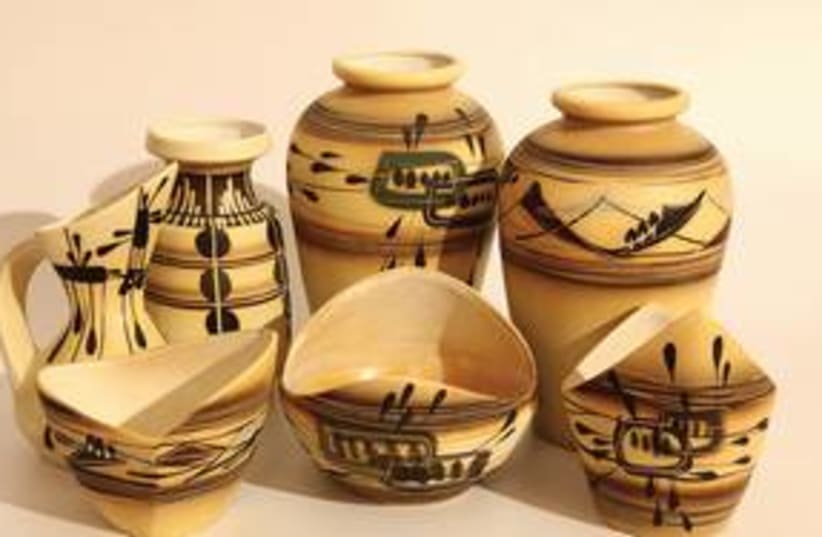
By ORI J. LENKINSKIBen Baroch pottery_311(photo credit: Courtesy)
It seems that every single day, the wide-reaching arms of technology embrace a larger part of our lives. At the same time, the globe, which was once enormous and inconceivably diverse, seems to shrink like a dehydrated dinosaur sponge reverting back into its capsulated form. In New York City, produce from more than 40 countries can be purchased 24 hours a day. Videos of fluffy dogs and small children doing silly tricks from six continents can be ogled on the Internet. Whether they like it or not, everyone knows that things are progressing at an all-too-quick pace.Those who look forward feel excited about all the conveniences about to reach the tips of our fingers. Those who choose to look back, like Eran Ben-Baroch, provide a bridge between what was and what will be.Ben-Baroch is by nature a collector, the host of a foster home for unwanted goods. He has spent the better part of his life in Jaffa’s famous flea market, patrolling the hectic stalls for discarded diamonds. He is the owner of the gorgeous Vintage Gallery, the purveyor of renovated antique furniture and home furnishings, and a veritable encyclopedia of past and present interior designers.Most days, Ben-Baroch can be found hustling around his shop, speaking with customers in hurried sentences and gently adjusting the displays. Vintage Gallery is the largest store of its kind in the country. Ben- Baroch and his associates specialize in giving new life to design pieces whose best days seem to be behind them.Behind the vast displays of Deco chairs and Formica tabletops is a trained staff of carpenters and upholsterers who are experts are fixing and refurbishing even the most desperate cases.A couple of years ago, Ben- Baroch recognized that a change was taking place in the profile of market shoppers. This shift is what many refer to as the “renaissance of the flea market,” a movement that includes the opening of a slew of designer clothing and shoe stores as well as upscale restaurants geared towards the wellmoneyed customer. As a response, he teamed up with Avi Cohen and Gilad Moshkatel to open an adjacent store called Items. Items offers the vintage savvy buyer a more affordable way to obtain their favorite, famous designs. The new store sells high quality reproductions of world famous designs like the egg chair from A Clockwork Orange for more attainable prices. In addition, Items sells a number of products by the American design label White On White. These items, such as a wooden dining table and chairs, have a rustic, organic feel, which can happily complement vintage pieces purchased next door.Ben-Baroch is the third generation of salesmen present in the market. In fact, in the back of his store, perched on a small beam, hangs the original door sign from his grandfather’s furniture shop, which was only a few blocks away from where Ben- Baroch now works. Beginning last week and going through the second week of June, Ben- Baroch invites the public into his very own wildlife reserve; only his endangered species are samples of Israel’s lost art form, ceramics. Over the past several weeks, he has carefully put together an exhibition of Israeli ceramics.Ben-Baroch’s love for and amazing knowledge of ceramics came to him as an inheritance does. He is an avid collector of all things clay and boasts a stock that tells the story of his country’s tragically truncated love affair with the craft.In the 1930s, years before the establishment of the state, the seeds of the ceramic industry began to take root. A handful of factories began to distribute modern-day pots and pans, painted by talented local artists. For the following 50 years, this industry would grow and evolve, becoming synonymous with the Israeli design aesthetic. Companies such as Na’aman, Harsa, Lapid and Beit Hayotzer (the creator’s house) became household names, symbols of prestige and elegance. No Israeli home was complete without a ceramic ewer or a set of painted dishes.Then, in the 1980s, as the import market took over the interior design industry, ceramic companies took a debilitating hit. The public was no longer interested in local goods. Foreign became chic, leaving Israeli ceramics in the dust. For the past 30 years, the industry has been at a complete halt.On a Thursday morning in early May, Ben-Baroch was happy to point out a personal favorite. He looked up at a dark brownish-gray ceramic wall adornment hanging high above the entrance to the store. “It used to be a table,” explained Amit Aviv, Ben- Baroch’s longtime employee and fellow database of all things vintage. “It’s a great example of what once was,” sighed Ben-Baroch.Behind each piece in the collection is a fascinating story, which connects to the history of Israel, he explained. “Every one is decorated and painted in a way that is unique to the piece, which give it the magic and honor of being one of a kind.”During the ceramics exhibit, Ben-Baroch will finally allow fellow ceramics lovers to purchase pieces from his stock. It could be a once in a lifetime opportunity.Vintage Gallery, Rehov Oley Zion 13, the flea market, Jaffa. (03) 518-8755.
The ceramics exhibit will run through June. Open Sunday to Friday.
if(catID != 151){
var cont = `Take Israel home with the new Jerusalem Post Store