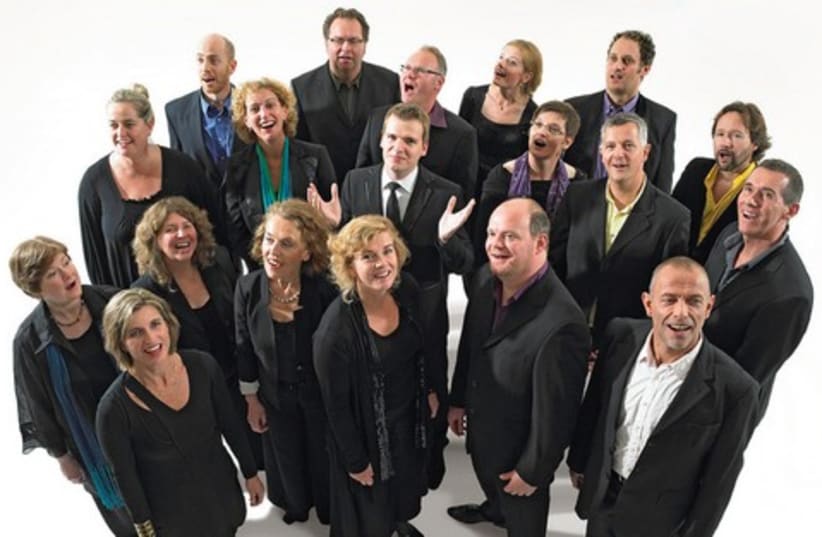
Among the more interesting musical events this year are I Saw A Bird of Infinite Beauty – music of and about birds.
By MAXIM REIDERThe Shavuot Abu Ghosh Festival returns next week(photo credit: JERUSALEM POST)
The biannual Abu Ghosh Vocal Music Festival Shavuot edition, taking place June 3-7, offers as always a rich and variegated musical program for a wide range of music lovers. It features both "hardcore" classical vocal concerts, such as masses by Shubert, Mendelssohn, Mozart (as well as the Requiem by the same composer), as well as less traditional programs, more befitting the concept of a musical festival, such as folk and world music concert dedicated to Joan Baez, as well as a performance of a Gypsy singer from Slovakia, and a world premier of a newly discovered piece by Pergolesi.Among the more interesting musical events this year are I Saw A Bird of Infinite Beauty – music of and about birds, where the words of William Shakespeare, Nathan Zach, John Bennet and Shlomo Gronich meet in one program sang by the excellent Israeli soprano Ye'ela Avital, accompanied by Meltzer Consort, performs. For Your Singing I Am a Violin – songs for soprano and violin, is another program, performed by local upcoming talents singer Einat Aronstein and violinist Yael Barolsky; the same goes to Spanish Soul, presented by soprano Hadas Faran- Asia, cellist Ira Givol and guitarist Oded Shoub.Barrocade, Israel's leading baroque music ensemble, traditionally participates in the festival. This year it takes part in four different programs: "We accompany four choirs," says the artistic director of the ensemble Amit Tiefenbrunn. "The Ramat Gan Chamber Choir, the new Vocal Ensemble, the Tel Aviv Choir, lead by Michael Shani, and Chamber Choir from Holland. Together with Ramat Gan Chamber Choir under Hanna Tzur and soloists, we will perform the Israeli premier of Requiem, by Pergolesi. This beautiful, and quite characteristic of the Italian composer, piece has been found only lately. Eyal Batt arranged it for orchestra – the orchestral score simply did not exist." "Granted, this is a great honor and pleasure to appear together with Nederlands Kamerkoor – the Netherlands Chamber Choir, one of the country's best, lead by Estonian conductor Risto Joost. Yet probably for us as an ensemble another program is even more important – the one with the New Vocal Ensemble under Yuval Ben Ozer. The reason is that just a few days after the Abu Ghosh concert, Barrocade will perform almost the same programs at the opening concert at the Potsdam festival, which celebrates its 60th anniversary." For the detailed program and reservations please visit: www.agfestival.co.il.
if(catID != 151){
var cont = `Take Israel home with the new Jerusalem Post Store