After 25 years of marriage, this woman’s assessment was that her husband had not given the family any pleasure whatsoever.
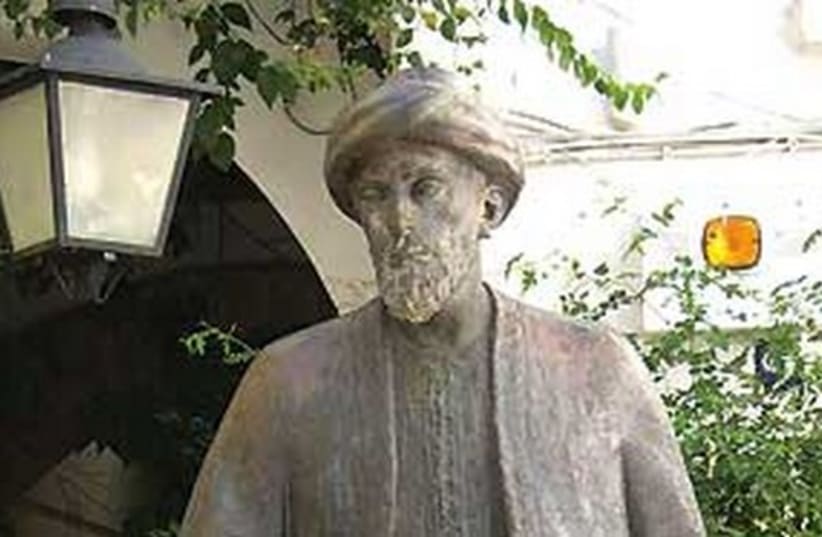
By RENÉE LEVINE MELAMMEDmaimonides 521(photo credit: courtesy)
In the collection of Maimonides’s responsa published by Joshua Blau (vol. 1, 1957), No. 34 contains a detailed question posed by a woman. Women, like men, are allowed to approach the Jewish court, but relatively few of them appear in the records. This is not surprising since the questioner needs to be educated enough to know what would be an appropriate question. It also required a bit of bravado (then and today) for a woman who would be alone in a male-dominated scenario.At any rate, the question presented by an unnamed Egyptian woman dates to sometime between 1167 (when Maimonides arrived) and 1204 (date of death). She explained how she was wed at the age of nine (possibly to a cousin), at which time her mother-in-law obligated herself to support the young couple for 10 years. (We have no idea of the age of the groom.) She also mentioned the fact that she and her sister owned some property in the same courtyard as her mother-in-law. We can only conjecture that this might have been a consideration when making the match. Be that as it may, after seven years, the older woman announced to the young couple that she could no longer support the two of them. Thus this 16-year-old bride found herself with a husband who had neither a profession nor a job, and was unable to provide for her.The situation on the home front deteriorated after she gave birth to a boy, and even further once the father of the newborn went gallivanting off, leaving his wife with a nine-month-old baby. Her husband left them with no means of support whatsoever. Because of the high degree of mobility in this society, it is not surprising to encounter Jewish men on the road. This particular husband was absent for three years “in the Land of Israel and in Damascus and elsewhere,” which was also not unusual. However, most husbands did provide for their families in their absence, leaving them with provisions and monthly stipends and/or sending funds or merchandise to their wives to sell or barter. This fellow not only neglected to make any provisions, but when he finally returned home, he was empty-handed. His wife noted that he was not able to pay his own annual poll tax (jizya); his family paid this for him to prevent him from being imprisoned.AFTER HIS return, he remained unemployed while his wife them another son. A year and a half after the birth, this husband again left town for another three years without providing for his growing family.His wife referred to the state of “utter degradation and poverty” from which she suffered with her two sons “whose hunger outweighed their satiation.” She described a husband who did not even buy any oil to light their lamps, and felt that she was “burned out” by the terrible situation in which she found herself.Fortunately, she found a means of survival: her brother was a Bible teacher and because she had some knowledge of the Bible, she asked him if she could join him as a teacher in the school. This initiative was clearly taken in order to provide for herself and her boys in the absence of the head of the household. She worked together with her brother for six years and when her brother joined the cadre of travelers, this woman continued teaching in the school on her own. In order to maintain an appropriately modest environment, her firstborn son, now 17 years of age, was also present. When parents came to get their children, she conversed with the mothers and he was there for the fathers.Her husband returned home and was not pleased to find his wife teaching in a beit midrash. This was the same husband who never provided for his sons, never paid their school fees or bought them clothes, shoes, mats, pillows – in short, furnished them with absolutely nothing during all this time. After 25 years of marriage, this woman’s assessment was that her husband had not given the family any pleasure whatsoever, for even during conversations with him, they were subjected to curses and foul language.To be continued.The writer is a professor of Jewish history and dean at the Schechter Institute as well as academic editor of the journal Nashim. She has published books and articles on Sephardi and Oriental Jewry and on Jewish women.
if(catID != 151){
var cont = `Take Israel home with the new Jerusalem Post Store