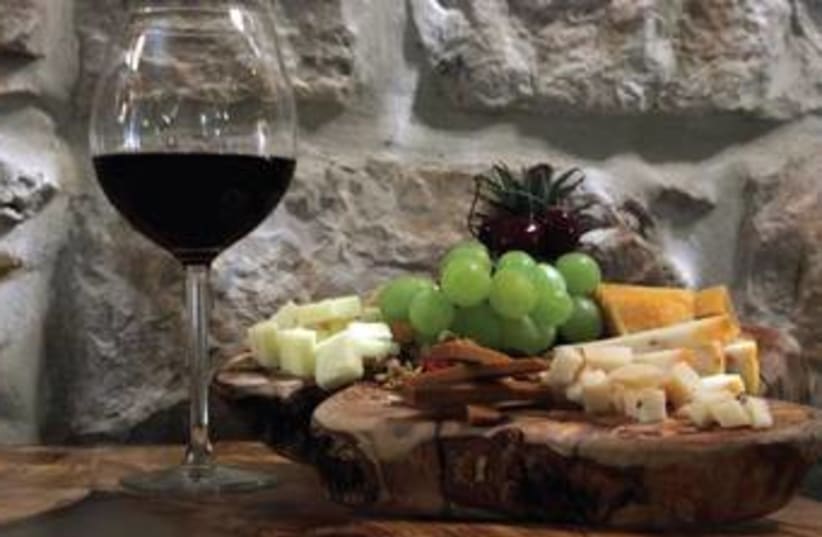
The Basher Resto-Cheese Bar is designed to refine one’s palate.
By DEBBIE KANDELWine and Cheese 370(photo credit: Marc Israel Sellem)
Many of you may be familiar with Basher Fromagerie, the huge cheese shop in the middle of the covered part of the Mahaneh Yehuda market. People come from all over Israel to buy some of the 1,000 international cheeses the store stocks. Established in 1956 by brothers Eli and Dudu Basher, whose family owned a small restaurant in the shuk for two generations, Basher Fromagerie also provides cheese to many delis and restaurants in the area. So it seems a natural progression that they should now have their own restaurant.Housed in a beautiful old Jerusalem building at the beginning of Agrippas Street, Basher Resto-Cheese Bar opened its doors on Israel’s Independence Day, but the story of the restaurant goes back further. The Basher brothers have partnered up with chef Idan Halperin and two veterans of the Jerusalem bar scene, Elad Cohen and Itamar Ben-Zaken.Idan Halperin brings more than 20 years of experience in French cooking to this venture, having owned the Rothschild chain of restaurants in Tel Aviv, Rishon Lezion and Eilat for 10 years and, more recently, Achuzat Halperin and Rigoletto in Beersheba.He has worked with Basher to put together a menu that highlights the wonderful selection of cheeses but also makes the most of the fresh fruit and vegetable produce from the neighboring market.Cohen and Ben-Zaken have worked together for many years and always dreamed of opening a good bar that was something different. They feel that their partnership with the Bashers and Halperin is the perfect realization of that dream. Talking to them both, it is clear that this is not just their work but their passion.When they found the building, it was in complete ruins. The basement was filled with mud and water and had not been used for 230 years, and the original Jerusalem stone had all been covered over. They worked together with Cohen’s cousin, Motti, a construction manager, to restore the building to its original glory. It is unusual to find original Jerusalem stone in the interior of a building outside of the Old City, so for them it was obvious to keep it that way.Many of the architects and designers they originally spoke to wanted to feature large chandeliers and make the bar very elegant, but they were determined to maintain the arced ceiling as it was and highlight the simplicity of the original stone. As a result, the lighting is minimal, and the beautiful cane up-lighter lamps on the sides of the walls illuminate the entire room.Even though the chiseled stone ceiling is no doubt the bar’s most striking feature, the wooden furniture comes a close second. The main bar and the surrounding tables both upstairs and downstairs are made from different types of wood. The bar and high tables are all olive wood, the small tables are red eucalyptus, and the downstairs tables are ficus. The same wooden design is also used for the cheese boards and salad bowls. As an added feature, all these wooden items are available to purchase.The downstairs area has a VIP dining room that seats 10, as well as two other rooms that can be used for large groups or private parties of up to 40 people. This area also includes the wine cellar (if you ask nicely, Ben- Zaken will give you a guided tour)and a pump that elicits fresh spring water from under the building.While Cohen talks in detail about the woodwork, the lighting and the stools he made himself, Ben-Zaken’s focus is clearly on the wine selection.Working with the Bashers and Halperin, he includes on the wine list more than 250 wines, mostly Israeli from wineries in the surrounding Jerusalem hills, as well as some international wines. He has the decanters, wine glasses and expertise to make sure you choose a wine that will complement your meal and the selection of cheese perfectly.On our arrival, he opened a bottle of Domaine Ventura Grand Vin 2009 (NIS 205), which is a blend of Cabernet Sauvignon, Merlot, Petit Verdot and Cabernet Franc. Next, we tasted Gvaot Herodion Vineyard Dance 2010 (NIS 190) served in taller Bordeaux glasses. This is a blend of Cabernet Sauvignon, Petit Verdot and Merlot made in the hills of the Shomron, and only 3,060 bottles were produced. This boutique winery is one of my personal favorites, and I recommend trying other wines from them.For our third bottle, we decided to try one of their Old World wines, and Ben-Zaken recommended the Château Tour Balladoz 2008 St.Emilion Grand Cru (NIS 360), a traditional Bordeaux blend.that is fullbodied and very well rounded. Easy to drink, it was a perfect partner for the cheese platter.Most nights there are 12 wines served by the glass. Although they have made the decision not to serve a full range of soft drinks, there is a choice of fruit juices and as flavored sparkling waters, known as Italian Sparkling, which especially complement the cheese. We tried the beautifully rich-colored Violet flavor, which was unusual and delicious.As for the menu, it includes a wide selection of dishes from light bites to full main courses. The majority of customers order a cheese platter of four cheeses (NIS 69) or seven cheeses (NIS 99). The chef sent us a European selection of four cheeses, but there is the option to go up to the cheese counter and choose your own selection.Our cheese board included Italian Tolegio, Swiss Gruyere, aged spiced Dutch Gouda and French bleu crémeux de Haute Loire with fresh apricots, cherries and grapes, which was a perfect combination. This was served with garlic bread and cream cheese, which was very nice, but we felt it took away from the flavor of the cheeses. However, there is the option to request a simple baguette.Personally, I would prefer to have some light crackers and wheat-free options as well.Our favorite items on the menu were the pineapple carpaccio with goat’s cheese and cane sugar sauce (NIS 39) and the pecorino carpaccio with truffle oil and balsamic vinegar (NIS 44). Both are very light dishes and full of flavor.Other highlights included asparagus with salmon, sun-dried cherry tomato, olives and a tomato cream sauce, drizzled with balsamic vinegar (NIS 28); baked Camembert with fig, pear and walnut glazed with Marsala wine (NIS 48); homemade vine leaves (NIS 42); and homemade four cheese ravioli with a white wine cream sauce and sundried cherry tomato made daily on the premises.For those just looking for a small accompaniment to their wine, there is a large selection of tapas style dishes, such as smoked fish (smoked tuna, Spanish sardines, anchovies), Moroccan olives, tehina, ikra labane (NIS 22), a variety of bruschetta and the chef’s sandwich – a sandwich of your choice (providing they have the ingredients).The menu still needs some finessing and the presentation is rustic, but the basic ingredients are there. There is no doubt in my mind that Basher Resto –Wine Bar is a great addition to Jerusalem’s restaurant offerings.The partners hope that this will be so successful that they will eventually open more branches across the country. But for now, they are focused on adapting to the needs of their customers. As of this week, they will be open from noon for those who want to enjoy a delicious lunch before heading to the shuk.The writer was a guest of the restaurant.
Basher Resto-Cheese Bar 21 Rehov Agrippas Street Jerusalem(02) 534-0400 Sunday – Thursday: noon to last customer. Friday: 10 a.m. to one hour before Shabbat. Saturday night: One hour after Shabbat ends.
if(catID != 151){
var cont = `Take Israel home with the new Jerusalem Post Store