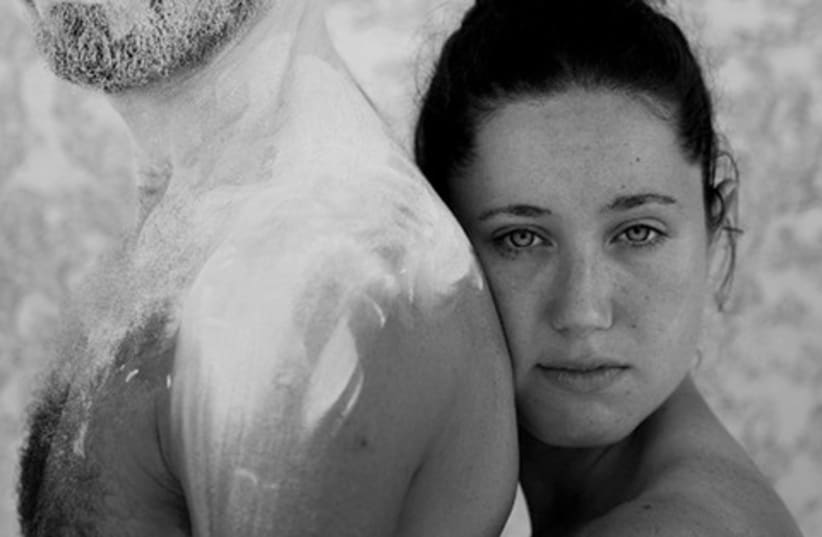
Two dancers and the stage itself perform in ‘Cell in a Human Scale,’ which premieres this week.
By ORI J. LENKINSKICell in a Human Scale 521(photo credit: Courtesy)
In the promotional video for Sahar Azimi and Tamara Erde’s new work, a heavily accented voice-over tells a disturbing tale of a dinner party. At this event, a group of happy guests stood in small groups chatting beneath a ceiling of bees. Every few minutes one of the insects dropped down to sting one of the party-goers, producing a sharp howl of pain. The people stayed put despite the ongoing attack, waiting to see who would be the next victim.The story, though perhaps not directly connected to the performance art/dance piece created by the two artists, sets an intriguing tone for Cell in a Human Scale, which premieres this week at the Suzanne Dellal Center.The meeting between choreographer/dancer Azimi and video Tamara Erde began several months ago when the two embarked on a joint creative process. The topic for their collaboration was the transformation from sterile to contaminated, from being alone to togetherness.Azimi brought his wealth of movement knowledge and his desire to explore new possibilities for his own performances. After dancing with Israel’s top choreographers, Azimi cut his choreographic teeth creating edgy, physical works, which he has presented in Israel and abroad. His previous works include Come Feel and UTF8. He recently curated and mentored four artists in the Curtain Up Festival.Erde came armed with her own singular aesthetic, which she has spent the past several years honing in Israel and in France, where she currently resides. Prior to her move, Erde collaborated with choreographer Tamar Borer on Ana, a dance film which was presented at the third annual VDance International Film Festival in Tel Aviv. A graduate of Bezalel Academy of Arts and Design, Erde has taken part in projects in New York, Israel and across Europe.In Cell in a Human Scale, Azimi and Erde find themselves on a white stage devoid of any color or personal touches. They examine themselves and each other in this stark environment, unsure of their status. Azimi and Erde are living sculptures in the space, contributing to the overall aesthetic. At the same time, they threaten to destroy the organization of the whiteness.As the piece unfolds, the stage takes on a life of its own, morphing and offering new stimuli for the two trapped performers. Erde’s handiwork is projected on the walls of the white space, at once filling the performance arena with images and emotions. Original music by Didi Erez helps to charge the stage with tension.
The works of beloved Israeli artist Meir Eshel, otherwise known as Absalon, inspired the stage design for Cell in a Human Scale. Eshel created most of his sculptures while living in Paris. His most famous pieces are abstract architectural sculptures known as Cellules, described by Eshel as “bastions of resistance to a society that stops me from becoming what I must become.” Eshel died in Paris at the age of 28.Cell in a Human Scale was co-produced by the Committee to Fight AIDS in Israel. Proceeds from the third of the five performances (November 26) in this engagement will be donated to the ongoing fight against AIDS. The artists will host a talkback following this performance.Cell in a Human Scale will be performed at the Suzanne Dellal Center on November 25 at 2 p.m. and 9 p.m. On November 26 at 9 p.m. and on December 1 at 8:30 p.m. and 10 p.m. For tickets, visit www.suzannedellal.org.il.
if(catID != 151){
var cont = `Take Israel home with the new Jerusalem Post Store