An encyclopedia undertakes the Herculean task of preserving the memory of the ghettos in Eastern Europe, their struggle to function and their final fatal disappearance.
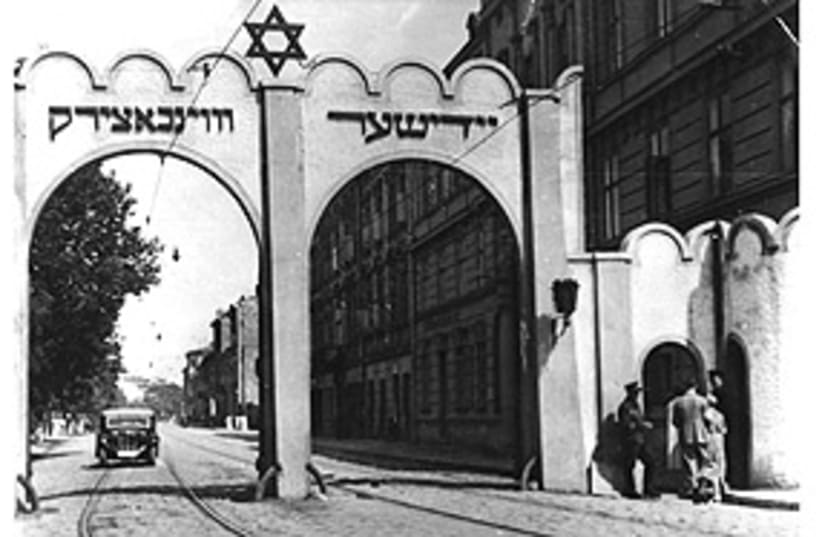
By ALEXANDER ZVIELLICracowGhetto311(photo credit: .)
Piotrkow Trybunalski, a county seat in the German-occupied Polish Lodz District, was one of the first ghettos, set up in October 1939 by the newly-appointed German mayor Hans Drexler. Radomsko and Pulawy followed. The Theresienstadt ghetto in Czechoslovakia, a “model Jewish city,” which at one time housed some 59,000 Jews, was the last to survive. It was liberated by the Red Army on May 8, 1945, but was closed only during the following August.Some 1,000 entries in the Encyclopedia of the Ghettos During the Holocaust, each one describing a specific ghetto, testify to the magnitude of the task undertaken by Yad Vashem in collecting, editing and publishing in English all relevant information on the six years of the European Jewish ghettos’ history.On November 12, 1938, following the Kristallnacht pogrom, Hermann Goering ordered the isolation of German Jews in ghettos. On April 30, 1939, the Law Concerning Tenant Relations with Jews laid the foundations for the administration of Jewish residents by the local government. Jews were confined to “Jewish houses,” while any and all protection for them was declared null and void. Thus the Nazi principle of isolating Jews was implemented and served as a pattern for the future. The encyclopedia includes a separate chapter on the “Judenhauses in Germany,” by Martin Buchhoz and Konrad Kwiet.Prof. Dan Miron, the editor of Yad Vashem’s educational journal Bishvil Hazikaron (For the Memory); Shlomit Shulhani, a researcher of Yad Vashem’s International Institute for Holocaust Research; and Ruth Shachak, the editorial coordinator, assembled a staff of scholars, contributing editors and authors, consultants, translators and linguistic specialists to preserve the memory of the ghettos in Eastern Europe, their structure, their struggle to function and their final fatal disappearance.A major part of the information was taken from Yad Vashem’s Hebrew Encyclopedia of the Jewish Communities. This was supplemented by research in the Yad Vashem archives and other available sources. The editors realized their research might never end, and additional knowledge may still come to light. Nevertheless they decided that more than 65 years after the last ghettos disappeared, the publication of the Encyclopedia was both timely and necessary.The Encyclopedia defines “ghetto” as any part of a preexisting settlement, occupied by Nazi Germany, where Jews were confined for at least a few weeks. There were different ghettos, according to their size, population and geographical location. They differed from concentration and labor camps by being still engaged in some sort of an urban life. They all served the same purpose of keeping Jews in complete isolation, intimidating, robbing and murdering them at will, and exploiting them before the evacuation to the concentration camps for the “final solution.” The conditions in separate ghettos might have been different – a lot depended on the quality of the German authority and the local circumstances – but ultimately they were all similar, served the same purpose and met the same fate.While the tragic history of major ghettos like that of Warsaw or Cracow is better known, the preservation of the memory of even the smallest ghettos is important. We learn about the rich Jewish world long gone by, an inseparable part of our national heritage. The Encyclopedia serves as a most powerful witness of the magnitude of the Holocaust and describes in detail many lesser-known instances of persecution, terror and exploitation. It allows us to learn a lot about the human and inhuman relations. While the ghetto was an ugly place, the invention of a sick, perverted mind, it was a reality that had to be faced to stay alive.Following an editorial written by Yehuda Bauer and Israel Gutman, Dan Michman describes the history of the Jewish ghettos under the Nazis and their allies, while Nina Springer-Aharoni concentrates on the role of the ghetto photographers as an inseparable part of the historical documentation. Both volumes are richly illustrated with the aid of Orit Adorian and Ofira Mizrachi of the Yad Vashem Museum. However gruesome the subject, they add to the impact and authenticity of the text, while maps indicate the ghetto sites in Poland, Ukraine, Belarus, Czechoslovakia, Hungary, Yugoslavia, Romania, Greece, Lithuania and Latvia.A quote by Rutka Lieblich, published in the Memorial Book of the Community of Andrychow, introduces us to the long, alphabetical list of ghettos where “people curl up frozen, worried, dejected, crushed by misfortune and poverty. They hurry through muddy, rainy streets. Where to? To the cold, unhealthy, damp apartments. Only the chosen received normal apartments. What do they [the Germans] do to people? They expelled them from their fine, comfortable, bright homes and put them into burrows.”While the Germans endeavored to reduce the ghettos’ size, the overcrowding was made worse by the steady influx of Jews brought in from the annexed Polish territories and from Western Europe. Permanent fear and uncertainty, overcrowding, typhus and other diseases, hunger, persecution, starvation and constant humiliation turned the ghetto into a hell on earth.And yet, despite the terrible terror and the frequent duplicity of the German-appointed Judenrat and the Jewish police, there were acts of bravery, attempts to ease the load, to take care of the weak and hungry, to organize escape and resistance. These efforts intensified when it became obvious that “resettlement” meant certain death. There were martyrs and there were heroes, but everyone wished to outlive the tragedy and to remember.EACH GHETTO had its chronicler, professional or amateur. They all endeavored to preserve their memories and set up hidden archives. They believed that the free world couldn’t even imagine the horrors that they went through and that the memory of their suffering ought to be preserved and never forgotten. A well-hidden press and hand to hand distribution of clandestine material was known to be punished, if discovered, by prolonged torture and an inevitable death sentence. No ghetto could survive without intensive smuggling, frequently carried out in mortal danger by its real heroes, the small children.The first of the ghettos, arranged in the Encyclopedia in alphabetical order, is Abony, a town in Pest-Pilis-Solt-Kiskun county of Hungary. The German army occupied Abony on March 19, 1944, and on May 22, 275 local Jews were moved into the ghetto. Later Jews from the entire district were added to its population, which on June 20, 1944, was transferred to the copper factory in Kecskemet, and from there again on June 25 and 27, to Auschwitz. Abony is followed by Adamow, Aknaszalatina, Aleksandrja, in a uniform pattern of ghettoization that usually began with restrictions, a yellow or white patch with a Star of David, and continued with robberies, forced labor, Judenrat and deportation.The last ghetto on this long list of woe is Zyrardow, a town in centralPoland, established on December 15, 1940, where some 2,700 local Jewswere augmented by some 1,500 Jewish refugees from Sohachev, each beingallowed to carry 25 kilos from their former houses. In late January1941, all of them were “relocated” to the Warsaw Ghetto where theyshared the fate of the Warsaw Jews. A number of them fought in theApril 1943 ghetto uprising.The history of the Warsaw Ghetto, and ghettos in other big towns, iswell told in a pragmatic but often impressive and moving manner. Thestatistics speak for themselves, and German ruthlessness is welldocumented. Whenever relevant, the barbarous activities of some Poles,Ukrainians, Estonians, Latvians and other Nazi lackeys are brought tolight.There is a list of additional ghettos and the camps in Transdnistria, aglossary, a selected bibliography, a list of photo sources and anindex. A disc on the ghetto’s history is also included. The reader isoffered two large well printed and bound, most readable volumes, anabsolute must for any important library.
if(catID != 151){
var cont = `Take Israel home with the new Jerusalem Post Store