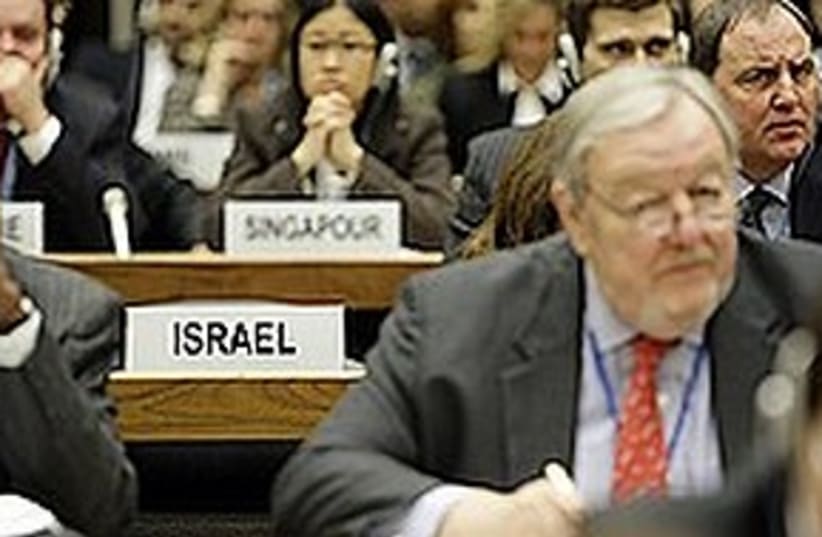
Official says the flotilla probe mandate is stacked against Israel.
By TOVAH LAZAROFF, HERB KEINON, JORDANA HORNUNHRC(photo credit: Associated Press)
Israel is unlikely to cooperate with the UN Human Rights Council’s investigatory team to probe IDF activities aboard the Gaza-bound flotilla on May 31, sources in the Prime Minister’s Office said on Saturday night.The sources said that while no formal decision had been made on whether to cooperate with the factfinding mission appointed on Friday, it was unlikely – given the committee’s one-sided mandate – that Israel would do so.Not only was the mandate stacked against Israel, one official said, but UN war crimes prosecutor Desmond de Silva, chosen to head the panel, spoke forcefully against Israel’s actions regarding the flotilla before he was appointed.Israel’s position is that the IDF investigatory committee, which was headed by Maj.-Gen. (res.) Giora Eiland and has already submitted its findings, and the Turkel Commission, which includes two foreign observers, are sufficiently able to probe the matter.Diplomatic sources said that Israel remains hopeful that UN Secretary- General Ban Ki-moon would find these investigations sufficient.News of the appointment of the new three-member fact-finding mission in Geneva was met with apathy in New York.Ban had no comment on the Human Rights Council’s committee, and was “continuing with his efforts to win approval for his proposed international inquiry, which is separate from this one,” a representative of his office said.Fatah and Hamas praised the appointment of the three-member panel.Fatah spokesman Ahmed A’saf said that Israel should not be treated as if it was above the law and that Israeli war criminals should be tried for their actions.Hamas political consultant Yusuf Rizka expressed concerns that Israel would not cooperate with the investigative team, which could damage the investigation’s findings.He added that Hamas hoped the investigation would lead to the experts recommending that Israel end the sea and land blockade of the Gaza Strip.Hillel Neuer, executive-director of the Geneva- based nongovernmental group UN Watch, said the outcome of the probe was predetermined.“The mandate of the probe violates due process and objectivity, by presuming Israeli guilt from the outset,” Neuer said. “It’s another example of what former UN rights chief Mary Robinson recently described as the unfortunate and regrettable practice by the council to adopt resolutions guided not by human rights but by politics.”According to Neuer, “by declaring Israel guilty before any facts were even collected, the [Rights Council] resolution taints the mission with prejudicial bias, and contravenes the UN’s own Declaration on Fact Finding, which requires objectivity and impartiality.“The perception of the council’s one-sided approach and lack of credibility is so severe that UN Secretary-General Ban Ki-moon’s office in New York has completely ignored this probe in seeking to establish their own,” Neuer said.Friday’s announcement of the panel’s formation in Geneva followed the council’s decision on June 2 to condemn the IDF raid on the flotilla and to probe the events of that morning.In that resolution, the council stated that IDF actions were “outrageous” and that it “deplored the loss of innocent” life aboard the flotilla.The council on June 2 asked the fact finding mission to “investigate violations of international law, including international humanitarian and human rights law, resulting from the Israeli attack on the flotilla of ships carrying humanitarian assistance.”The resolution made no mention of video footage already available that showed passengers aboard one of the flotilla ships, the Mavi Marmara, attacking IDF commandos. All nine fatalities that morning were aboard the Mavi Marmara.On Friday, council President Sihasak Phuangketkeow said, “The expertise, independence and impartiality of the members of the mission will be devoted to clarifying the events which took place that day and their legality. We call upon all parties to fully cooperate with the mission and hope that this mission will contribute to peace in the region and justice for the victims.”In addition to de Silva, the probe includes Judge Karl T. Hudson-Phillips of Trinidad and Tobago and Mary Shanthi Dairiam of Malaysia.Hudson-Phillips was a judge of the International Criminal Court from 2003 to 2007. He was attorney-general and minister of legal affairs of Trinidad and Tobago between 1969 and 1973. He was appointed Queen’s Counsel in 1971. He has now returned to private practice with chambers in Trinidad and Tobago and in Grenada.De Silva, from the United Kingdom, is an attorney with experience in human rights, war crimes, terrorism, business crime, espionage trials and sports law. He was chief prosecutor of the UN-backed Special Court for Sierra Leone in 2005 at the level of a UN under-secretary- general. He has been Queen’s Counsel since 1984.Dairiam was a member of the Committee on the Elimination of Discrimination against Women from 2005 to 2008. Since 2007, she has been on the Gender Equality Task Force of the UN Development Program. She is a founding member of the board of directors of the International Women’s Rights Action Watch Asia Pacific.Meanwhile, the cabinet on Sunday is expected to approve the addition of two members to the Turkel Commission: former Foreign Ministry director-general Reuven Merhav and law professor Miguel Deutsch. They will join retired Supreme Court justice Jacob Turkel, Maj.-Gen. (res.) Amos Horev, international law expert Shabtai Rosenne and international observers David Trimble and Ken Watkin on the panel.Jerusalem Post staff contributed to this report.
if(catID != 151){
var cont = `Take Israel home with the new Jerusalem Post Store