A new documentary claims the Nazi leader did not commit suicide in his bunker towards the end of WWII.
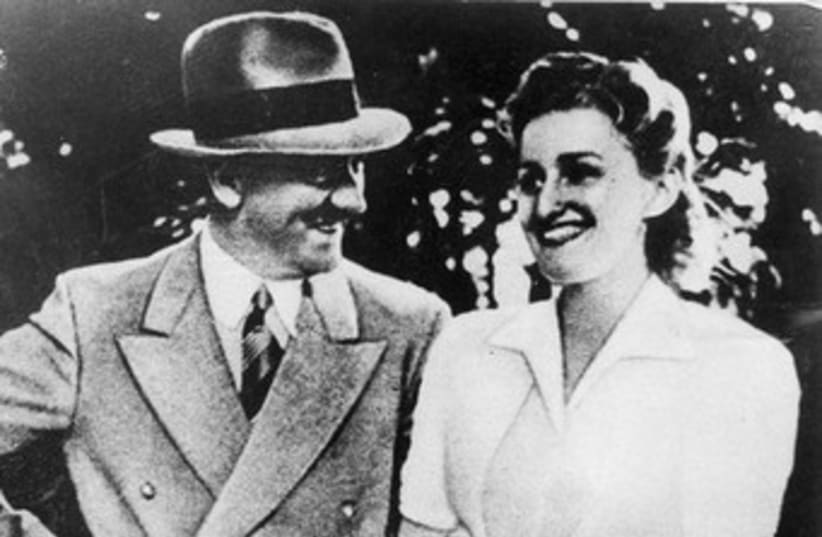
By HANNAH BROWNEva Braun with Adolf Hitler 370(photo credit: Jerusalem Post Archives)
Hitler’s last days were not spent in his Berlin bunker, but in tranquil luxury in an Argentine hotel – at least, that’s the story that director/ producer Noam Shalev and researcher Pablo Weschler are trying to prove in their upcoming documentary, Revealed: Hitler in Argentina, set for release next year.“We will never know the truth,” Shalev cautions, sitting in the offices of Highlight Films, the video production company he and Weschler run in Bnei Brak. “But there is enough evidence to build an alternative theory about what happened to Hitler.”“No one believed the Russians’ story of Hitler’s suicide in the bunker,” says Weschler. “As early as the summer of 1945, there were headlines asking, ‘Where is Hitler?’ all over the world.”One difficulty in confirming the basic facts of Hitler’s suicide with his wife, Eva Braun, in the final days of the Allies’ approach to Berlin, was that the Russian troops did not give access to many forensic investigators. Shalev and Weschler believe that British intelligence officer and historian Hugh Trevor-Roper’s investigation was rushed and “unprofessional.”But what inspired them to begin making their film about the evidence they believe leads to proof of Hitler’s secret flight to Argentina were recently declassified FBI documents.“In those days, the FBI, not the CIA, was responsible for South America,” explains Weschler. “And in declassified documents, we see that the FBI took very seriously the possibility that Hitler fled to Argentina.”The FBI set up a special unit to investigate this possibility.Shalev and Weschler are convinced they have gathered significant evidence that pinpoints Hitler’s whereabouts during the years following World War II. Inspired by the book Hitler’s Escape by Italian journalist Patrick Burnside, they have done their own research as well.“When Burnside published his book, in 1998, he got thousands of e-mails from people coming forward with information,” says Shalev. “Some of them were crazy, of course, but he had enough information to do more research and write another book.”The manuscript of that book, which will be published next year, was a useful guide for Shalev and Weschler, and led them to a famous hotel.“The Eden Hotel in La Falda, Cordoba [in Argentina] was owned by Ida and Walter Eichhorn, who were close friends of Hitler,” explains Weschler. “Hitler sent them a Mercedes Benz as a gift. It was the first Benz in Argentina.”The once-opulent hotel, now in ruins, was the site of lavish parties, and a host of notables, including Albert Einstein, stayed there in the Twenties and Thirties. The Eichhorns were very vocal in their support for the Nazi party, and made financial contributions.They also broadcast speeches Hitler’s, whenever he spoke on the radio, throughout the hotel.Citing a September 1945 letter from the FBI (one of the documents declassified in the Nineties), Weschler points to the lines that show that the FBI believed that if Hitler got into trouble, he could always find a safe haven with the Eichhorns if he could manage to get there. Weschler found former employees of the hotel who say they met and waited on Hitler after the war there.“It was easy for them to recognize him, because his picture was all over the hotel,” says Weschler. He says that his research shows that Hitler moved on from the hotel to an isolated rural estate in Argentina, where he lived out his days with Braun and their two daughters, and that he died in the mid-Sixties.Particularly persuasive evidence, according to Weschler, is DNA testing done in 2009 on Hitler’s skull fragments that were recovered from the bunker.“They showed that they couldn’t have been Hitler’s skull because they were from a woman under 40,” says Weschler, a finding that was reported in the mainstream press.“DNA doesn’t lie,” he says. “The more you look into it, the less credible the official version becomes, and the more plausible an alternative theory seems.”
if(catID != 151){
var cont = `Take Israel home with the new Jerusalem Post Store