While Tiran is not as obnoxious as Maestro Daniel Barenboim in his expressions of disapproval regarding Israel’s policies in the West Bank and its treatment of the Palestinians, he does not conceal his opinions.
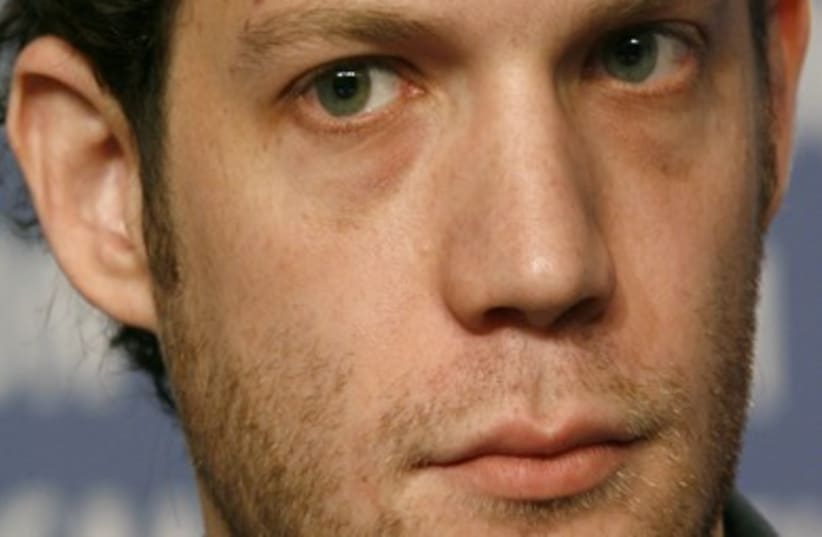
By SUSAN HATTIS ROLEFIsraeli actor Tiran (R370)(photo credit: REUTERS)
In 2005, when he was only 25, actor Itay Tiran first appeared in Hamlet, produced by the Cameri Theater, in the title role. Many eyebrows were raised at the time; Hamlet is considered a part only experienced, mature actors should contend with. However, the unusual production, directed by Omri Nizan, in which the audience actually sits on the stage, was a grand success, both in Israel and abroad, and is still part of the Cameri’s repertoire.The indefatigable Tiran is still playing the tormented prince of Denmark, with the same brilliance and energy as he did seven years ago. Five years ago, Tiran wrote that before opening night he had a nightmare in which he is preparing to take a curtain call, and Omri Nizan scolds him: “You forgot!” “Forgot what?” “To be or not to be...”In fact, he has recited the lines with precision over 800 times to date.As veteran Haaretz theater critic Michael Handelzalts recently wrote, in Tiran are combined rare talent, range and good looks. Tiran is also a trained musician, who, inter alia, played the piano as Mozart in Amadeus, and the saxophone as the Nazi officer Kittel in Ghetto. A year ago he recited/ sang the German text at the end of Schoenberg’s Gurrelieder with the Philharmonic Orchestra.Tiran has also started to direct, with no small measure of success. One of the plays he directed was Georg Büchner’s Woyzeck, in which he also played the title role. It was after seeing this play that I concluded that Tiran is as great an actor as was Sir Laurence Olivier. In this play Tiran, who usually plays dazzling extroverts, tackled a physically unattractive, mediocre character with such perfection that one could hardly recognize him. This is exactly what happened with Olivier’s performance in John Osborne’s The Entertainer, which I saw in London 50 years ago.Now Tiren has added to his Shakespearean resumé the two Richards – Richard II and Richard III – which he is performing these days at the Cameri simultaneously with Hamlet and Cabaret – another tour de force in which he plays the master of ceremonies.The two Richards as depicted by Shakespeare are very different both in character and appearance, and Tiran manages to get into the skins of both – the beautiful, blond and narcissistic Richard II, who turns rather philosophical after abdicating, and the blackhaired, physically deformed and murderous Richard III, who ends up wounded in a battlefield pleading, “My kingdom for a horse.”However, while no one denies Tiran’s greatness as a performer, there are many who have reservations about him, to the point of actively trying to sabotage his career. The reason for this is the fact that he did not serve in the IDF – apparently on grounds of conscientious objection, together with his political views, which led him to sign, with other actors, a petition in which they declared their refusal to perform in Ariel.While Tiran is not as obnoxious as Maestro Daniel Barenboim in his expressions of disapproval regarding Israel’s policies in the West Bank and its treatment of the Palestinians, he does not conceal his opinions, and the fact that he agreed to appear last year (where on earth does he find the time?) in a four-chapter British television serial, The Promise, in which he portrays an Israeli who is sympathetic to the Palestinians, enraged many.The campaign against Tiran has so far enjoyed only very partial success in that his biographical details and photograph no longer appear on any official Israeli website, and the invitation he received last year from the musical director of the New Haifa Symphony Orchestra, Maestro No’am Sheriff, to stage a production of the George Bizet’s opera Carmen, was cancelled after a group of citizens wrote in protest that “the provision of a stage and public funding to someone who has dodged the army and hurts our soldiers, is outrageous and shameful.”The protestors were less successful back in 2010 when they tried to convince Minister of Culture and Sport Limor Livnat to prevent Tiran’s participation in Yehoshua Sobol’s play Ghetto, and to support his exclusion from any publicly financed theater in Israel.While I believe every able-bodied Israeli should serve in the IDF, and that even when one is critical of Israel’s policy in the territories and toward the Palestinians, one should avoid even the semblance of support for forces that are active in delegitimizing Israel, I find the efforts to delegitimize Tiran to be undemocratic and repulsive.Just as Tiran cannot be forced to perform in Ariel, so no one forces anyone to go and see him perform. Tiran is an Israeli, and contributes to Israel in his own way. He has done nothing illegal or illegitimate, even if many disapprove of his positions.It will be a major loss to Israel as a democratic state with a rich and versatile culture if Itay Tiran is finally forced to conclude that despite the massive support he enjoys both from the theatrical establishment and theatergoers, he has no future in this country.The writer teaches at the Max Stern Yezreel Valley College and was a Knesset employee for many years.
Related Tagsorchestra
if(catID != 151){
var cont = `Take Israel home with the new Jerusalem Post Store