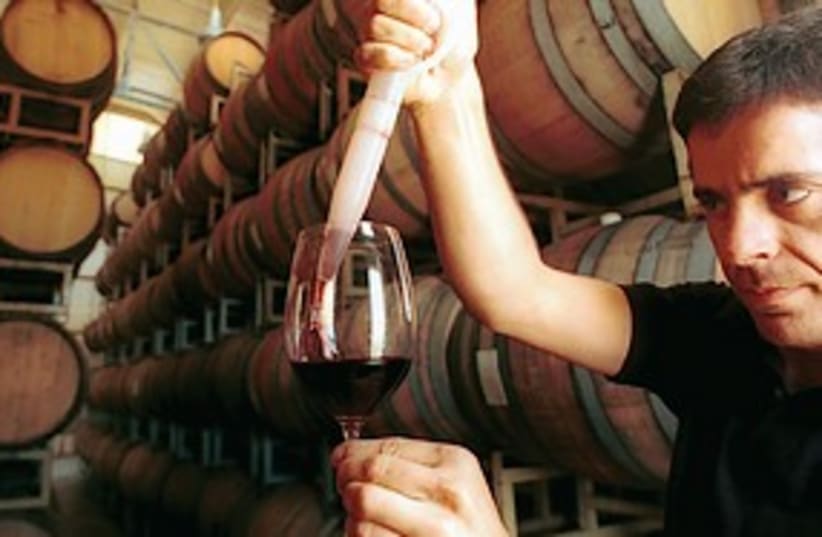
What is the difference between a viticulturist, a winemaker and a sommelier? Each is an expert in his own domain.
By ADAM MONTEFIOREWine talk 311(photo credit: MCT)
The wine industry is like any other in that it finds a home for those looking for a career in production, distribution, logistics, sales and marketing. However, there are three professions that are unique to wine alone.
The viticulturist A viticulturist is an agronomist who has specialized in vineyards. In wine growing, the management of the vineyards is very important, as you can make good wine from good grapes but it is difficult to make good wine from bad grapes. That is why wineries talk about growing wine in the vineyard rather than just growing grapes.Some of the larger wineries will employ a vineyard specialist to manage their vineyards and give instructions to the growers and vineyard managers. Agronomists in Israel generally study at the Hebrew University Faculty of Agriculture at Rehovot and at the Volcani Institute in Beit Dagan. Most of their knowledge comes from practical work in vineyards, which they will support by study visits to wine-growing regions around the world.Their job is to supervise the vineyard year. This includes the choice of varieties and clones, the planting of vines, winter pruning, cultivating and harvesting.Trellising or vine-training and canopy management of the vine are crucial to the final quality. The viticulturist plays a major part in the quality of the resulting wine.The winemaker The winemaker is the chef of the winery. He will work closely with the viticulturist and growers, but if the viticulturist is responsible for the vineyard, the winemaker is in charge at the winery. He is responsible for receiving the grapes at harvest and transforming them into wine. The sampling, crushing, pressing, fermentation, aging, blending, bottling and bottle maturation are his responsibility. He has to decide on which wines to blend, the idea being to create something greater than the sum of its parts. Also he has to decide which plot or parcel in which vineyard should be kept separate for a single vineyard wine or to be part of a prestige blend.Twenty years ago most Israeli winemakers rarely visited vineyards.Today, it is not an exaggeration to say that wine is made in the vineyards, so the modern winemaker will be well versed in viticulture and will often be found sampling grapes in the vineyards.The winemaker is part scientist, part artist, part agriculturist.Two different winemakers with exactly the same fruit and equipped with the same machinery and technology will produce totally different wines.The finest Israeli winemakers are usually internationally trained and follow this by work experience at famous wineries. Once, most of the new-wave Israeli winemakers studied enology at the University of California at Davis. Today it seems more popular to study at Roseworthy College and Adelaide University in South Australia. However, others choose universities in France or Italy, and even New Zealand and Canada.The sommelier Sommeliers are the wine professionals outside the gates of the winery. They are most known in the restaurant context. A quality wine waiter in Israel will often be complimentarily referred to as “the sommelier.” In theory, a sommelier will be responsible for meeting winery representatives, tasting and buying wines, managing the cellar and storage facilities, compiling the wine list, ensuring the availability, maintenance and cleanliness of wine accessories such as glassware and decanters, and training bar staff and waiters in wine service. They will also have a sales responsibility and be responsible for promotional programs. They will need to know not only about wine but also beers, spirits, liqueurs, coffee, tea, water, soft drinks and even cigars.The sommelier will learn on site through career progression through the food service industry, supplemented by wine courses like the Wines & Spirits Education Trust (WSET) in London or one of the college wine courses in Israel. Afterwards, he may specialize by doing the progressive courses organized by The Court of Master Sommeliers or Guild of Sommeliers. Most important is that they do an internship in one of the top international restaurants to gain experience.Trained sommeliers do not have to work in a restaurant. They may also work in wine education or as a wine buyer or be the wine professional for a wine shop, importer or distributor.Where to study wine The wine store chain Derech Hayayin (www.wineroute.co.il) and Ish Anavim (www.grapeman.com) teach wine appreciation ranging from tasting events to five-session courses.Various colleges offer wine courses lasting a full academic year. Ramat Gan College’s Wine Academy is suitable for both wine lovers and wine professionals. It also has an advanced course. Tel Hai College’s Cellar Master Course, held in the Upper Galilee, is suitable for future winemakers. Ariel University Center of Samaria organizes a wine course especially geared for those running a boutique or small winery. Sorek Winery at Moshav Tal Shahar also runs a practical winemaking course, which has a more hands-on approach. It is ideal for home winemakers.New last year, the Ohalo College in Katzrin runs a course for winemaking students in cooperation with the CFPPA in Beaune, France.These courses are all in Hebrew. However, for English speakers, help is at hand.American-born David Rhodes is a trained sommelier and wine educator from California, who writes and broadcasts about Israeli wine. He is known as “the Israeli wine guy.” His educational wine lectures, courses, tastings and wine event dinners are all conducted in English. He can be contacted by e-mail: israeliwineguy@gmail.com Wine of the week: Teperberg Cabernet Sauvignon Reserve 2008This good-value wine is made 100 percent from Cabernet Sauvignon grapes grown in the Samaria hills. The wine has an aroma of black fruits, cherries and sweetish vanilla from oak aging. It is produced by the Teperberg 1870 Winery, previously known as Efrat. Teperberg is Israel’s largest family-owned winery and the fourth-largest winery in Israel.Since moving from Motza to Kibbutz Tzora, the winery’s wines have improved no end and are now sold under labels called “Teperberg Reserve,” “Terra,” “Teperberg Silver” and “Israeli.” This reserve wine is a fine example of its premier label.Price: NIS 110.■ Adam Montefiore works for Carmel Winery and regularly writes about wine for Israeli and international publications.
adam@carmelwines.co.il
if(catID != 151){
var cont = `Take Israel home with the new Jerusalem Post Store