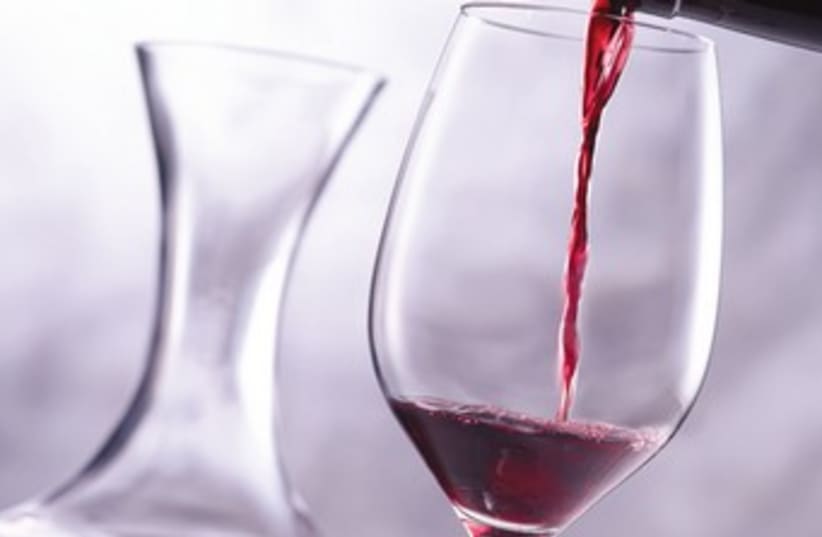
The procedure of decanting wine at the table may add to the perceived value of the occasion, but is it necessary?
By ADAM MONTEFIOREWine(photo credit: Courtesy)
To decant a wine is to transfer the contents from the bottle to a glass receptacle.The reason is either to enhance the quality or drinkability of a wine or to give it a better look or appearance. The most basic use of the decanting principle is the inexpensive house wine that may be decanted into a carafe in your local restaurant.This is more about marketing than quality, and the intention is to give an impression of informality and good value, with the focus on the carafe rather than the bottle itself.Apart from this, there are basically four reasons to decant a wine. Firstly, to remove sediment that may be thrown by an older wine. Secondly, to aerate a young closed wine. These are the main, most commonly used reasons. Also, if you have a chilled cellar or wine fridge, you can use a decanter to help change the temperature of the wine by rinsing out the decanter in warm water first. However, it does not bother me to serve quality red wines in Israel chilled and let them warm up in the glass. (I even recommend putting red wines in the fridge for 20 minutes before you open them. I feel this is the right thing to do for our climate and with our high alcohol levels.) Finally, some people decant for reasons of style and to make an impression. The decanting procedure looks good and may add to the perceived value of the occasion.It is theater pure and simple, no less than carving a joint of roast beef or flambéing at the table. The wine sitting in a decanter may also add to the perceived value of the wine.Whether to decant or not is a question that the professionals don’t agree on. Some swear by it, while others are adamantly against it. My personal view is that any wine, even a simple Beaujolais Nouveau, will benefit by aeration. Be careful not to decant an old wine too early in case it falls apart, but young astringent wines will benefit from the extra time to soften and become more approachable.The most regular professional reason to decant is to separate an older wine from the sediment. In this instance, the bottle will be lying horizontally where it is stored, so the cork stays moist. It should be carefully removed from the wine rack and carried in the same position to the point of service. A professional restaurant may use a wine basket or cradle, which will keep the wine horizontal but at a slight angle. The wine will be opened, and in this case the capsule will be removed to enhance visibility. (Usually it is recommended that the capsule not be removed totally.) Then the wine will be poured into the decanter gently and steadily to avoid shaking up the sediment. Using a light source like a candle or torch placed behind the shoulder of the bottle, the pourer will watch for the sediment to become visible and stop pouring when he sees the first evidence of the dustlike granules arriving in the neck of the bottle. The skilled pourer will end up with a nearly full decanter of clear, bright wine, and the dregs will be left behind in the cloudy wine at the bottom of the bottle.Many experts advise standing up the bottle that one intends to decant about 24 hours in advance, so the sediment of an older wine will settle. This I don’t recommend because the sediment will be unavoidably shaken up during the pouring action.To decant a young, tannic or closed wine is simpler. For show, the waiter or host at home may decide to do it with the same care and finesse as the finest sommelier.Alternatively, they can upend the bottle upside down and let the wine glug into a carafe or decanter. This will give the ungenerous, sleeping wine the best opportunity to awaken and open so that it shows itself better. Here no delicacy or professionalism is required.Many people ask “How long should we let the wine breathe?” The idea is to open the wine two hours before it is needed to allow a certain aeration and slight oxidation to bring the wine forward. This I never advocate, as the only part of the wine that actually breathes is the diameter of wine in the neck of the bottle exposed to air. If the wine does need to breathe, I recommend pouring the wine into any glass receptacle (water pitcher or jug), and then pouring it back into the bottle from which it will be served. This will allow the wine to breathe properly, and you will do the wine the honor of serving it out of the bottle with the label on show, as the producer intended.There are many decanters that can be used, from a simple carafe to an expensive Riedel decanter, which may be a work of art in its own right. They are designed to hold a single bottle of wine, but there are also those produced in a larger size to take a magnum, the equivalent of two bottles.There are others for white wines designed to fit in an ice bucket.There are many different styles of decanter. There is the upright, elegant Claret decanter with the silver top and handle (like the Claret Jug awarded as the trophy to the winner of the British Open Golf Tournament). Or alternatively, the large bellied decanter that allows the wine to be exposed to a greater surface area. There is the so-called Duck decanter that allows the wine to be poured gently down a slight slope. Or the more traditional, beautiful lead crystal glass decanters. Without doubt, a decanter on the table looks good, though the empty bottle and cork should be displayed nearby.Having said all this, I normally don’t decant wine and prefer the wine to open up in the glass. The exception is Seder night, when I get out some dusty old family heirloom decanters and decant some expensive wines for what is for me an annual wine banquet.However, wine is a broad church. It caters to everyone. The genuine connoisseur, the wine snob, the unpretentious wine lover and the person who just wants to open a bottle for a drink can all find a place. No one has to debate the merits of decanting before opening a wine. Follow the road you feel most comfortable with, without shame or a second thought. The only rule is this: No matter how you choose to partake of wine, don’t forget to enjoy it!Adam Montefiore works for Carmel Winery and regularly writes about wine in both Israeli and international publications. adam@carmelwines.co.ilFollow @JPost_Lifestyle
if(catID != 151){
var cont = `Take Israel home with the new Jerusalem Post Store