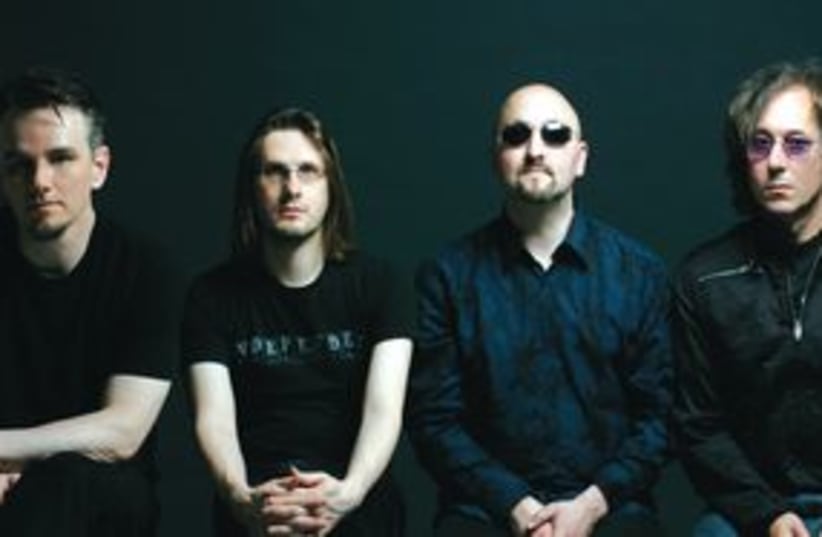
By DAVID BRINNPorcupine 311(photo credit: Andy Leff)
Considering that Steven Wilson loves being in Tel Aviv, it’s surprising that his world class, atmospheric rock group Porcupine Tree hasn’t performed here in almost 10 years.But the acclaimed British guitarist/singer, who given his druthers, would divide his time between London and Israel, isn’t the one deciding where the band plays.Which is why their upcoming July 7 show at the Tel Aviv Exhibition Grounds is their first since two wildly successful 2001 concerts cemented their reputation among Israeli music fans as one great live act.“Porcupine Tree is a band, and it’s not up to me where the band goes – it’s between the manager, our agent and the band as a whole,” said Wilson, speaking on the phone from England during a break in the band’s summer tour schedule, which had just seen them play a series of festivals in Europe.“As much as I would have loved to bring them to Israel in the last few years, with our hectic cycle of albums, and due to the fact that our production is quite expensive with video screens and a large crew, either the offer wasn’t there, or there wasn’t a convenient time. Or there was something going on, if you know what I mean, and one or more of the band members wasn’t keen to come. So, what should have been a year- or two- [year] break from Israel turned into 10.”What? The same Steven Wilson who calls Tel Aviv one of his favorite places, who rented an apartment here in 2006, and who formed a side band with his friend Aviv Geffen called Blackfield and released two albums with another on the way, isn’t able to convince his Porcupine Tree bandmates that Israel is the greatest place on Earth? As a matter of fact, no.“It’s very hypocritical of me, of course. But, there’s always that risk of cancellation. If the boat thing [the Gaza Flotilla] had happened this week instead of a month ago, who knows? The other guys don’t have personal attachments to Israel, but they are committed to doing the show, and we’re coming,” said Wilson, adding that the band had received numerous emails and appeals for them to cancel their upcoming show in Tel Aviv.“I can understand the pressure other artists who cancelled must have felt.We take the appeals seriously, but I’ve had to reconcile that with what I believe, from my experience in England, that the people of a country often differ intensely with what their government does.“Just as British citizens objected to Tony Blair and the invasion of Iraq, I get a sense that the Israeli people are upset about what’s going on. You forget living outside of a country that the actions of the government are not the actions of the people. Why penalize the people who live in Israel for the actions of their government or their army? It doesn’t achieve anything. It’s a cliché that music rises above it all, and it’s a cliché for a reason – it’s very often true.”WILSON HAS been riding on Porcupine Tree’s musical wave since 1987, when as a sideline to his main musical project, No-Man, he and a friend decided to make up a Pink Floydinspired fictional band, with an intricate back story and psychedelic, progressive- based music to prove their existence.The lark proved to be more enjoyable than his other musical endeavor, and within a couple years, Wilson had hand-picked a band to flesh out the fictional Porcupine Tree into an aural reality.“It’s one of those things – life surprises you when you least expect it.”Said Wilson. “Porcupine Tree started out as a bit of fun in the studio more than 20 years ago, when I had these so-called serious projects going on.And they all failed. I think this succeeded because it was purely about making music to please myself. It pleased other people too, and so it goes on.”With over a dozen albums to their credit featuring everything from complex song suites with odd instruments for progressive rock, like dulcimer and banjo, to sweeping instrumental epics and shorter, more conventional rockers, the only constant in Porcupine Tree’s career has been their challenging themselves to do something different every time.Their latest album, 2009’s The Incident, according to one reviewer “manages to incorporate bombast and melody (the sixth movement, which shares the album’s title), rock (“Octane Twisted”), Yes’ folky moments (“The Seance”), and Toollike grooves (“Circle of Manias”), before it all gently floats away on a cloud of fairy dust (“I Drive the Hearse”).” As proud as he is of the band’s recorded work, Wilson sounded almost cocky when talking about Porcupine Tree’s live shows.“We have one of the best shows in the world right now, and Porcupine Tree is one of the best live bands in the world right now. I’m the worst musician in the band – they’re amazing,” he said, referring to his bandmates, keyboardist Richard Barbieri, Gavin Harrison on guitar and bassist Colin Edwin.MAYBE THAT unexpected bravado has something to do with the personality shift that Wilson said he’s experienced by his ongoing relationship with Israel, a romance which began when Geffen met Wilson in 2000 and arranged for the band’s 2001 shows.The Israel that Wilson experienced – the sun, beaches, clubs and tumult of Tel Aviv – was unlike anything he had anticipated, and it prompted him to spend more and more time in the country, culminating in the renting of an apartment in Tel Aviv in 2006 in order to enable him and Geffen to work more frequently on Blackfield material.“To me, Israel is almost the antithesis of what I had grown up with. Being English, we’re polite and reserved, we don’t express our opinions, we’re very private people. Plus the weather is s**t, and I’ve never been a big fan of English women. In Israel, I found it all opposite. It’s friendly, there are beautiful women,” said Wilson.“There was a fire missing from my personality, an element missing, and when I started to spend more time in Israel, I became more forthright, more passionate and opinionated – in a good way and in a bad way. I think I was able to complete my personality by finding its Israeli side.”While Wilson’s stays here have become less frequent over the last few years, it’s mainly due to his work schedule and not because he’s any less enamored with the country.“I love Tel Aviv, but I’ve spent so much time on the road in the last year that I’ve hardly been home in England, let alone had any time to spend in Israel. I was only there a couple times, but next year, I hope to return for a longer period,” he said.WILSON’S CONNECTION to Israel remains strong, however. He and Geffen are currently writing and recording songs for Blackfield’s third album.And the musical workaholic recently mixed and played keyboards on Tel Aviv-based Middle Eastern metal band Orphaned Land’s album the The Never Ending Way of ORWarriOR. With his time limited and his commitments many, Wilson said that he’s looking for something specific beyond a pay check when he agrees to collaborate with another artist.“I’m looking to get something out of it. Artists will come to me to produce or mix and they look for what you can give them, but they don’t think that I’ll take anything away from the project myself, but I do,” he said.“When I get involved, it’s so I’ll learn something myself. With Orphaned Land, it was a completely new perspective. You won’t hear what they do anywhere else – that fusion of Western metal with a Middle Eastern sensibility – it’s completely unique, like nothing I ever heard before. That was an attraction. Plus, I can learn from a band like that – they were using instruments I had never seen before.”Kobi Farhi, the singer for Orphaned Land, said he was thrilled to work with Wilson, calling Porcupine Tree “one of the best progressive rock bands of today.”“I had met Steven in 2001 when they came here for the first time, and when we released our 2004 album Maboul, I sent him a copy. He was fascinated with the production and with how we combined progressive music with Arabic and Jewish elements,” said Farhi.“Steven really likes things that don’t sound like anything else, so we succeeded to reach that definition, and he agreed to help on our next album.“It was amazing to work with him.Our music is so full of layers, and so diverse, that you need someone to mix it properly – otherwise some of the stuff will get lost. And he knew exactly what to do.” Farhi will be front and center when Porcupine Tree takes the stage next week, a show that Wilson said he was looking forward to, not only because it will allow him to return to a place he loves, but because it’s providing a needed respite from the string of festivals the band is playing this summer.“Playing at festivals is sort of a balagan,” said Wilson, using the Hebrew vernacular for a big mess to describe the scene of dozens of artists as divergent as Stone Temple Pilots, Jack Johnson, and the Strokes providing non-stop entertainment for the hundreds of thousands of fans braving the elements of hot sun and cold rain.“It’s a battle; you don’t have your usual production, you’re often playing in daylight with very little atmosphere, and it’s usually to fans of other bands who quite possibly don’t know you,” he added. “And to top it off, the audience has usually been rained on at some point and they’re a bit miserable.So, it’s a bit of a struggle. But if you’re able to win over 20 percent of the crowd, it’s pretty good.” In the case of Porcupine Tree, it would be a good bet that the percentage would be considerably higher.
if(catID != 151){
var cont = `Take Israel home with the new Jerusalem Post Store