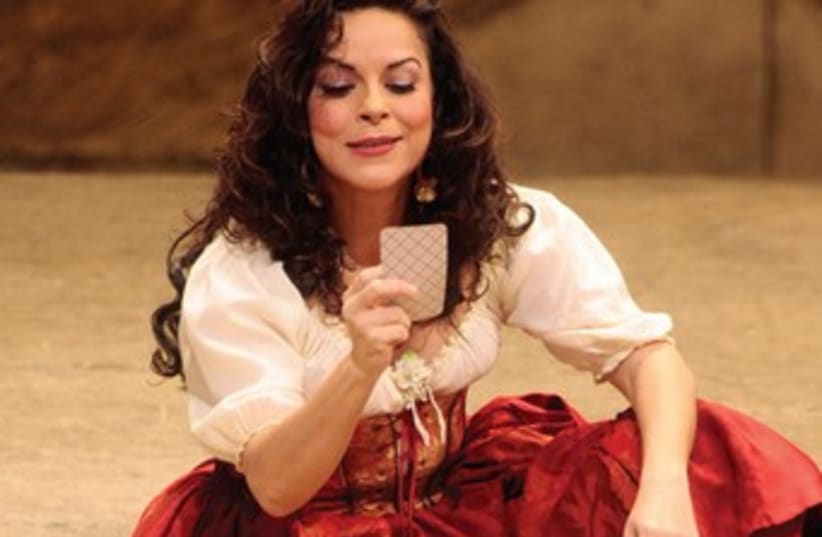
Venezuelan-born opera singer Nancy Fabiola Herrera is looking forward to singing under the stars as she performs the role of Carmen at Masada.
By BARRY DAVISVenezuelan-born opera singer(photo credit: Beatriz Schiller)
Carmen is, of course, one of the most popular operas around – and with good reason. It ticks most of the entertainment genre boxes – action, romance and comedy and, at the center of it all, there is an exotic, sensuous woman for whom men tend to fall hook, line and sinker. Add to that one of the most stirring locations in the world for staging Bizet’s work and you end up with what most marketing executives would term “a sexy product.” Nancy Fabiola Herrera is certainly looking forward to playing the central character in five performances at Masada, starting on Thursday.It is a role the Venezuelan-born opera singer has performed many times before, although she says it makes quite a difference singing under the stars rather than in the acoustically tighter confines of an indoor auditorium.“It is not the same to perform in closed space [as opposed to] an open space. You have microphones and the whole sound system has to be set up differently,” she notes.Even so, that does not directly impact on the style of delivery. “As professionals, opera singers perform in different conditions and we don’t relate to the presence of the microphones, we just get on with it. That is the most natural way to work.”Herrera arrived at Masada somewhat tired after a long journey but says her spirits and energies were lifted when she got a look at the venue.“I feel a special bond with Masada and this area. To see the full moon and the mountains and desert, that is really something special. The place is really magical. It is like being on a film set.”Considering that Herrera’s career, to date, has taken her to many of the world’s most glittering stages, including in New York, London, Berlin and Tokyo, that is quite a compliment for our desert outcrop site. Mind you, that doesn’t mean that absolutely everything in the garden is rosy.“It was a bit dusty and windy,” Herrera continues, “but I was really speechless when I saw everything at Masada.”Naturally, each production has its own challenges and considerations, one of which is the language in which the opera is performed.That involves such cardinal logistics as the intrinsic musicality of the language, as well as the singer’s own understanding of it.The fact that Carmen has a French libretto, and Herrera’s mother tongue is Spanish, comes into the performance equation.“French is not an easy language to sing in, because of the pronunciation. So, in such a case, the singer has to prepare themselves very well beforehand,” she explains. “It definitely helps to learn the language, and if you don’t know the language you have to put a lot of hard work into learning the pronunciation.”The challenge is even greater when a non-native speaker performs a work in its country of origin.“The French are very particular about that sort of thing,” adds Herrera. Still, if a singer has prior experience of a role that can give him or her a head start.“I have performed this role many times before and, yes, that helps. But no matter how many times I have performed Carmen I always take my time to review the pronunciation,” muses Herrera. “I have to make the words sound as close as possible to the way a native speaker would say them.”Herrera has sung the role of Carmen on quite a few occasions over the years and professes to having strong admiration for the character. So what keeps drawing her back to the opera? “One of the things is the music,” she says.“It is such a beautiful score. Bizet wrote so wonderfully for each character in the opera.” And then there is Herrera’s role.“Carmen is a gypsy, and I know gypsy women and dancers. The gypsies are a special community, and the women are very strong.”The latter epithet certainly applies to the opera’s central character.“Carmen represents a lot of things,” continues Herrera. “She defies lots of things in society, lives the moment, enjoys life and, if she doesn’t enjoy something, she stops it immediately. We can all learn a lot from that.”For Herrera, Carmen is something of a femme fatale, with a very pragmatic ethos.“She deals with things as they come. She can manipulate people, especially men, to get what she wants but she is also very compassionate. She is very strong-willed, but when she walks by people stare at her. She has charisma, she knows it and she takes full advantage of it.”That, says the Venezuelan, is a highly potent combination.“I have always been bewitched by her. We all learn things from the characters we play, and I have certainly learned something, about life and about myself, from this role.”Even with all those highly “marketable” assets, Carmen proved to be ahead of its time.It was first performed at the Opéra-Comique in Paris, on 3 March 1875, and was initially something of flop. The portrayal of proletarian life, immorality and lawlessness, and the tragic nature of the storyline, proved to be too much for the opera-going public of the time.The show’s first run extended to just 36 performances and, sadly, Bizet died in the middle of the run and thus did not live to see the opera eventually achieve success. It was revived in 1883 and has never looked back.At the end of the day, Herrera says the opera is about having a good time.“Carmen is such a fun role to play,” she exclaims. “You have to have fun and must not forget she is full of life, has a sense of humor, and is so playful. I try to be playful.”Carmen will be performed at Masada on June 7, 9, 10, 11 and 12. The first performance will also be transmitted live to three locations around the country, at Gan Hashlosha near Beit She’an, Netanya and Beersheba, free of charge. For more information: www.operamasada.com
if(catID != 151){
var cont = `Take Israel home with the new Jerusalem Post Store