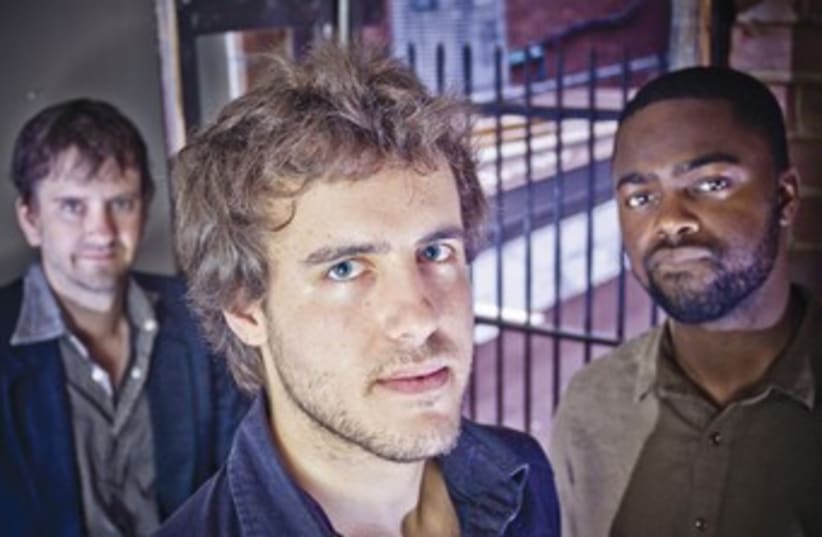
Having made a name for himself in New York’s jazz scene, Israeli guitarist Gilad Hekselman returns home to perform at the annual Red Sea Jazz Festival.
By BARRY DAVISGilad Hekselman (center) 370(photo credit: Derek Branscombe)
Considering his ascendancy in the global jazz world in recent years it is hard to believe that Gilad Hekselman has yet to appear at our preeminent jazz gathering, the annual Red Sea Jazz Festival in Eilat. But that will be redressed this time round, when the 29-year-old New York resident guitarist fronts a stellar band at Eilat Port on July 31 and August 1.Hekselman left these shores and headed Stateside eight years ago. During that time he has put out three well-received CDs. His last release, Hearts Wide Open, has attracted particularly high praise and Hekselman is now an established leading member of the New York scene and the global jazz circuit. And the next album is already in the works.His debut in Eilat will see Hekselman front a heavyweight quartet, featuring stellar saxophonist Mark Turner, longtime colleague drummer Marcus Gilmore and bassist Matt Brewer, who replaces Joe Martin, who played on the album but is unable to make the Eilat date.The guitarist says he has come a long way since moving to New York, and particularly since he took charge of his own artistic output.“I am always thinking about my music, and always writing,” he says. “I recently decided to take charge of producing my own albums. It gives me complete freedom to achieve the end result I really want.”Some musicians write with specific sidemen in mind. Hekselman likes to take a broader view with his writing.“I did think about Mark [Turner], but I know there are a lot of composers that do think about specific players at the writing stage, like Duke Ellington thought about his bands. But, with me, I start with a song. I sit at home, find a melody, which generally comes with the harmony too, and then the members of the band come into the picture. What is great about my band is that, when they get to play the score, it sounds even better that I imagined beforehand.”That’s not a bad position to be in at all.“Yes, I am lucky in that respect,” he says.In fact, it is probably far more about Hekselman’s talent and honed instrumental skills than about any four-leafed clover he might have hidden in his guitar case. The truth is that during his time in the Big Apple to date the Israeli has attracted bucketloads of praise from fans and fellow jazz artists alike, including from some of the veteran members of the fraternity, such as iconic septuagenarian trombonist Curtis Fuller.In the final analysis, Hekselman actually writes for the specific players who perform his music, and he says he feels blessed by the top-drawer talent he has managed to recruit for the project.“All the guys I have in my band are my favorites on their particular instruments. When I write music I write it for my ideal band so, I suppose, I do write for these guys, because they are my favorite musicians.”Naturally, it can help to have developed an understanding, over time, with your musical cohorts.“Marcus [Gilmore] and I have been playing together for around five years, and he is an essential part of my work, and integral to my sound,” Hekselman observes. “As soon as we started playing together it was clear to me that we have a special and interesting connection.”Mind you, there was some groundwork to set in place before the drummer and guitarist could entirely go with the flow.“I had to learn how to play with Marcus. Sometimes, in the middle of a solo I’d lose my place in the piece. But I learned how to listen to him and how to play with him. It was the same with Mark.”Hekselman singles out Turner with singular praise.“He was one of the musicians with the most individual sound out there in jazz today,” he declares.“On the other hand, when he comes to a band, he tries to see where he fits in with the others. Once someone asked Mark what he thinks about when he plays, and Mark said he always tries to make the band sound better. And he does that – even when he’s not playing and just standing to the side. He projects something special onto the other guys in the band.”Before leaving these shores Hekselman learned the ground rules of his craft at the Thelma Yellin High School of the Arts in Givatayim, with such teachers as Yossi Regev and the late Amit Golan. He first set out on his musical road on piano, but after three years he realized he should try his hand at something else.“I understood I wasn’t going to be a concert pianist,” he recalls, “so I moved to guitar.”It took a while for jazz to make it into his consciousness, and for several years Hekselman played in rock bands in and around Tel Aviv. Eventually, jazz became his musical direction and the rest is history.Above all, Hekselman says it is about emotion. “I listen to vocal jazz a lot. I always ask myself what really moves me, and the answer is always vocal jazz.”Some of that emotion will, no doubt, be on display in Eilat at the end of the month, with not a little polish and adventurous endeavor.For more information about the Red Sea Jazz Festival: www.redseajazzeilat.com
Related TagsRed Sea
if(catID != 151){
var cont = `Take Israel home with the new Jerusalem Post Store