Israel’s advanced economy is endangered by a rapidly growing Third World-like sector.
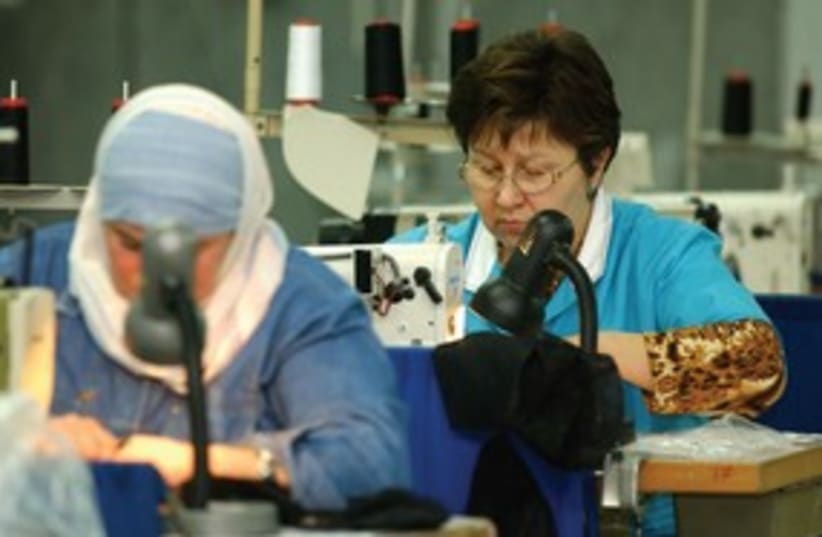
By ZVI HELLMANSweat shop workers-311(photo credit: Courtesy)This article was published in The Jerusalem Report on June 21, 2010. To subscribe to TheJerusalem Report, click here.TRAVEL IN CERTAIN CIRcles in the major cities of Israel nowadays, and you might be justified in feeling that things are going superbly well. In the high-tech start-ups, far more per capita than in any other country, top-notch engineers work on many of the most cutting edge projects in the world. If you want to speak to someone with a PhD – there are more here per capita than in any other country – just drop by an advanced seminar at the universities, now celebrating a decade in which five Israelis were awarded Nobel Prizes in the sciences, three times as many per capita as any other country. If you need a physician – yes, there are more of them here per capita than in any other country – you can take advantage of state-of-the-art medical treatments at acclaimed hospitals. Artists and intellectuals abound.The glittering new high-rises growing like mushrooms after the rain in Tel Aviv are evidence of the wealth being generated in a country that, almost alone in the West, registered positive economic expansion last year and is emerging from the world economic crisis in excellent financial shape.The future looks bright indeed. Or does it? If you take seriously the conclusions of the latest Annual State of the Nation Report issued by the Taub Center for Social Policy Studies in Jerusalem, an independent, nonpartisan, socioeconomic research institute, immensely troubling trends have been underway for decades that make Israel’s successes unsustainable, to the point of threatening its very survival.“We are a super First World country, pushing the envelope in so many directions,” says Dan Ben-David, a professor of public policy at Tel Aviv University and the executive director of the Taub Center. “On the other hand, we are carrying a huge weight around our neck.”BEN-DAVID POINTS OUT THAT it is wrong to look at Israel with what is essentially myopia, seeing only the First World side of the country. His research shows that the country is more akin to two or more countries stuck together, with segments of Third World characteristics coexisting with the First World sector.That might be tolerable if the Third World sector were slowly being eliminated, but Ben-David argues that the exact opposite is the case – the Third World elements are growing rapidly and will eventually overtake the country. An unsustainable burden is being placed on the fewer and fewer Israelis who can contribute effectively.Perhaps most perturbing in his view, given the urgency of the situation, is how few people are even aware of the problem, much less giving thought to how to enact vital reforms.“Even I find much of this surprising, especially the depth of the dichotomy and the speed of change that is underway, despite my familiarity with the subject,” Ben-David tells The Report. “The way things are going, we are going to have major sustainability problems in the future. That does not mean that the sky is going to fall one day, but we will reach a point of no return, almost without noticing it. The analogy I use is a boiling frog. Place a frog in a boiling pot of water, and it will leap out. But if you raise the temperature slowly and gradually, it will not feel that it is being cooked. That is what is happening to us. And I don’t want to be cooked.”AS BEN-DAVID RELATES HIS findings, one theme quickly emerges as paramount: education.One would expect that a country that has for the past two decades staked its economic wellbeing on exporting advanced technological products and services would place the highest possible emphasis on pushing forward education, from pre-school to post-doc. But the Taub Center’s studies show the opposite is happening.“We have lost our way,” says Ben-David.“In the 1960s, Israeli schoolchildren were first in international comparisons of educational achievements in mathematics, science and reading. Now we are consistently at, or near, the bottom.”Not only that, the education gaps between the best and worst pupils in Israel are the greatest amongst OECD countries. Does that mean that at least the top students can be counted on to attain super-achievements? No, replies Ben- David. “Our top 5 percent, our best and brightest, are at the bottom of the heap in the OECD [compared to the top 5 percent in other nations]. And this in a country filled with pride at its Nobel Prize winners.”The low attainments in primary and secondary education inevitably affect the quality of higher education, which is supposed to provide the basis for innovation. “As a professor,” reports Ben-David, “I give my university students reading assignments, which they refuse to read. They often don’t have the skills to write, either.”Investment in university faculties has been stalled for decades. “This was a poor country in the 1950s and 1960s, but it knew what it wanted – it grew seven major universities. Since then, we have not created one new major research university, not one, even though the population has doubled.” The situation in the existing universities is just as bad. Since 1973, the Technion has added a total of one faculty position. And that is the good news. The Hebrew University and Tel Aviv University now have 14 to 20 percent less faculty positions.“We are going in reverse,” concludes Ben-David sadly.For the past several decades, however, Israeli universities have produced cohorts of world-class academics, who have moved abroad, due to a lack of opportunities at home.The numbers are staggering: about 2 percent of British academics have moved to the United States. The comparable figure for France is nearly 3 percent, and over 4 percent for Italy.Canada, bordering the United States, has lost about 12.2 percent of its scholars to its larger neighbor. The numbers for Israel, however, are in another league altogether: for every 100 Israeli academics in Israeli universities, 24.9 are working in the United States.The potential win-win remedy for this state of affairs has been clear for a long time. By increasing the number of faculty positions available at universities, the growing population of Israeli students can benefit from smaller classes taught by returning world-class scholars, while the painful brain drain of creative minds from the country is reversed. But although the subject has been discussed for several years, little has been done on the ground to make it happen.ALL THAT SOUNDS BAD enough, but it describes only the situation in Ben-David’s “First World sector.” Since the founding of the state in 1948, the primary and secondary educational system has been divided into several independent school systems. The main educational track is the general Hebrew-instructional state school system, serving the secular Jewish population.There is also a Jewish religious state school system, an Arab-instruction state school system, for the Arab minority, and an independent haredi school system.The Arab school system has always lagged far behind the Jewish sector in educational attainment. The haredi school system, although required by law for many years to teach its pupils a core curriculum that includes instruction in mathematics, history, and English as a second language, regularly ignored the requirement, providing at best perfunctory classes in those subjects at the lowest possible level, and sometimes not teaching them at all. Male highschool students in the haredi system typically study religious texts exclusively.The net result, says Ben-David is that “we have the worst education in the Western world.In the past decade, even the non-haredi Jewish sector has performed at a low level compared to most of the First World. The Arab sector’s education is at Third World levels, and the haredi sector is not even learning what is taught in the Third World.”Poor education hampers a person’s job and earning potential for an entire lifetime. The statistical correlation between educational attainment and income, work productivity, and labor participation could hardly be tighter.Labor productivity in Israel has been slipping behind other advanced nations over the past three decades. Concomitant with that fall, the rate of increase in GDP per capita, compared to the United States, has also stalled.Rises in GDP per capita were so sharp in the 1950s and 1960s that by 1972, Israel was on track to reach US levels by the 1990s, but in the post-Yom Kippur War period the trend line took a turn for the worse.THE LOW LEVEL OF LABOR participation in Israel, which translates into a heavy burden on the working population to carry the non-working, has been noted for years. Among men aged 35 to 54, who are expected to be the main breadwinners in the economy, the average non-employment in the OECD is 11.9 percent. Israel is far at the bottom of the list, with 18.9 percent nonemployment.What skews the figures, as is well known, are the Arab and haredi sectors, with about 27 percent of Israeli Arab males and an astounding 65 percent of haredim in the 35 to 54 age group not working.Education plays a significant role here.Among Arab women without a high school degree, fewer than 10 percent work, compared with 70 percent of Arab women with degrees.Among Arab men and non-haredi Jewish men and women, 90 percent who have earned a high school degree work.Among haredi men, cultural attitudes that regard a man’s proper role as being a yeshiva student all his life hinder labor force participation.But the lack of a firm grounding in basic subjects in early schooling also has the effect of reducing the employment potential of products of the haredi school system who do choose to work as adults, whether or not they choose to leave the haredi sector. Woefully unprepared, they must either arduously make up for years of lost schooling on their own, or give up on higher education and work in low-skilled, lowpaying jobs.“Expecting someone to skip the most basic subjects in schooling, and then easily make up the lost gaps, is like cutting off someone’s leg and expecting him not to limp,” says Menashe Tsoref, recalling how hard he needed to struggle to be accepted to Haifa University and complete a degree there, after a childhood in the haredi school system. “We are talking about people in their twenties literally learning the ABCs for the first time.”A law passed in 2008 permitting haredi schools to continue to receive state funding without teaching any subjects from the core curriculum has sparked an appeal to the Supreme Court to invalidate the law. The petitioners essentially argue that the state has a responsibility to provide all the children of the country with the elementary education they need to survive economically as adults, and that just as compulsory education requires parents to send their children to school regardless of their beliefs, the fact that some haredi parents may oppose the teaching of a core curriculum to their children should not impede the state from teaching it to them for the sake of their future welfare. The petition was presented to the Supreme Court in mid-May. There has also been consideration of the possibility of a class action suit, on behalf of products of the haredi school system, demanding compensation for the state’s failure to insist on their receiving an education appropriate for a modern economy.“I took on this case because of what I saw my students go through,” says Yaacov Ben- Shemesh, who is one of the authors of the petition.Ben-Shemesh teaches law in the Ono Academic College in central Israel, which has a campus dedicated to haredi students. “I had students who were completely unprepared for their studies, because of the lack of knowledge of English, of basic quantitative reasoning, and even familiarity with the assumptions of modern democratic governance and law. They themselves complained about the difficulties they faced and blamed their school system.Unfortunately, not one of those who complained to me privately eventually agreed to join the petition to the Supreme Court – they are too afraid of paying a price for such a public statement, which itself points to deep problems.”THE MOST PERTURBING aspect of Ben-David’s prediction for the future is his reading of the trend lines. In 1960, only 15 percent of children entering primary school came from the Arab and haredi sectors. By the 1980s, that number had risen to 26 percent, growing further to 40 percent in 2000, and fully 48 percent in 2008.If the trends continue unabated, says Ben-David, by 2040, “78 percent of primary school enrollment will be haredi and Arab.Look at what happened over the past 20 to 30 years, and consider what the country will look like in another 20 to 30 years. That is simply unsustainable. We will reach a point of no return, when we will not be able to fund the growing non-working population.At that point, the non-working population will have no choice but to work – but they will not have the tools to deal with a modern economy. The result will be that this country will not be able to compete or survive economically.Given the neighborhood we live in, that means we will not survive at all.”Not surprisingly, he urges education reform, which must go beyond throwing money at the issue – Israel, he notes, was until recently spending more per pupil than most OECD countries. He calls for higher targets, longer school days, enrichment programs, reevaluation of teaching methods and, of course, a core curriculum. “Insisting on a core curriculum means deciding what sort of a country we want,” he says.“I have shown these facts and figures to every prime minister since Ehud Barak [in 1999],” continues Ben-David. “The leadership is surprised every time I explain the trends to them. Many of them remember when they were in school, back when the system was still excellent, and they are not aware of the changes that have occurred, and how fast they are taking place.”Ben-David blames a dysfunctional political system for most of the inaction on the matter so far. “The prime minister here appoints government ministers who know nothing about the ministries they head,” he says angrily, “and as if that were not enough, most of the time they want to replace the prime minister, so they have incentives to work against him, rather than with him. And at this point, one-third of the Knesset members are government ministers, so there is no real separation of powers.”Perhaps surprisingly, Ben-David had an opportunity to be a political player himself, but chose to walk away from a Knesset seat that was his for the taking. “Ariel Sharon was so concerned by what I showed him on the subject that he invited me to join his political party, Kadima, to deal with the issues. But then Sharon had a stroke, Ehud Olmert took over, the priorities changed, and I was moved down the party list, and so did not enter the Knesset after the 2006 elections.“In 2008, a Kadima seat in the Knesset was vacated, and I was next on the list. But by then I was appointed head of the Taub Center, and I felt I would have more impact in that position than as a back bencher in the Knesset for a short period of time.”BUT CAN POLITICAL WILL really overcome deeply entrenched cultural factors leading to low labor force participation? Ben-David argues that it can.“The cultural factors are not as entrenched as they seem, even to the haredim themselves,” he says. “Today, about 65 percent of haredim aged 45 to 54 do not work for a living. Thirty years ago, that number was only 20 percent.“Haredi men in countries outside of Israel, such as the US and the UK, do work.So it is wrong to say it is a cultural matter, or that ‘it has always been this way.’ It is in fact a very recent phenomenon. And when they become the majority, there will be no choice – they will need to produce doctors and engineers. That does not mean they need to be non-religious, not at all. The more they become familiar with the modern workplace, they will discover it is not so bad, and that they can maintain their religion while being part of a modern economy.”Ben-Shemesh broadly agrees. “There are historic precedents for the haredi world learning secular subjects, and it can accommodate it,” he says. “It cannot, and should not, be done by coercion. But the law must be clear that a core curriculum is a requirement.Once that is established, a committee with haredi representatives can be formed to determine how secular subjects can be introduced smoothly into the haredi school system.”Tsoref, familiar with the haredi system from the inside, warns that any attempt at coercion will only boomerang. “Push them, and they will push back,” he says. “But the right approach can make a change. There are already some haredi leaders who recognize the importance of teaching some secular subjects, such as mathematics and English.”Ben-David insists that, despite all his gloomy warnings, there is plenty of reason to be optimistic. “Europe and other parts of the world are aging. We are a young country, and that is an advantage,” he says. “We are about the size of metropolitan Philadelphia. What we call peripheral areas here would be considered suburbs in other countries, if we could just get our act together in terms of infrastructure. And in contrast to South America or South Asia, there is no need to import skills and knowledge. It is all here, but it is not filtering down.“We are the anomaly of the Western world.Few look as bad as we do, in terms of poverty, inequality, and poor education. On the other hand, few look as good as we do, in the areas in which we excel – we have the best universities outside the United States, some of the world’s best engineers and physicians. We have everything we need to outperform the world. If we just give our kids the education they deserve, the sky is the limit. We can have the highest income in the world. So something has to give. Either we get rid of our Third World sector, or we get rid of our First World Sector. It’s our choice.”
if(catID != 151){
var cont = `Take Israel home with the new Jerusalem Post Store