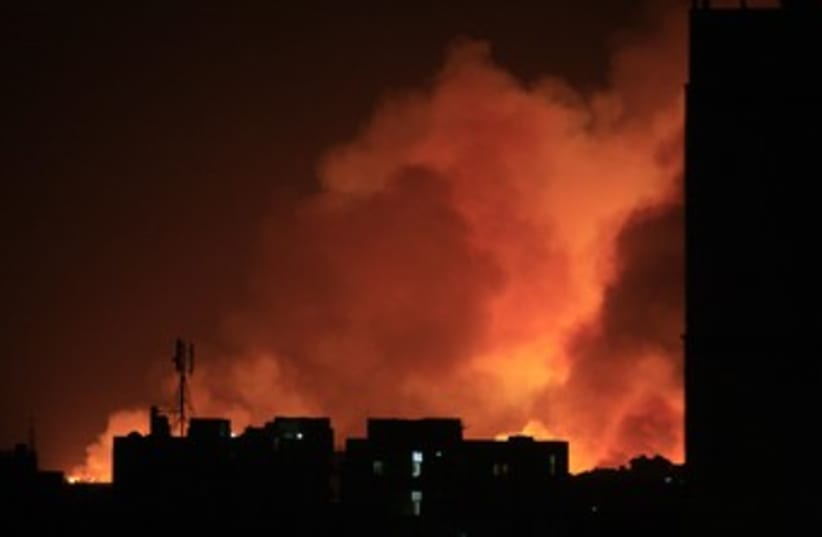
Israel’s alleged bombing of Khartoum plant may be a warning to Tehran that it could be the next target.
By YAAKOV LAPPINKhartoum arms fire R370(photo credit: REUTERS/Stringer )
Amid the latest escalation between Hamas and Israel this week, a covert strike that is far more strategically significant may have occurred.Israel has remained officially silent over Sudanese accusations that Jerusalem carried out an air strike on a weapons factory near Khartoum, but tellingly, Jerusalem has not taken the trouble to deny the allegations either.If Israeli fighter jets did fly 1,900 km. to the Sudanese capital to bomb a rocket factory, the move could represent a major blow to Iranian efforts to smuggle arms into Gaza, and contain a demonstrable threat to Tehran of what may occur if it continues to develop its nuclear weapons program.In 2008, defense ministers from Sudan and Iran signed a military cooperation pact and vowed to advance “defensive ties” between them. The two countries presented the move as a step to promote regional peace and stability. It likely had the exact opposite effect.Sudan has been a central transit point for Iranian arms headed to the Gaza Strip for several years. According to open source reports, officials from the Iranian Revolutionary Guard have loaded long-range rockets and an array of sophisticated missiles onto ships at Iran’s Port Bandar Abbas, from where ships have sailed to Sudan. From there, the weapons travel in land convoys into Egypt, and are then smuggled into Gaza via tunnels from Sinai.This long route has presented Israel with opportunities to intercept the weapons.In 2011, for example, at least two land convoys believed to be carrying Iranian weapons for Gaza were reportedly bombed from the air in eastern Sudan. Similarly, ships carrying Iranian arms to Gaza have been intercepted by the Israel Navy.In light of this vulnerability, Iran may well have decided to construct a rocket factory in the Sudanese capital, shortening the distance between the arms’ manufacturing center and their target destination. The Iranians may have also mistakenly believed that Israel is unlikely to direct action in a foreign capital.If this was indeed the case, Sudan agreed to have weapons produced on its territory that are later used to target Israeli civilians in the South.The reported bombing appears to be the latest in an ongoing and gradually escalating Israeli-Iranian covert war, which spans arenas across the Middle East and beyond. In this context, an air strike that allegedly involved Israeli fighter jets flying 1,900 km. and back would also send an unmistakable signal to Tehran.With Iran’s nuclear sites roughly the same distance from Israel, an air strike in Khartoum would demonstrate Israel’s long-range capabilities, and make the military threat on the table that much more tangible.At the same time, striking a single target in a country with minimal air defenses cannot be compared to the operational challenges inherent in striking multiple targets fortified by vigorous air defenses.
if(catID != 151){
var cont = `Take Israel home with the new Jerusalem Post Store