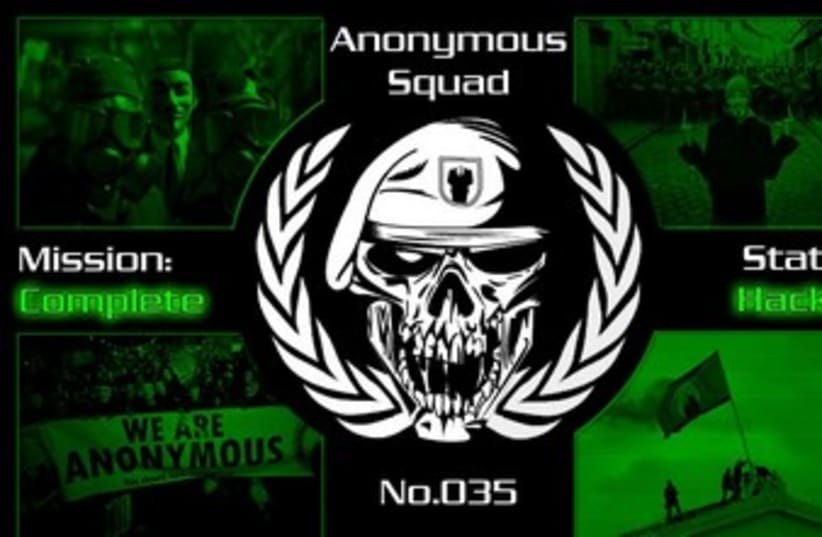
Hacker collective launches wide-scale attack, named "#OpIsrael," on hundreds of Israeli websites in protest of Gaza operation.
By MICHAEL OMER-MANAnonymous 370(photo credit: Screen capture)
Hacker collective Anonymous launched a wide-scale attack, named #OpIsrael, on hundreds of Israeli websites late Friday night in protest of Operation Pillar of Defense in the Gaza Strip.The attacks ranged from prominent targets such as the Foreign Ministry to tourism companies and locksmiths.One of the most high-profile targets of the attack was the Foreign Ministry’s international development program, Mashav. In an announcement on Twitter, Anonymous claimed to have tampered with the website’s internal database.The website was inaccessible at the time of this report and an error message referenced a database error.The mass hacking attack follows a press release put out by the collective on Wednesday, in which it said: “For far too long, Anonymous has stood by with the rest of the world and watched in despair the barbaric, brutal and despicable treatment of the Palestinian people in the so called ‘Occupied Territories’ by the Israel Defense Forces.Tweets announcing websites that it targeted were peppered with hashtags #OpIsrael and #GazaUnderAttack.Click for full JPost coverageA statement published Friday stated: “The reasons for Anonymous intervention through #OpIsrael should be abundantly clear: What is happening in Palestine is oppression. They have no navy, no army, or air force. There is no war in Gaza.”The collective also attempted to preempt any allegations of anti-Semitism, writing: “Anonymous has not used any anti-Semitic language during our campaign.Nor have we vocalized any support for Palestinian military operations or resistance groups.”The attack’s goals, the statement continued, was to “protect the rights of the Palestinian people.”While a list posted online of the operation’s targets included nearly 700 websites, most of them were subdomains of the same site and a random sampling proved that a number of the sites listed were still online and appeared untampered with.Among the other targets were the websites of the Kadima Party, Bank of Jerusalem, a jeep tour company, a locksmith company, allbiz.co.il, fashion accessory companies and even a blog.Most of the sites were simply unavailable but others displayed pro-Palestinian images and messages.One site, whose front page was replaced with an image of a man wearing a Palestinian keffiyeh, displayed a message reading: “This attack is in response to the Injustice against the Palestinian people.”Anonymous also claimed to have taken down the Tel Aviv Municipality’s website, which along with its normal functions is also providing residents with directions to bomb shelters. The municipality’s website was accessible at the time of this report and did not appear to have been tampered with.
if(catID != 151){
var cont = `Take Israel home with the new Jerusalem Post Store