Netanyahu says seized arms ship "Victoria" justifies naval blockade on Gaza; cargo includes shells made in Israel, sold to Iran in 1970s.
By YAAKOV KATZnetanyahu anti-ship missile_311(photo credit: Avi Ohayon / GPO)
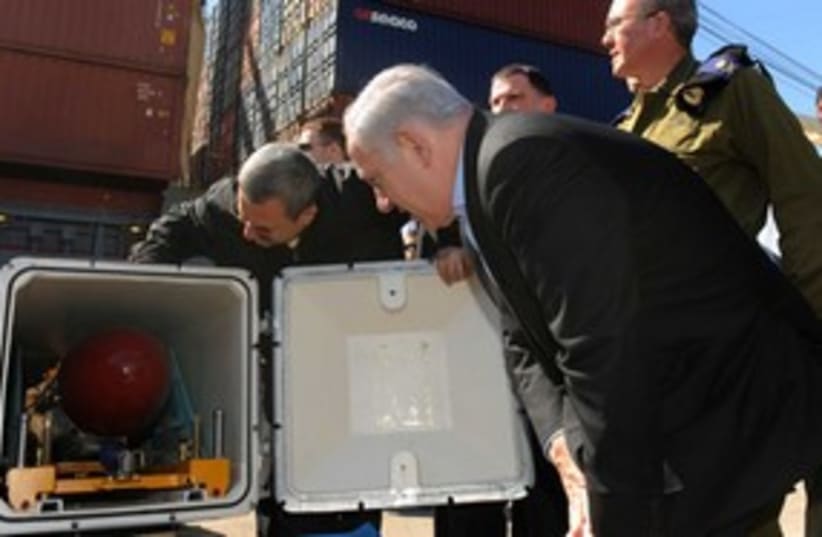
Six advanced Iranian-made anti-ship missiles, two radar systems and close to 50 tons of assorted weaponry were put on display on Wednesday after being discovered inside three containers aboard the German-owned Victoria cargo ship.The Victoria was seized by Israeli naval commandos early Tuesday morning as it sailed from Turkey to Egypt, about 320 kilometers from Israel’s coast.RELATED:IDF releases list of weapons on the 'Victoria'Iran on arms seizure: 'Zionist regime is full of lies'Arms ship docks in Ashdod; IDF to display contentsOn Wednesday, Prime Minister Binyamin Netanyahu, Defense Minister Ehud Barak and IDF Chief of General Staff Lt.-Gen. Benny Gantz visited the Ashdod Port and inspected the arms cache.“To all those who questioned and attacked and criticized Israel for stopping Gazabound ships in order to check them, here is the answer,” Netanyahu said, with the anti-ship radar-guided missiles, artillery rounds and assault-rifle ammunition laid out behind him.Netanyahu said that Iran’s attempt to smuggle arms to Hamas in the Gaza Strip was a demonstration of the “axis of terror” that Israel needs to confront in the Middle East.“Every day there are efforts by Iran, Syria and terrorist organizations to smuggle weapons to Hezbollah and Hamas,” Netanyahu said.“There is an axis of terror in our region, and we have to confront it if we want to prevent terrorism and create a chance for peace.“The weaponry discovered onboard the Victoria proves why Israel needed to prevent ships from sailing freely into the Gaza Strip.”The containers filled with weaponry included six C-704 anti-ship missiles made in Iran with Chinese components, and two radar control systems manufactured by Kelvin Hughes, a British company.In addition, the ship contained thousands of mortar shells designed according to specifications sold to Iran by the Israeli company Soltam in the 1970s, when Israel and Iran were allies.The Chinese-designed C- 704s could have enabled Palestinians in Gaza to undermine the navy’s operational freedom along the Gaza coast.Hezbollah used a similar missile to attack an Israeli Sa’ar 5- class missile ship during the Second Lebanon War in 2006.Iran put stickers that said “Made in Britain” on all of the crates, in an attempt to deceive whoever inspected the containers.“We prevented something dangerous,” Barak said. “This is weaponry that could have impacted our navy ships and gas fields.“I have no doubt that the other side will continue trying, but we will continue fighting,” Barak added.Gantz said the IDF “will continue operating in the air, on land and sea. The war continues all the time. It doesn’t stop for a moment.”OC Navy Adm. Eliezer Marom said the Navy will “defend Israeli shores and Israeli citizens with determination.The members of the axis of evil need to understand that this type of smuggling will not succeed.”Asked about the Victoria, a spokesman for the Israeli Embassy in Berlin said that the “German authorities were updated by the ambassador and are fully coordinating.”Regarding the phenomenon of German ships being used to transport Iranian weapons, the spokesman declined to comment.The spokesman said “It is good question,” when asked why Germany had failed to implement unilateral sanctions to stop the leasing of German ships involved in circumventing sanctions.Two previous German-owned ships, the Hansa India and Francop, were involved in transporting Iranian weapons in late 2009. Benjamin Weinthal contributed to this report from Berlin.
if(catID != 151){
var cont = `Take Israel home with the new Jerusalem Post Store