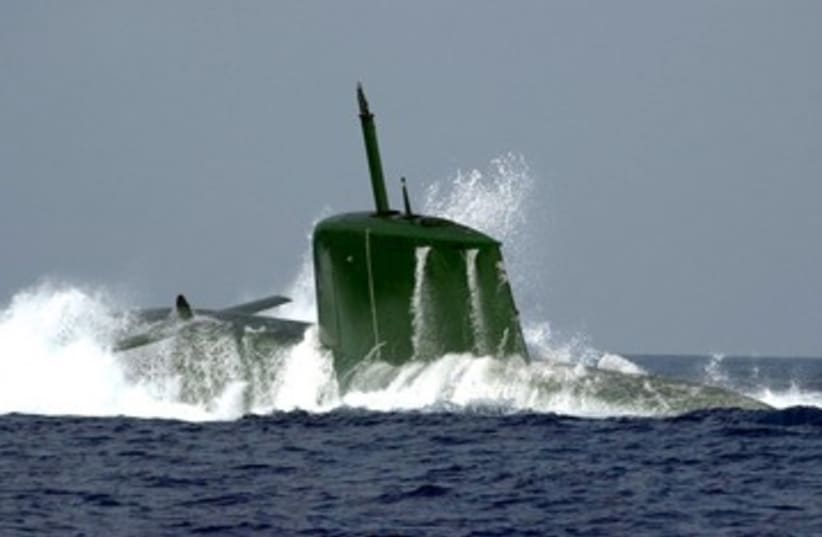
Defense delegation arrives in Germany ahead of delivery of Dolphin-class sub, rumored to be capable of carrying nukes.
By YAAKOV KATZIsraeli Navy Dolphin-class submarine 390 (R)(photo credit: REUTERS/Handout)
A defense delegation arrived in Germany on Wednesday ahead of the planned delivery of Israel’s fourth Dolphin-class submarine, widely rumored to be capable of carrying nuclear weapons.Led by Defense Ministry director-general Udi Shani, the delegation met with senior German defense officials and was scheduled to visit the shipyard where the submarine is being built. It is expected to arrive in Israel in the coming months.Israel’s submarines are the military’s most expensive platform and are often referred to as the country’s second-strike doomsday weapon due to their reported ability to fire cruise missiles tipped with nuclear warheads.The three Dolphin-class submarines in the navy’s fleet are called Dolphin, Leviathan and Tekuma and are believed to be some of the most advanced diesel-electric submarines in the world.Germany donated the first two submarines after the First Gulf War and split the cost of the third with Israel. The three submarines currently in the navy’s possession employ a diesel-electric propulsion system, which requires them to resurface frequently to recharge their batteries.The submarines under construction will be fitted with a new propulsion system combining a conventional diesel lead-acid battery system and an air-independent propulsion system used for slow, silent cruising, with fuel cells for oxygen and hydrogen storage.The submarine that will be delivered is one of two which Israel ordered following the Second Lebanon War in 2006.In March, Israel signed a contract for a sixth submarine, meaning that by the end of the decade the navy will have doubled its fleet. The German government heavily subsidized both recent deals.
Related Tagsdolphin
if(catID != 151){
var cont = `Take Israel home with the new Jerusalem Post Store