'IDF preparing for more violence on Lebanon border'
Official tells AP more demonstrations expected on northern border ahead of Six Day War anniversary; will allow protests, but "red lines" set.
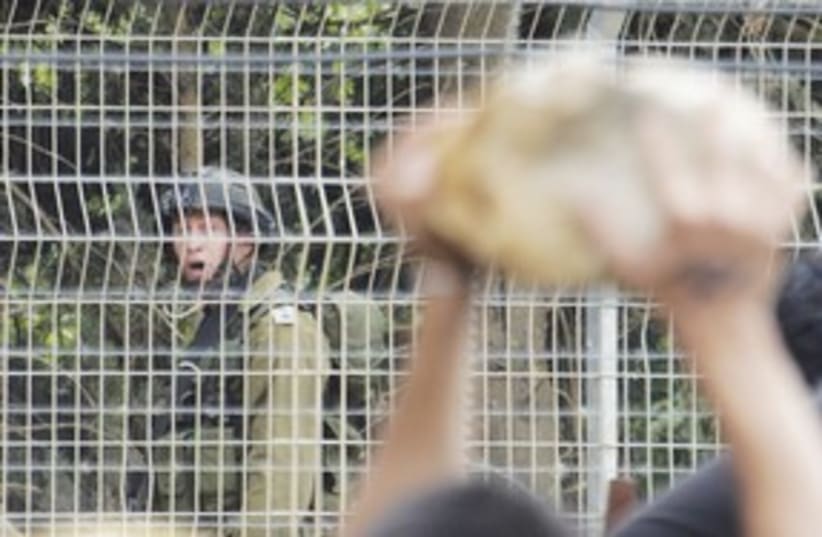
By JPOST.COM STAFFIDF officer at Nakba Day rally 311(photo credit: REUTERS)
The IDF is preparing for additional protests along the Lebanese border ahead of the Six Day War anniversary next week, a senior military official told the Associated Press.Earlier this month, on the day that Palestinians commemorate Nakba Day, a dozen people were killed in demonstrations along the Lebanese and Syrian borders by both IDF and Lebanese troops attempting to disperse the demonstrations and prevent border breaches.RELATED:HRW demands Israel investigate 'Nakba Day' deathsPalestinian group calls for more 'Nakba Day' style riots According to the Monday report, the IDF is aiming to avoid civilian casualties but has set several "red lines," meaning it would not allow any breaches of the border or allow Palestinians to enter West Bank settlements.Troops, he added, would refrain from reacting to non-violent demonstrations, including those near settlements, but that it would act in life threatening situations, the Associated Press reported.In addition, IDF soldiers deployed on the borders will be better equipped to deal with protesters, the official told AP. Crowd dispersal tools will be deployed in the units, including rubber bullets and water cannons, according to the report.The IDF spokesperson did not have a comment at the time of this report.On Sunday, Israel Police Insp.-Gen. Yochanan Danino said that police are preparing for the possibility of large scale riots in September following an expected declaration of statehood by Palestinians.“The Israel Police is currently preparing for September, and for the possibility that various declarations regarding a nonviolent-civil struggle against the background of a declaration of a Palestinian state will end up becoming a violent conflict, and turn into wide-scale rioting,” Danino said.The police commissioner added that his forces faced a “new reality” due to areas of friction between populations, attempts to infiltrate the borders, and “calls on Internet sites and Facebook to violate Israel’s sovereignty, as well as the the situation that the whole of the Middle East is experiencing during these days.”Yaakov Lappin contributed to this report.
if(catID != 151){
var cont = `Take Israel home with the new Jerusalem Post Store