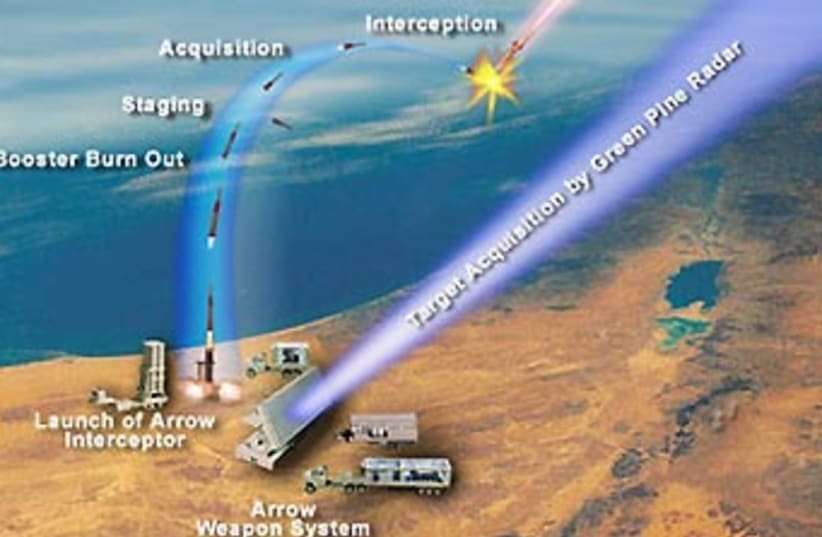
New Arrow missile interceptor is designed to shoot down Iranian Shihab 3 missiles, other long-range projectiles.
By YAAKOV LAPPINArrow US diagram(photo credit: Courtesy)
The Ministry of Defense carried out its first successful test of the Arrow 3 missile defense interceptor on Monday morning, firing it into space from a coastal military launching pad in central Israel.Set to become operational in around 2016, the Arrow 3 missile defense system operates in space, traveling at twice the speed of a tank shell to leave the atmosphere. It is designed to seek and destroy Iranian Shihab 3 missiles, as well as other long-range projectiles.A senior defense source said the interceptor took off at around 8 a.m. on Monday morning over the Mediterranean Sea. "It obtained hypersonic speed, and reached an altitude of 100 kilometers, entering space. It followed various objects, such as stars, and gained further altitude. Its engine stopped after six minutes," the source said.The test was led by technicians from the Israel Aerospace Industries, together with a team from the US Department of Defense's Missile Defense Agency. The effort is being coordinated by the Ministry of Defense's Israel Missile Defense Organization."The Israeli and American teams congratulated one another warmly," the source said.Defense Minister Ehud Barak congratulated those involved in the test, saying, "This is an important milestone for the state of Israel's multi-layered defense system, which includes Iron Dome, David's Sling, Arrow 2 and Arrow 3."Once it breaks free of the Earth's atmosphere, the interceptor breaks off from its launching missile, and turns into a space vehicle that carries out several swift maneuvers as it locks on to its target, before lunging directly at the incoming projectile for a head-on collision.Video: Archive footage.The test was designed to examine the Arrow 3's fly-out capablities, though no dummy missile was intercepted.Weighing less half of the Arrow 2 missile, the Arrow 3 creates an additional missile defense layer in space. Together with the Arrow 2 system, Arrow 3 gives the military two to three opportunities to intercept long-range missiles.The Arrow 3 does not need to know the exact location of the incoming missile when it takes off to intercept it. Once in space, it locates the target rapidly.US funding assistance is crucial for the development of the project.The US has earmarked 250 million dollars for four Arrow 3 batteries, and is set to examine a request for four more batteries at a cost of 680 million dollars. Future batteries are expected to hold more interceptors, making them more expensive than the first batch.The US gave Israel 211 million dollars for development of the Arrow 3 system in 2012, and will transfer 269 million dollars in 2013."We are in arms race. We hope to be one step ahead, technologically," a defense source said.Israel is working to create a multi-layered missile defense shield, consisting of the Arrow 3 at the outer perimeter, followed by Arrow 2, which stops ballistic missiles in the upper atmosphere. Lower down, the David's Sling (also known as Magic Wand) system, still under development, is designed to stop intermediate rockets and missiles, and the Iron Dome is in place to intercept short-range and medium-range rockets.
if(catID != 151){
var cont = `Take Israel home with the new Jerusalem Post Store