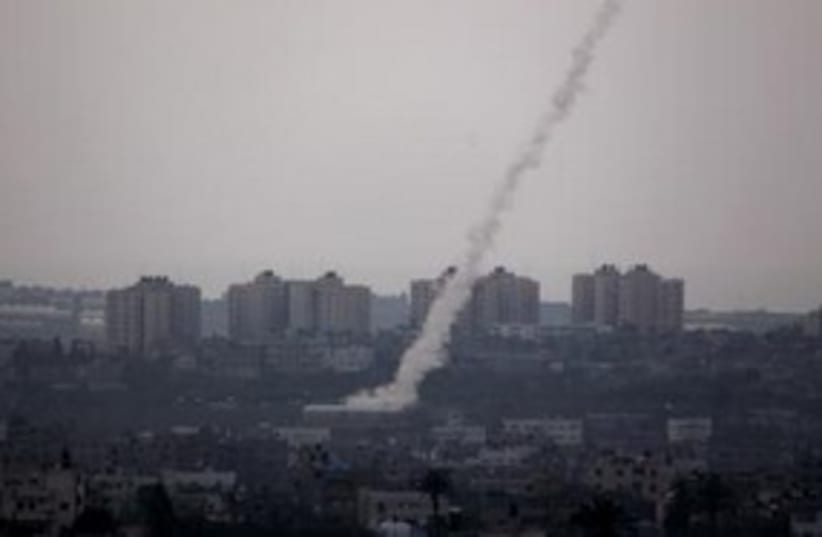
Hamas renews rocket fire: Kassam explodes near Ashkelon
No injuries or damage reported; attack comes amid talks of de-escalation in violence between Hamas and IDF in South; 13 rockets, mortars in total launched from Gaza in latest of attacks.
By JPOST.COM STAFF, HERB KEINONKassam rocket being fired from Gaza Strip 311 (R)(photo credit: REUTERS/Darren Whiteside)
A Kassam rocket fired from Gaza on Sunday exploded in an open area in the Ashkelon Coast Regional Council, but no injuries or damage were reported. The rocket fire comes after talks Sunday of a deescalation in violence between Israel and Hamas.However, as the situation in the South seemed to quiet down, the security cabinet earlier in the day empowered the IDF to "continue acting against terrorist elements in order to stop the firing on Israel and return quiet and routine to the south."RELATED:Iron Dome works in combat, intercepts Katyusha rocketIDF to move Iron Dome to Gush Dan region in weeksThe security cabinet met following the weekly cabinet meeting and was briefed on the situation in and around Gaza over the last few days.Prime Minister Binyamin Netanyahu, who went to visit an Iron Dome counter-rocket defense system in Ashkelon after the security cabinet, said it was Israel's intent that quiet return to the south. "I hope that is also Hamas' intention. If that is its intent, then the quiet will return. If Hamas increases its attacks, it will feel the might of our response, which will be much, much harder."The IDF, Netanyahu said, dealt Hamas painful blows following its "criminal attacks" on Israel. "There is no state that would be willing to absorb the intentional firing of an anti-tank missile on a school bus, to say nothing of criminal attacks on civilians. And Israel is certainly not willing to tolerate this"Netanyahu praised the Iron Dome system, those who developed it and operate it, saying it was a "very impressive technological feat." At the same time, he said, it was necessary to understand that it was impossible, even with all the technological developments, to protect every house and installation in the country."We can do a lot more, Netanyahu said, "but in the final analysis our true defense is a combination of defensive capabilities with deterrent offensive capabilities."In addition to empowering the IDF to do what it takes to bring down the attacks from Gaza, the security cabinet, according to a statement put out after the meeting, approved a large scale national homeland security drill. The message that the government was trying to send with this announcement, one government official said, was that it was taking all measures – offensive and defensive – to protect the country's civilians.Netanyahu visited Ashkelon along with Defense Minister Ehud Barak who said at the weekly cabinet meeting that Israel holds Hamas responsible for everything that happens in Gaza, and that it did not differentiate between Hamas' political and military echelons – a reference to reports that Hamas' political echelon was opposed to the attacks that were carried out by the group's military arm.
if(catID != 151){
var cont = `Take Israel home with the new Jerusalem Post Store