Israel knew that it could expect rockets when it made the decision to assassinate the leader of the PRC.
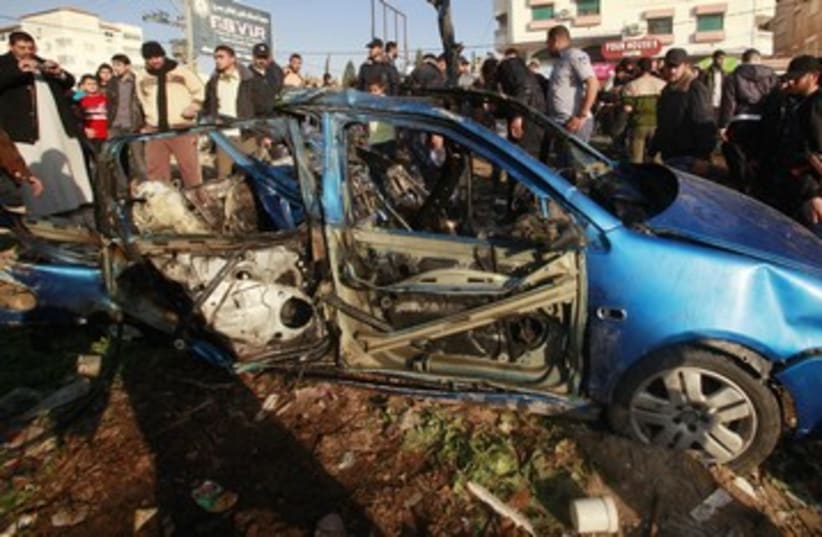
By YAAKOV KATZPalestinians look at the remains of exploded vehicle 390 R(photo credit: REUTERS)
When the IDF decided on Friday afternoon to assassinate the leader of the Popular Resistance Committees in the Gaza Strip, it knew what it was getting itself into.Assessments ahead of the decision to bomb the car carrying Zuhair Qaisi predicted that around 100 rockets could be fired into Israel during each day of the round of violence expected to erupt. This was a price the government felt it was capable of paying.In the decision to recommend Qaisi’s assassination, the IDF was basically implementing the lessons it had learned from the August attack along the border with Egypt.Then too, Israel knew of PRC plans to launch an attack along the border, but refrained from attacking the terrorist group’s leadership until immediately after the attack was carried out. The thinking then was that a targeted killing before the attack – during which eight Israelis were killed – would lead to a definite escalation and that maybe there was a different way to thwart the attack from Sinai.This time, the IDF decided not to take any chances. Qaisi was believed to be planning another attack against Israel from Sinai and the military was not willing to rely on its intelligence apparatuses and patrols along the border in stopping it. This time, it decided to try and thwart the attack before it took place.Starting a war is easy though. The difficult part is ending it.In this regard, the IDF did not seem on Saturday to be in a major hurry to do so and it was instead more focused on hurting the PRC and Islamic Jihad – responsible for the firing of around 100 rockets and mortars into Israel – than it was in stopping the violence.There are a number of reasons. Firstly, the IDF hopes that the assassination will prevent the attack along Israel’s border with Egypt.Secondly, there are three Iron Dome rocket-defense batteries that have been deployed in Beersheba, Ashdod and Ashkelon and have achieved a record-high 90 percent interception success rate over the weekend.And lastly, the IDF is using this as an opportunity to do some “maintenance work” in Gaza and to mow the lawn, so to speak, with regard to terrorism, with the main goal of boosting its deterrence and postponing the next round of violence for as long as possible.This is essentially the situation in the Gaza Strip since Operation Cast Lead ended in January 2009.Every few months, something happens, setting off a round of violence that usually lasts a few days until it suddenly ends just like it began. Once it is an antitank missile attack against an Israeli school bus and the next time a targeted killing of a top terrorist.Either way, the scenario is pretty much played out the same way. The main difference today is that Hamas is completely uninvolved in the sense that its operatives are not firing rockets into Israel. On the other hand, Israel does believe that Hamas could be doing more to stop the fire into Israel.This way, Hamas sends a double message to Israel. By not actively attacking Israel, it is demonstrating its desire for quiet and stability, which it wants in order to solidify its rule while at the same time warm up to the new government in Egypt.The other message is more difficult to decipher.Not stopping the other groups’ rocket attacks could be the result of a Hamas understanding that it needs to let the Gaza terrorists blow off some steam every once in a while – particularly groups like Islamic Jihad and the PRC, which it does not completely control.On the other hand, the fact that these groups are continuing to fire rockets into Israel could be perceived as a Hamas weakness, meaning that it does not have the ability to stop Islamic Jihad or the PRC.Both of these groups have been building up impressive military capabilities – some even greater than Hamas’s – and pose a direct challenge to Hamas’s rule over the Gaza Strip. A direct confrontation with them is not something that Hamas wants either, even at the price of several days of Israeli air strikes.Click here for special JPost coverage
if(catID != 151){
var cont = `Take Israel home with the new Jerusalem Post Store