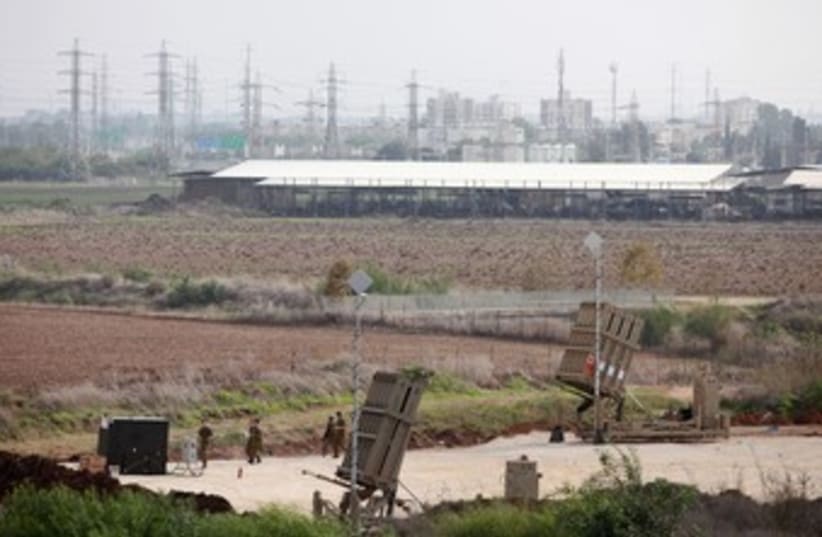
Since being deployed 10 days ago, the battery intercepted several Fajr-5 and M75 long-range rockets.
By YAAKOV LAPPINiron dome in tlv 19-1-12-8, 370 (photo credit: Marc Israel Sellem)
Air defense conscripts are set to replace reservists at the hastily deployed fifth Iron Dome battery, which is protecting the greater Tel Aviv metropolitan area.Since being deployed 10 days ago, the battery intercepted several Fajr-5 and M75 long-range rockets fired at central Israel from Gaza in the course of the recent confrontation with Hamas. The IAF is preparing to receive more Iron Dome batteries soon, said Col. Zvika Haimovitch, commander of the Air Defense Command.“We’re shortening the time frame it takes to get the batteries deployed, in order to adjust ourselves to the operational reality, which is changing before our eyes,” Haimovitch said.During the conflict, the system successfully shot down 85 percent of incoming enemy rockets directed at populated areas. It could also be deployed in the North to deal with Hezbollah’s short-range and some medium-range rockets.“Iron Dome is just one component of a whole puzzle of systems, like the Arrow [anti-ballistic missile system], which operates higher up,” Haimovitch said. “In the not-too-distant future, we will also have David’s Sling.”The David’s Sling defense system, designed to stop long-range rockets and cruise missiles, is designed to cope with Hezbollah’s arsenal of projectiles, and was successfully tested this week in the South. In the test, a David’s Sling battery stationed in southern Israel fired a two-stage interceptor missile and stopped an incoming missile.The system is designed to fill the gap between Iron Dome’s short-range protection and the Arrow 2 long-range ballistic missile defense program.
if(catID != 151){
var cont = `Take Israel home with the new Jerusalem Post Store