Unique program creates counter-terror commandos
12/05/2012 02:39
Man who spends seven months getting soldiers ready for special ops in West Bank tells ‘Post’ about training regime.
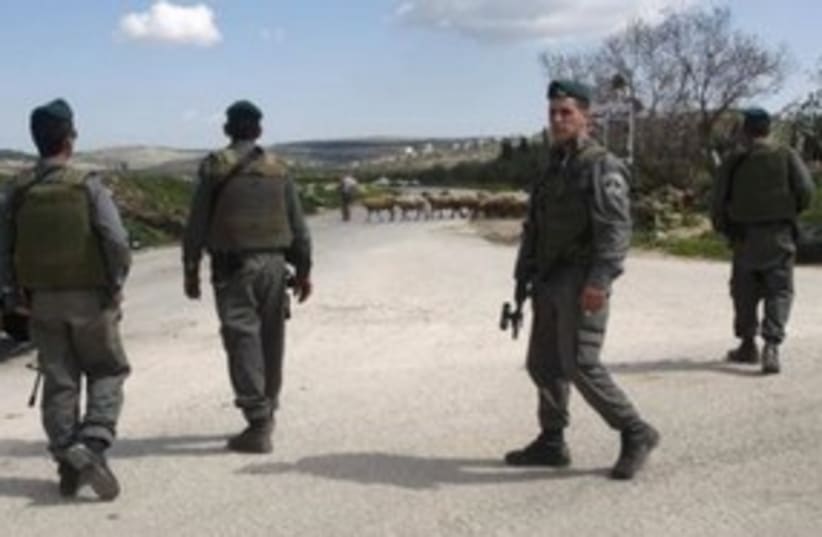
IDF Duvdevan unit. Photo: IDF Spokesman’s Office
On any given day, members of the IDF’s elite Duvdevan (“Cherry”) unit might be
found in the West Bank running through an alley on their way to carrying out an
arrest of a terror suspect.
The unit is famous for sometimes disguising
its soldiers as Palestinians and surprising its targets.
Duvdevan’s main
aim is to thwart terrorist activity through special operations and lightening
raids.
Before going into the field, the soldiers spend around seven
months undergoing specialized training, under the watchful eye of Capt. Boaz,
who is charge of getting the 18-year-olds into the best shape of their lives,
and preparing them for face-to-face combat.
“The two most important
qualities we instill in our soldiers are determination and pugnacity,” Boaz told
The Jerusalem Post on Tuesday. “They strive to reach their goals and not to quit
until they reach it.”
Duvdevan conscripts reach Boaz after undergoing
seven months of advanced infantry combat training. Once they enter the Duvdevan
program, they begin firearms and orienteering training, as well as spending no
less than 180 hours practicing Krav Maga self defense.
The Krav Maga
lessons involve the use of their firearms in close-quarter combat. “If it
jams or can’t fire, it can still be used in self-defense, because the gun is
stronger than the body,” Boaz said. “We teach them for five to seven days how to
strike with weapons.”
“We teach them how to use their legs and hands as
weapons, and tackle targets as quickly as possible, with a minimum number of
strikes directed at weak spots,” he added. “They must learn how to deal with a
terrorist running at them with a knife or a gun.”
Throughout the
training, the soldiers are instilled with what Boaz described as “aggressive
capabilities which they can switch on like a button, taking them from a state of
calm to 100 percent speed and power to neutralize a terrorist who can harm them
or others. If the terrorist runs at them, the soldiers don’t stop. They move
forward toward the target. We teach the soldiers not to fear
contact.”
Boaz stressed the trained aggression is never to be used
against noncombatants.
“But as soon as they are dealing with a danger,
the button is pressed,” he added.
To test their new skills, soldiers are
placed into high-pressure and noisy simulated situations. Once the combat
training is complete, soldiers spend several weeks tracking more than 100
km. across Israel, getting to know its mountains, paths and natural
terrains. They practice evacuating wounded soldiers on a stretcher, and
running 3 km. in less than 19 minutes.
“They move quickly and carry heavy
equipment over distances. This helps them practice a retreat from the target
with a wounded soldier.
“It prepares them as a crew, and it means they
must all make a physical effort on a personal level. If one soldier isn’t
pulling his weight while carrying a stretcher, the rest will feel it,” Boaz
said.
A team of doctors and physiotherapists is on hand to treat any
soldiers injured in training, and to get them back into the unit as soon as
possible.
After passing through the grueling training, “the soldiers go
from a stage in which they couldn’t do more than 50 push-ups when they got here,
to reaching a state of mind where we can give them any number of push-ups to do,
and they say, ‘Fine, no problem.’ The notion that they can’t do it is absent
from their mind. They realize their bodies can do everything, within physical
limits,” Boaz said.
“We demand this from them. Not to give
up. They will have to enter a building, and perhaps get through a crowd
of 10 to 15 people before catching and neutralizing a terrorist. At first, the
training looks impossible. The young soldier didn’t imagine his body can do
this. At the end, he learns there’s nothing he can’t deal with. This is the the
education we give them,” he said.