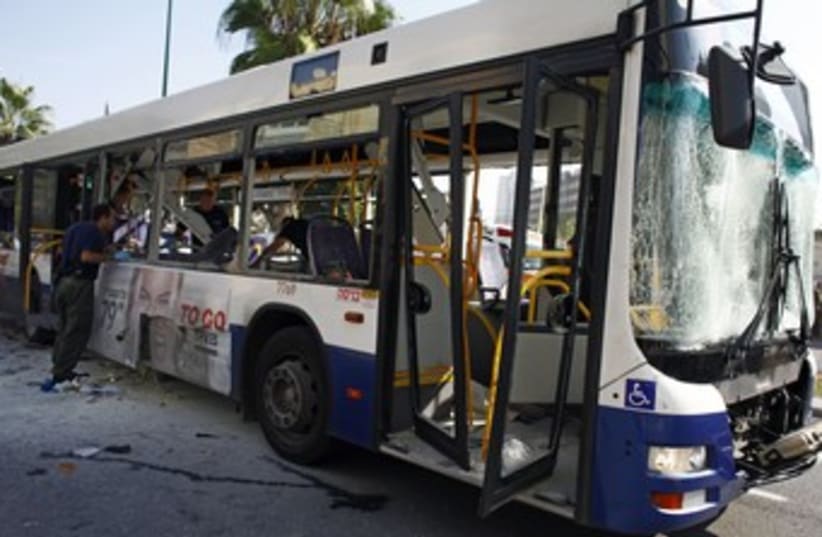
Indictment alleges Ahmad Musa was the mastermind of attack in Tel Aviv which injured 24 during Operation Pillar of Defense.
By YONAH JEREMY BOBTA bus bomb 370(photo credit: REUTERS/NIR ELIAS)
The Military Advocate-General’s Office filed an indictment with the West Bank Military Court of Judea on Wednesday against the alleged mastermind of the Tel Aviv bus bombing that injured 24 people on November 21.The indictment alleges that Ahmad Salah Ahmad Musa, a 25-year-old resident of Beit Likya, headed the terrorist cell and was the mastermind of the attack, which occurred on the last day of Operation Pillar of Defense.Musa is charged with attempted murder, conspiracy to commit murder, dealing in weapons and materials for war, creating an explosive, membership in an illegal organization and incitement, among other crimes.According to the indictment, Musa recruited other Palestinians to assist him in carrying out terror attacks, acquired weaponry for the attacks, assembled bombs and gathered intelligence about the potential targets, even going so far as to lead his recruits on tours of the sites. He is suspected of remotely detonating the Tel Aviv bomb and police said he admitted to planning other attacks during his interrogation.According to the Shin Bet (Israel Security Agency), Musa taught himself how to make the remote-detonated explosive by watching videos online.The medium-sized bomb was packed with over 800 screws and used fireworks components as its explosive ingredient.Musa also attempted to recruit would-be suicide bombers – including from among the student population at Bir Zeit University in Ramallah, where Muhammad Abed al-Jaffer Nasser Mafarja, who perpetrated the bus bombing, studied – but was unsuccessful, the Shin Bet added. It also claimed that the alleged mastermind planned to kill soldiers in a drive-by shooting in the West Bank.Mafarja, an 18-year-old resident of Taiba, was one of Musa’s recruits, the indictment alleged. Mafarja was indicted in the Tel Aviv District Court on December 19 for the bombing.Fuad Rabah Shukri Atzi, a 27- year-old Beit Likya resident, and Muhammad Mahfud Said Damra, a 25-year-old resident of Kafr Mazra near Ramallah, were also members of the terror cell, according to the indictment.Two separate indictments – for dealing in weaponry and failing to prevent a felony – have been filed against them in the Judea court.Mafarja was indicted in Tel Aviv because he is an Israeli citizen, whereas Musa and the others were indicted in the West Bank courts as residents of Ramallah.According to prosecutors in the Tel Aviv case against Mafarja, on the morning of the bombing, he spent a few hours riding around on several different buses in Tel Aviv while carrying the bomb, all while looking for a bus full of passengers.The indictment claimed that, after eventually getting on Bus 142 from Ramat Gan to Tel Aviv, Mafarja activated the bomb just before the bus arrived at a stop at the Ramat Gan industrial district. He then left it on the third seat on the right side and got off the bus.The bomber called Musa immediately afterward and told him that the explosive was in place. Minutes later, the bus arrived near the corner of Shaul Hamelech Boulevard and Henrietta Szold Street, where the bomb was detonated, noted the indictment.Prosecutors said that after Mafarja got off the bus, he took a train from the Savidor Central Train Station back to Modi’in, where he returned to his job at the McDonald’s eatery in the Azrieli Mall.The Shin Bet and police said that several hours after the bombing, they managed to arrest the members of the Beit Likya cell, including Musa.Superintendent Rona Morad- Fingelay, the head of the special investigations branch of the Yarkon Police subdistrict, said at the time of Mafarja’s indictment that police had identified him as the bomber within an hour or so of the attack and that by 4:30 p.m., police and Shin Bet officers had arrested him at his place of work. Shortly thereafter, he led police to the other members of the cell, including Musa, she said.Morad-Fingelay added that hundreds of police officers, Border Police, Shin Bet and IDF personnel took part in the short-lived manhunt.Though she would not get into the specifics of how police homed in on him, Morad-Fingelay said it was not prior intelligence that led them to Mafarja, who was seen by a number of people fleeing the scene of the bombing and was caught on CCTV video at the site as well.She added that during a Shin Bet interrogation following his arrest, Mafarja confessed to the crime and reenacted it for the investigators.Ben Hartman contributed to this report.
Related TagsOperation Pillar of Defense
if(catID != 151){
var cont = `Take Israel home with the new Jerusalem Post Store