Southern Command: 'There is anarchy in Gaza and Hamas'“The protection provided to the city is good, but this is still an operational test stage and it is not hermetic,” Gavish told reporters, at the site of the battery near Beersheba.Gavish said that the deployment of the Iron Dome was part of the IDF’s wider strategy of using offensive as well as passive defensive means to combat Palestinian rocket fire from Gaza.He said that despite the Iron Dome deployment, the public must continue to listen to the Home Front Command’s instructions regarding what to do in the event of a missile attack.Gavish said that the battery would be mobile, moving according to operational requirements, and the decision to launch interceptors would be made by commanders at the battery in real time. It is possible that the second battery will be deployed near Ashkelon later this week.There had been some hesitancy in the defense establishment about deploying the Iron Dome outside of Israeli cities. Some officials believed the system should be deployed outside of bases to provide the IAF with protection in the event of a larger conflict and allow for continued operations in the event of an attack.Iron Dome is designed to defend against rockets at a range of 4-70 km. Each battery consists of a multi-mission radar manufactured by Israel Aerospace Industries and three launchers, each equipped with 20 interceptors named Tamir.Prime Minister Binyamin Netanyahu also tried to lower expectations that Iron Dome would provide complete security, telling the cabinet Sunday that the system could not protect every house, school and installation in the country.“Israel has been under the threat of missile attack for 20 years, since the [first] Gulf War. I don’t want to create the illusion that Iron Dome, which we are deploying for the first time today, will provide a full or comprehensive answer,” he said.Netanyahu said that the Iron Dome system was still in its experimental stages. He said the true answer to the missile attacks was a combination of aggressive deterrence, preventive measures and the resilience of the government and the people.In any event, Netanyahu said, Israel holds Hamas responsible for anything that is fired from the Gaza Strip. He said that while Israel was not interested in escalating the situation, “we will not hesitate to use the might of the IDF against anyone who attacks our people.”He reiterated that every country has both the right and the obligation to defend its citizens.The prime minister said that, from a security point of view, the last two years – during which Israel adopted a policy of “systematic and consistent responses” to any attack – have been the quietest two years in the last decade.But, he said, “In the last two weeks, various elements have tried to violate the quiet and the security to which we have become accustomed over the last two years. Naturally, we are interested in quiet and security.”Defense Minister Ehud Barak, meanwhile, briefed the ministers on the situation in the South over the last two weeks, saying that the terror organizations have taken “harsh blows” over the last 10 days, with 13 terrorists killed by IDF action, dozens injured, and the terrorist infrastructure hit. During this period, four Palestinian civilians were also killed.On Sunday, two Islamic Jihad terrorists were killed after the IAF struck a terror cell as it was planning to fire rockets into Israel from the northern Gaza Strip.At the same time, Barak said, more than 100 mortar and rockets were fired on the South, leaving three people wounded, and a number of buildings damaged.He said that while the Israeli fire was pinpointed and for the most part hit those targeted, the Palestinian fire was indiscriminate and aimed at large communities.Regarding the deployment of Iron Dome, Barak said that it is not a “100 percent solution” but will gradually improve Israel’s defense.Noting that in recent years Israel fortified school buildings in the communities near Gaza, Barak said it was not possible now to do the same to every school building in the country that is inside the widening missile range.Vice Premier and Regional Development Minister Silvan Shalom told the cabinet that while Iron Dome is important, Israel cannot only think in terms of defensive measures, but must always keep on the table the option of going on the offensive.“Unequivocal Israeli declarations about the possibility of a large-scale operation and targeted assassinations undoubtedly have a deterrent effect,” he said.Members of the Knesset’s Foreign Affairs and Defense Committee had militant tones in their voices during a Sunday visit to the rocket-plagued south, with chairman Shaul Mofaz (Kadima) warning that “Israel cannot hide behind an Iron Dome. Everybody who harms our children must bear the consequences.”Following the recent increase in rocket fire, the committee decided to hold its meeting in Beersheba, together with mayors of southern towns impacted by the rocket fire.Mofaz said that the committee had come to show support for local government leaders “who are coping with the helplessness being demonstrated by the State of Israel.”“The government’s policy is an incorrect one that has harmed Israel’s deterrence, which has declined since Operation Cast Lead,” Mofaz complained. “It is the terror organizations that have determined the quality of life in Israel in the most recent round of conflict.”Beersheba Mayor Ruvik Danilovich told MKs that “it is impossible to continue to live in uncertainty and to maintain a routine when, at any given moment, a rocket could land on us. No country can accept this situation; it is impossible to gamble with residents’ lives.”Danilovich said that he welcomed the government’s decision to deploy the Iron Dome rocket defense system in the South, but added that he understood that even the cutting-edge system “is not a hermetic seal.”MK Avi Dichter (Kadima) described as an “error” the decision not to deploy more Iron Dome batteries to offer coverage to a larger area.“Hamas is developing in Gaza the offensive abilities of a military organization and the State of Israel cannot allow itself a situation like this. It cannot be that the state does not manage to find NIS 40 million in funding, which could solve the entire problem of defense,” Dichter continued.Danilovich’s colleague, Kiryat Malachi Mayor Moti Malcha, told the committee that he had a specific fear: the dangers of the 70 tons of ammonia currently being stored in the city.“If one rocket hits the containers, half of the city disappears. I was promised that they would be secured, but nothing has been done,” said Malcha.“I believe that the best defense is offense, but if there isn’t an offensive, then at least offer defense,” complained MK Arye Eldad (National Union).“While we argue about the nature of our response, armored trucks continue to shuttle money to Gaza from Israel.”
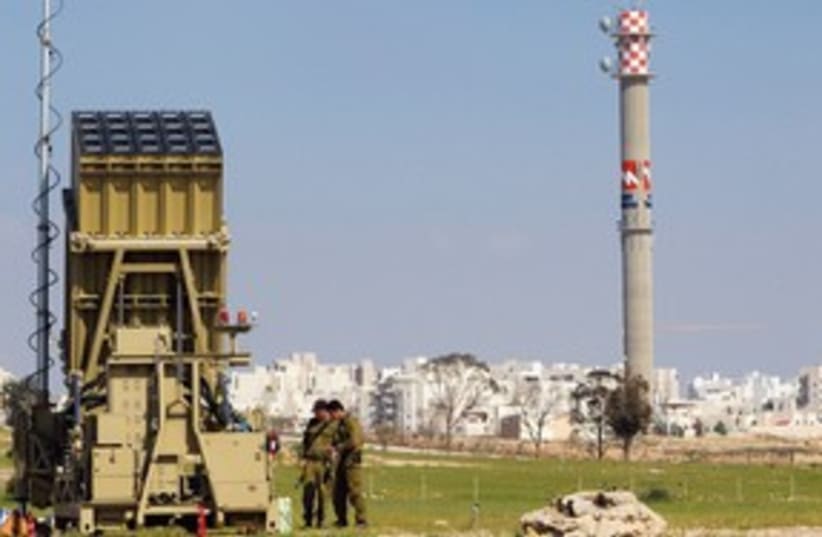
IDF deploys Iron Dome battery outside Beersheba
Mofaz: Israel can't hide behind missile defense system; PM: True answer to missile attacks is aggressive deterrence, preventive measures.
Southern Command: 'There is anarchy in Gaza and Hamas'“The protection provided to the city is good, but this is still an operational test stage and it is not hermetic,” Gavish told reporters, at the site of the battery near Beersheba.Gavish said that the deployment of the Iron Dome was part of the IDF’s wider strategy of using offensive as well as passive defensive means to combat Palestinian rocket fire from Gaza.He said that despite the Iron Dome deployment, the public must continue to listen to the Home Front Command’s instructions regarding what to do in the event of a missile attack.Gavish said that the battery would be mobile, moving according to operational requirements, and the decision to launch interceptors would be made by commanders at the battery in real time. It is possible that the second battery will be deployed near Ashkelon later this week.There had been some hesitancy in the defense establishment about deploying the Iron Dome outside of Israeli cities. Some officials believed the system should be deployed outside of bases to provide the IAF with protection in the event of a larger conflict and allow for continued operations in the event of an attack.Iron Dome is designed to defend against rockets at a range of 4-70 km. Each battery consists of a multi-mission radar manufactured by Israel Aerospace Industries and three launchers, each equipped with 20 interceptors named Tamir.Prime Minister Binyamin Netanyahu also tried to lower expectations that Iron Dome would provide complete security, telling the cabinet Sunday that the system could not protect every house, school and installation in the country.“Israel has been under the threat of missile attack for 20 years, since the [first] Gulf War. I don’t want to create the illusion that Iron Dome, which we are deploying for the first time today, will provide a full or comprehensive answer,” he said.Netanyahu said that the Iron Dome system was still in its experimental stages. He said the true answer to the missile attacks was a combination of aggressive deterrence, preventive measures and the resilience of the government and the people.In any event, Netanyahu said, Israel holds Hamas responsible for anything that is fired from the Gaza Strip. He said that while Israel was not interested in escalating the situation, “we will not hesitate to use the might of the IDF against anyone who attacks our people.”He reiterated that every country has both the right and the obligation to defend its citizens.The prime minister said that, from a security point of view, the last two years – during which Israel adopted a policy of “systematic and consistent responses” to any attack – have been the quietest two years in the last decade.But, he said, “In the last two weeks, various elements have tried to violate the quiet and the security to which we have become accustomed over the last two years. Naturally, we are interested in quiet and security.”Defense Minister Ehud Barak, meanwhile, briefed the ministers on the situation in the South over the last two weeks, saying that the terror organizations have taken “harsh blows” over the last 10 days, with 13 terrorists killed by IDF action, dozens injured, and the terrorist infrastructure hit. During this period, four Palestinian civilians were also killed.On Sunday, two Islamic Jihad terrorists were killed after the IAF struck a terror cell as it was planning to fire rockets into Israel from the northern Gaza Strip.At the same time, Barak said, more than 100 mortar and rockets were fired on the South, leaving three people wounded, and a number of buildings damaged.He said that while the Israeli fire was pinpointed and for the most part hit those targeted, the Palestinian fire was indiscriminate and aimed at large communities.Regarding the deployment of Iron Dome, Barak said that it is not a “100 percent solution” but will gradually improve Israel’s defense.Noting that in recent years Israel fortified school buildings in the communities near Gaza, Barak said it was not possible now to do the same to every school building in the country that is inside the widening missile range.Vice Premier and Regional Development Minister Silvan Shalom told the cabinet that while Iron Dome is important, Israel cannot only think in terms of defensive measures, but must always keep on the table the option of going on the offensive.“Unequivocal Israeli declarations about the possibility of a large-scale operation and targeted assassinations undoubtedly have a deterrent effect,” he said.Members of the Knesset’s Foreign Affairs and Defense Committee had militant tones in their voices during a Sunday visit to the rocket-plagued south, with chairman Shaul Mofaz (Kadima) warning that “Israel cannot hide behind an Iron Dome. Everybody who harms our children must bear the consequences.”Following the recent increase in rocket fire, the committee decided to hold its meeting in Beersheba, together with mayors of southern towns impacted by the rocket fire.Mofaz said that the committee had come to show support for local government leaders “who are coping with the helplessness being demonstrated by the State of Israel.”“The government’s policy is an incorrect one that has harmed Israel’s deterrence, which has declined since Operation Cast Lead,” Mofaz complained. “It is the terror organizations that have determined the quality of life in Israel in the most recent round of conflict.”Beersheba Mayor Ruvik Danilovich told MKs that “it is impossible to continue to live in uncertainty and to maintain a routine when, at any given moment, a rocket could land on us. No country can accept this situation; it is impossible to gamble with residents’ lives.”Danilovich said that he welcomed the government’s decision to deploy the Iron Dome rocket defense system in the South, but added that he understood that even the cutting-edge system “is not a hermetic seal.”MK Avi Dichter (Kadima) described as an “error” the decision not to deploy more Iron Dome batteries to offer coverage to a larger area.“Hamas is developing in Gaza the offensive abilities of a military organization and the State of Israel cannot allow itself a situation like this. It cannot be that the state does not manage to find NIS 40 million in funding, which could solve the entire problem of defense,” Dichter continued.Danilovich’s colleague, Kiryat Malachi Mayor Moti Malcha, told the committee that he had a specific fear: the dangers of the 70 tons of ammonia currently being stored in the city.“If one rocket hits the containers, half of the city disappears. I was promised that they would be secured, but nothing has been done,” said Malcha.“I believe that the best defense is offense, but if there isn’t an offensive, then at least offer defense,” complained MK Arye Eldad (National Union).“While we argue about the nature of our response, armored trucks continue to shuttle money to Gaza from Israel.”