What is interesting about Gates' comments is not that they're new, because they're not, but why they were made public.
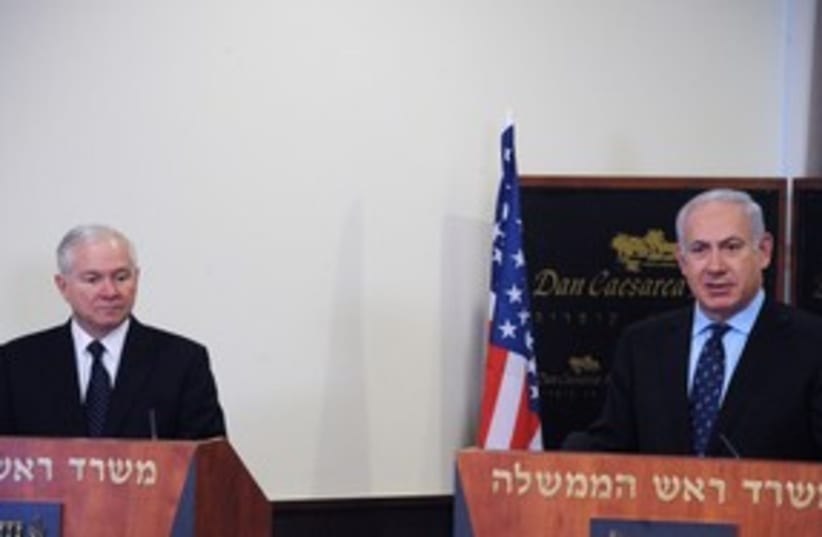
By HERB KEINONNetanyahu Gates 311(photo credit: GPO)
Anyone who has paid any attention to Israel-US ties since the start of the “Obibi” era in early 2009, when US President Barack Obama and Prime Minister Binyamin Netanyahu took power in their respective countries, knows well that this relationship has been anything but a honeymoon.Anyone who has paid any attention knows there are wide gaps in the way the Obama administration and the Netanyahu government view the world and the swiftly changing region.RELATED:Obama, Netanyahu discuss 'regional issues,' peace US Army seeks to increase joint training with IDF These differences were on public display from the first meeting between the two in the Oval Office in May 2009, when Obama called for a complete settlement freeze and disagreed with Netanyahu’s assessments that it was imperative to first deal with Iran, and then the Palestinians. They were on public display in March 2010 when Obama publicly dissed Netanyahu by keeping him waiting in the White House while he had dinner with his family, and refused to issue a public statement with Netanyahu or allow non-official photographers to record their meeting. And they were on public display when Netanyahu politely but firmly told Obama at a White House meeting in May 2011 that Israel could not accept the pre-1967 lines as a baseline for talks with the Palestinians, something Obama called for the day before.Anybody who has paid attention to this relationship knows the US administration is as impatient with what it views as Netanyahu’s recalcitrance, as Israel is frustrated with the way the Obama administration has dealt with the diplomatic process and created the perception that it would “deliver” Israel from day one.
So what was new in what Jeffrey Goldberg revealed in his Bloomberg column Tuesday about how former secretary of defense Robert Gates really feels about Netanyahu was not the content of what Gates was quoted as saying – that the US has given Netanyahu so much and received nothing in return – but rather that these feelings were brought to the fore now.The Obama administration, through leaks and various on-and off-the-record statements by various officials over the last three years, has made clear that it feels that with the US giving Israel so much in terms of security assistance and diplomatic cover, it should not be so much to ask once in a while for something in return: a little settlement freeze, a small apology to Turkey, some concessions to the Palestinians that Washington deems are not that big of a deal.And that, pretty much, is what Gates – according to Goldberg – said.“Gates coldly laid out the many steps the administration has taken to guarantee Israel’s security – access to top-quality weapons, assistance developing missile defense systems, high-level intelligence sharing – and then stated bluntly that the US has received nothing in return, particularly with regard to the peace process,” Goldberg wrote.“Senior administration officials told me that Gates argued to the president directly that Netanyahu is not only ungrateful, but also endangering his country by refusing to grapple with Israel’s growing isolation and with the demographic challenges it faces if it keeps control of the West Bank.According to these sources, Gates’s analysis met with no resistance from other members of the [National Security Council Principals] committee.”These statements met with no resistance from other members of the NSC because that has been the feeling in the White House for some time.What is interesting about the Goldberg piece is not the content of what Gates was reported to have said, but rather that someone wanted his having said it to be out there now.One question that has to be asked is why Gates. Why put these words in Gates’ mouth.Surely, because he said them, but if no one else at the meeting objected, certainly others must have articulated similar sentiments. But from the Obama administration’s perspective, Gates is the perfect spokesman to articulate these feelings.First of all he is bipartisan, brought on as secretary of defense in 2006 by president George W. Bush.Secondly, he has overseen a security relationship with Israel that both Israeli and US officials say is unprecedented in scope and depth. Don’t get the wrong idea; Gates is not all warm and fuzzy about Israel. He is, as Goldberg pointed out, “not considered hostile to Israel,” but he is also not considered the greatest champion Israel ever had in the Pentagon.And finally, he is out of office. Get the message of impatience with Netanyahu out there by a bipartisan former cabinet secretary and Obama retains some distance because the messenger does not work for the White House anymore, and also because – unlike other former officials like Rahm Emanuel and David Axelrod – he is not someone fundamentally identified with this US president.Another question is why now. Cabinet member Yossi Peled, interviewed Tuesday on Israel Radio from Africa, said it seemed to him that someone in Washington was trying to mix into the Israeli political pot.At first glance, there may be more to this than the paranoid musings of a Likud minister.Some in Washington may indeed have looked at last Saturday night’s massive cost-of-living protests and concluded Netanyahu was weak politically, and this might be the perfect time to let it be made clear to the Israeli public what Washington really thinks of its leaders.For, as Goldberg quoted Kadima head Tzipi Livni as saying in a recent interview, when Israelis “wake up in the morning and ask themselves, what is the general situation today, the litmus test for them is the health of the relationship between Israel and the United States.”If the White House really believes that, then it could be excused for concluding that with the weekend of the social protests, it was time to “push a little.” But it’s hard to believe the White House would believe this premise.First of all, Livni ran on this line in the last elections – that only she could preserve the relationship with the US – and she failed to capture the prime minister’s chair.Secondly, in March 2010 after the dust-up with Vice President Joe Biden over the construction in Ramat Shlomo, the White House pushed unprecedentedly hard on Israel, only to see that Netanyahu got a bounce in the polls – the Israeli public rallied around him, not Obama.And finally, it is hard to believe that the White House would conclude – after looking at the coalition math – that Netanyahu’s days are numbered. True, more than 400,000 people may have taken to the streets a few nights ago, but that is unlikely to lead Shas, Israel Beiteinu or Ehud Barak’s Atzmaut party out of the coalition, and without that happening, the government remains stable.Trying to bring down a government that looks stable seems far-fetched.Which then still leaves the question open as to why Gates’ comments were leaked now? With September here, it doesn’t take a lot of imagination to conceive of a link between Gate’s “blunt articulation,” as the column in Bloomberg characterized the former defense-secretary’s feelings about Netanyahu, and the Palestinian gambit at the UN.Senior US Middle East hands Dennis Ross and David Hale arrived in the region on Tuesday for what is being reported as a last ditch attempt to come up with a formula that would bring the Israelis and the Palestinians to the negotiation table, and keep the PA from going through with its UN move. The clear message that emerges from Gates’s comments are that the US is fed up with Netanyahu’s position. The subtext to the Palestinians might very well be, “give us some more time by not going to the UN, and we’ll turn these articulations of frustration and resentment into policy.”Then again, as Freud has been quoted to have said, “Sometimes a cigar is just a cigar,” and perhaps there is no greater meaning or message in what Gates said, beyond the fact that he said it and Goldberg reported it.But if that were indeed the case, then there is not much “news” in the story, because what Gates said, most people – including policy makers in Jerusalem – realize many in the Obama administration have believed for some time.
if(catID != 151){
var cont = `Take Israel home with the new Jerusalem Post Store