Analysis: Obama-Netanyahu: Not everything is personal
Some would chalk up current difficulties in US-Israeli relationship to lack of chemistry or fondness between the two leaders. But they'd be wrong.
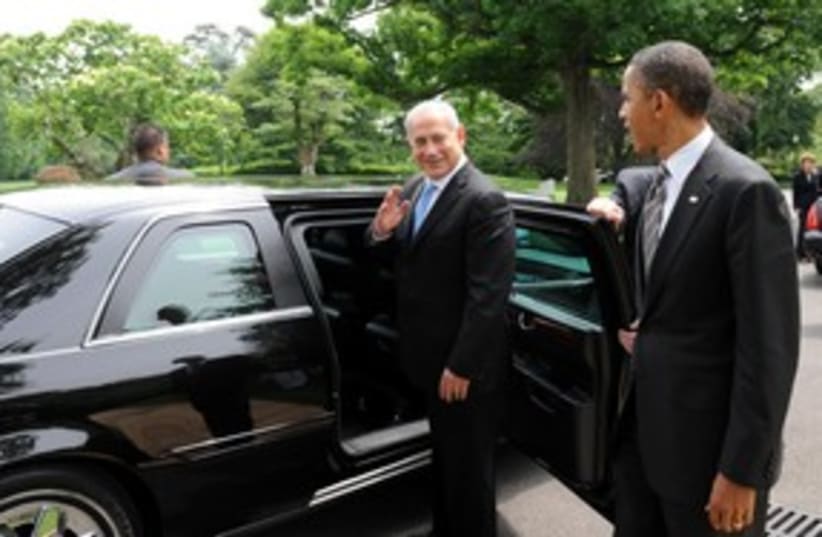
By HERB KEINONPM Netanyahu saying bye to US President Obama 311(photo credit: Avi Ohayon / GPO)
There are those who would chalk up the current difficulties in the US-Israeli relationship to a lack of chemistry or fondness between the two leaders. There are those who would look at the current tension and attribute it to Obama’s coldness, or Netanyahu’s arrogance.But they would be wrong. Because what was on display in the White House Friday for the world to see was not a personality clash, but rather a conceptual one.RELATED:Analysis: What rankled Netanyahu in the Obama speech Comment: Obama’s failure to internalize Palestinian intoleranceMideast Quartet supports Obama's vision for peaceWhat happened Friday afternoon in the White House was actually exceptional. Less than 24-hours after US President Barack Obama -- the most powerful man on the planet -- called on Israel to withdraw to the 1967 lines with mutual land swaps, Prime Minister Binyamin Netanyahu -- sitting right next to the president -- said for the whole world to see that this was not going to happen; that it was a risk Israel simply could not take.“I think for there to be peace, the Palestinians will have to accept some basic realities,” Netanyahu said in a blunt rebuttal of Obama’s proposal. “The first is that while Israel is prepared to make generous compromises for peace, it cannot go back to the 1967 lines -- because these lines are indefensible; because they don’t take into account certain changes that have taken place on the ground, demographic changes that have taken place over the last 44 years.”This isn’t a personal crisis, it is not the result of a ”bad connection” or “bad blood" between the leaders. Rather, it is reflective of significantly different way of viewing reality. Even were Obama and Netanyahu to get along as swimmingly as Prince William and Kate Middleton, wide chasms in how each views their country’s interests and what is and is not possible would still separate the two. Obama essentially believes in the land for peace formula, and that what it will take to solve the Israeli-Arab conflict is a painful ceding of Israeli land. Netanyahu, on the other hand, believes, based on past experience, that this will not do the trick nor ensure Israel’s security -- so forget about it.Moreover, there is also a significant rift regarding timing.“For over two years, my administration has worked with the parties and the international community to end this conflict, building on decades of work by previous administrations. Yet expectations have gone unmet,” Obama said during his speech Thursday evening. “The world looks at a conflict that has grinded on and on and on, and sees nothing but stalemate. Indeed, there are those who argue that with all the change and uncertainty in the region, it is simply not possible to move forward now."“I disagree,” Obama said. “At a time when the people of the Middle East and North Africa are casting off the burdens of the past, the drive for a lasting peace that ends the conflict and resolves all claims is more urgent than ever.”The person he is disagreeing with is Netanyahu, because Netanyahu believes that with everything else happening in the Arab world, and Israel really not knowing what will happen to any of its regional partners -- Egypt, Jordan and the PA with the Hamas-Fatah reconciliation -- this is not the time to delve forward and take huge risks. Rather, he believes this is the time to step back and let the dust settle before taking daring next moves. And that, indeed, is a fundamentally different way of viewing the current regional reality.The differences are real and genuine. Neither Obama, facing re-election next year and a divided Congress, nor Netanyahu -- with Opposition leader Tzipi Livni blaming him for poisoning Israeli-US ties -- need this squabble right now. It doesn’t help Obama with his Jewish constituency, and being cast as the US-Israel relationship-wrecker is not exactly the ticket Netanyahu wants to ride on in his next elections.But yet the squabble is there, because this crisis can’t be reduced to a conflict of personalities. Rather, it is a conflict of competing perceptions of reality.
if(catID != 151){
var cont = `Take Israel home with the new Jerusalem Post Store