Arabs leaders: Address inequality before IDF draft
Be’eri-Sulitzeanu, Darawshe tell Keshev Community that Arab participation in national-service programs linked to equality.
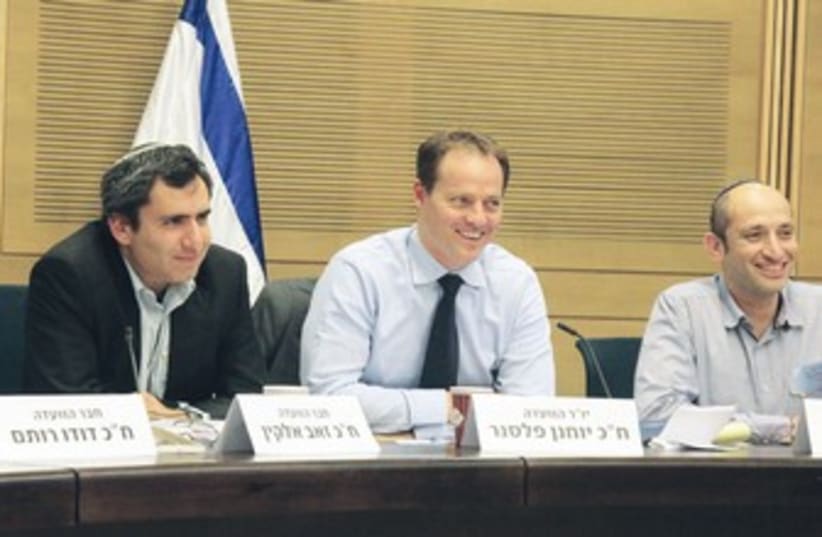
By JEREMY SHARONKeshev Committee 370(photo credit: Marc Israel Sellem)
The Israeli-Arab community and political leadership will only be willing to discuss participation in national-service programs if the issue is linked to addressing inequality in the Arab sector, Amnon Be’eri-Sulitzeanu and Muhammad Darawshe, co-directors of the Abraham Fund coexistence organization, told the Keshev Committee on Tuesday.The Keshev Committee is tasked with finding an alternative for the “Tal Law” that would lead to a more equal societal division in regards to military and national service.According to Be’eri-Sulitzeanu and Darawshe, if dialogue were to be conducted with the Higher Arab Monitoring Committee, an extra-parliamentary organization representing Arabs citizens, and elected Israeli- Arab leaders separately from the issue of the Tal Law, then it would be possible to reach agreements on the issue within as little as six months.The Higher Arab Monitoring Committee has so far refused to participate in the Keshev Committee’s deliberations and has not sent any representatives to sit as members.Be’eri-Sulitzeanu said that given the level of inequality experienced by the Arab community in numerous areas of society, the leadership is unwilling to separate the demands of its constituents from the national service requirements demanded by the state.“There is such a wide discrepancy between the status of Jews and Arabs in the country that the Arab community does not feel it can discuss the issue of sharing the burden of national service while ignoring all other aspects of life in Israel in which they are in a much inferior situation than the Jewish population,” Be’eri-Sulitzeanu told The Jerusalem Post.According to Be’eri-Sulitzeanu’s understanding, the Arab political leadership would be willing to discuss several options for enabling voluntary community service to function as national service for the Arab community, initially in the Arab sector and then possibly further afield in the future.Providing incentives would attract many Arab youngsters to community service programs, he added.Be’eri-Sulitzeanu also emphasized that the two-month window allotted for replacing the Tal Law would be insufficient to address the issue of Arab national service, and pointed to the fact that the government has engaged in dialogue with the haredi community for over a decade to try to resolve issues of ultra- Orthodox national service.“If a sincere effort is made to reach out to the Arab political leadership to engage them in dialogue on the issues of inequality as well as national service, then a formula could be agreed on,” Be’eri-Sulitzeanu said.In response to the comments made by Be’eri-Sulitzeanu and Darawshe during Tuesday’s hearing, Keshev Committee chairman MK Yohanan Plesner (Kadima) said that efforts have been made to get Arab representatives onto the committee and to establish dialogue with them, which have so far failed.Plesner stated that he was “disappointed to find that representatives of the Arab leadership continue to miss historic opportunities for change, which leads them nowhere.”Israeli Arabs are not drafted by the IDF. There are approximately 2,000 Israeli Arabs who volunteer for national service programs every year, according to the National Civil Service Volunteers Association.During Tuesday’s hearings, former head of the IDF Manpower Directorate Maj.-Gen. (res.) Elazar Stern presented figures to the committee that he claimed showed that there are approximately 10,000 ultra-Orthodox men enrolled in full-time yeshiva study programs – through which they indefinitely defer military service – but who are not actually studying.Stern said it would be possible to draft these men within six months to combat roles in the IDF, and added that senior representatives of the haredi community, including ministers, have approached him to advance the recruitment of these men.There are approximately 58,000 ultra- Orthodox men currently enrolled in full-time yeshiva study programs that allow them to defer their national service.
if(catID != 151){
var cont = `Take Israel home with the new Jerusalem Post Store