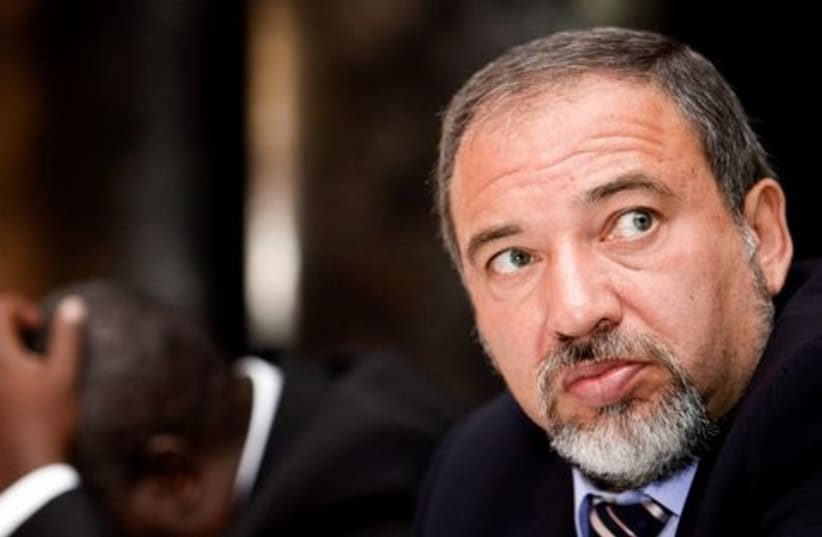
Avigdor Liberman tenders resignation over indictment
Following meetings with legal team, foreign minister to leave post over pending indictment for fraud, breach of trust; Likud officials say Liberman will still play central role in campaign, he has not resigned from Knesset.
By JPOST EDITORIALUpdated: APRIL 1, 2018 15:39Avigdor Liberman 521 ok(photo credit: Reuters)
Yisrael Beytenu leader Avigdor Liberman resigned on Sunday from his positions as foreign minister and deputy prime minister on Sunday, due to the pending indictment against him for fraud and breach of public trust. The resignation will take effect on Tuesday at 10 a.m.Moments after he handed in his letter of resignation, the foreign minister asserted that his break will be short. "I am leaving temporarily" he said, after what he described as four very interesting years in the Foreign Ministry.Liberman said that he was not concerned about the trial ahead of him and hoped the process would be quick. He also said that he wants a trial rather than a plea bargain, making it very unlikely that the legal process will be complete by the time the government is formed in March. He added that every move he had made was for the good of the public and the break would give him time to focus on elections. "Israel needs a strong prime minister with a clear majority," rather than having to rely on sliver parties, he stated.The foreign minister confirmed on Saturday night that he had not resigned from the Knesset or as chairman of Yisrael Beytenu, and was still running in the election with the hope of getting a top ministerial position in the next government, assuming Prime Minister Binyamin Netanyahu forms the next coalition.Likud officials said that they wont hide Liberman in the campaign and that he will play a central role. They added that they appreciated his resignation because it enables the election to return to key diplomatic and security issues rather than focusing on Liberman.Liberman announced Friday that he would be stepping down, hours after Meretz filed a petition asking the High Court of Justice to order his resignation.In a statement published by his office, Liberman said his legal counsel advised him he did not have to resign. Nonetheless, he said he would do so in order to fight the charges against him, thereby enabling him to serve in the next government if exonerated. Liberman has denied all wrongdoing and called for expedited legal proceedings.To this end, Liberman said he would immediately drop his parliamentary immunity, “so that after 16 years during which investigations have been carried out against me, I can conclude this matter quickly, without delay and clear my name.“I am also doing this because I am convinced Israeli citizens have the right to go to the polls with this matter already having been decided,” he said, in the hope the legal proceedings against him are concluded before the January 22 election.Liberman added that he hopes he will be able to continue serving Israel “as part of a strong and united leadership in order to face the security, diplomatic and economic challenges that the State of Israel is facing.”A source close to Liberman expressed optimism that a plea bargain could be reached before the election. The source said the State Attorney’s Office and Liberman both believed this was possible.In the worst-case scenario for Liberman, if a plea bargain is not reached by the time the next government is formed in February or March, the High Court or Attorney-General Yehuda Weinstein could rule that Liberman cannot become a minister. He could also be suspended from the Knesset, pending the conclusion of the legal proceedings.The prime minister spoke with Liberman on Friday afternoon ahead of his resignation announcement, telling the foreign minister that he hopes he will “prove his innocence as quickly as possible” and quickly return to a senior position in the government.A source in the Prime Minister’s Office said Netanyahu would retain the title of foreign minister until the next government is formed, dispelling rumors that a Likud minister such as Vice Premier Silvan Shalom or Deputy Prime Minister Dan Meridor would be given the post.According to Israeli constitutional processes, when a minister resigns, his deputy automatically resigns with him.Netanyahu and Liberman both want Deputy Foreign Minister Danny Ayalon to remain in his post, so Netanyahu is expected to ask the Knesset to approve Ayalon’s reappointment.Liberman’s decision follows Weinstein’s surprise announcement on Thursday that he will charge the foreign minister not only with breach of trust, but also with fraud, in a 2008 case involving obstruction of justice by former ambassador to Belarus Ze’ev Ben- Aryeh.It was widely predicted that Liberman would be charged with breach of trust for allegedly not revealing that Ben- Aryeh leaked information to him regarding a separate investigation against him when he visited the ambassador in Belarus in 2008. But the charge that by allegedly helping Ben-Aryeh advance to two additional positions in the Foreign Ministry as “payment” for Ben-Aryeh’s leaking classified information to Liberman, he had committed fraud, came as a surprise.At the same time, Weinstein decided to close the “main” case against Liberman, regarding wider and more serious allegations of money-laundering millions of dollars, fraud and other allegations from 2001 to 2008.Weinstein took the first step in the indictment process on Thursday when he sent the indictment text to Knesset Speaker Reuven Rivlin, asking him to remove Liberman’s parliamentary immunity so the indictment could be filed in court. But Liberman’s announcement that he was waiving his immunity preempted Rivlin and the Knesset taking action, which could have been put off by up to 30 days.Reacting to Liberman’s resignation, a Meretz spokesman said the party would withdraw the petition once he actually handed in his resignation or upon a decision by the court, whichever came first.Leaders from the Center-Left praised Liberman’s decision to resign.Labor Party chairwoman Shelly Yacimovich welcomed Liberman’s move, saying the indictment had “severely undermined the rule of law and the public’s trust in its elected leadership and democracy.” She said that “he who is indicted cannot serve even one day as a public emissary.”The Labor leader said she would not sit in a government in which anyone under indictment served, and called on the heads of all political parties to boycott any such cabinet.The No. 2 candidate on The Tzipi Livni Party’s electoral list, Amram Mitzna, called Weinstein’s ruling the most severe condemnation of an Israeli public figure ever. He urged the public to read it to understand who the No. 2 man in the Likud Beytenu joint list really was.“The public should ask itself if it wants a government with Liberman after this lethal indictment,” Mitzna said. “Public figures who want to lead must be clean beyond all doubt. If he remains a Knesset candidate, I hope it makes Likud Beytenu supporters rethink their votes.”Charles Bybelezer,Michael Omer-Man, Ben Hartman and Reuters contributed to this story.
if(catID != 151){
var cont = `Take Israel home with the new Jerusalem Post Store