Latvia FM: EU should avoid 'lecturing' on settlements
In interview with the 'Post,' Rinkevics says it's difficult to lecture another country on such a complex situation.
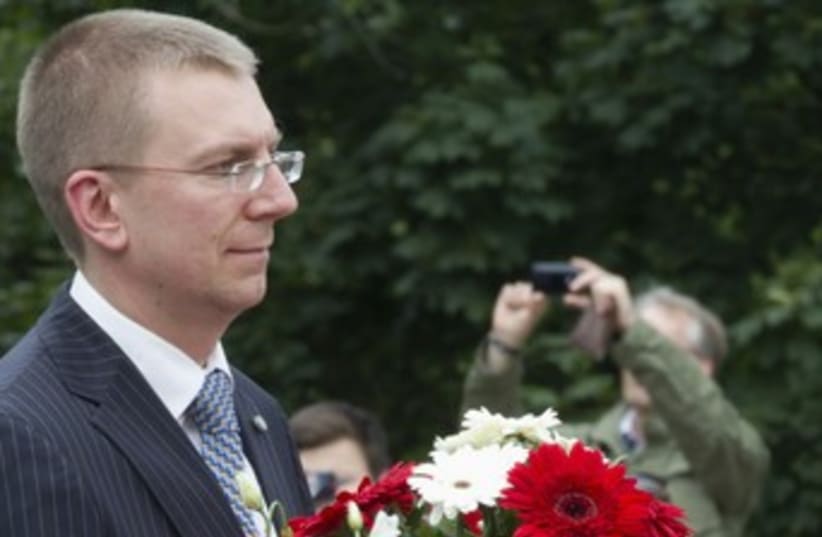
By HERB KEINONLatvian Foreign Minister Edgar Rinkevics 370 (R)(photo credit: Reuters / pool)
The EU should be cautious to avoid being perceived as lecturing Israel on the settlement issue, Latvian Foreign Minister Edgar Rinkevics said Tuesday in a somewhat unusual public comment by a senior European diplomat.“There is concern about the settlement issue, and I raised this issue yesterday,” Rinkevics told The Jerusalem Post, referring to a meeting he had Monday with Foreign Minister Avigdor Liberman.Then, in a rare admission, he added, “It is very difficult for people who are not really experts in the region, first of all. Second, [it is very difficult] taking into account the absolutely complex situation historically, politically and legally, to start kind of lecturing any other country, because what we see here is a very complex situation.”Rinkevics made clear that he was not breaking ranks with the EU’s censure over Israel’s settlement policy, articulated most recently by EU foreign policy chief Catherine Ashton two weeks ago when she condemned a plan to build some 800 new housing units in Jerusalem’s Gilo neighborhood, beyond the pre-1967 lines. He said he hoped the EU’s concerns “will be heard here.”He said, however, that while the EU was “expressing our views on how we see the situation,” he didn’t want this to be “perceived as lecturing.”Rinkevics explained that “sometimes Latvians get irritated because they perceive some communication from Brussels and the EU as lecturing.”The Latvian foreign minister – making his second trip to Israel, but the first visit to the country by a Latvian foreign minister since 2007 – arrived Monday and in addition to meeting Liberman, met President Shimon Peres and National Security Council head Yaakov Amidror. On Wednesday he will be going to Ramallah to meet with Palestinian Authority President Mahmoud Abbas and PA Prime Minister Salam Fayyad.Rinkevics said he will reiterate to the PA leadership that the EU’s position on their likely UN bid next month to gain non-state observer status is that doing so “will not help the overall process.”“We very much hope [to see] direct negotiations between the Palestinian Authority and Israel, and no unilateral moves,” he said. “That is the position that has been repeated by many of my colleagues, by Lady Ashton when she was here last week, the same message. I think it is important that it is being delivered by big and small members of the EU.”The Latvian foreign minister was non-committal regarding what the EU would do if the PA ignored this advice and went ahead with their plans, saying that the EU foreign ministers were set to formally discuss the issue at their next meeting in mid-November.He said that the hope was that the EU could come to a united position on the issue, something – given recent history – that does not seem likely.Last November the EU split in the UNESCO vote on admitting Palestine as a state, with five countries voting against the move, 11 for and 11 abstaining. Latvia cast one of the abstentions.The Latvian vote, Rinkevics said, was “a clear sign that if we cannot forge a united stand, then we wanted to symbolically underline our disappointment that we did not have a common EU stance.”
Related TagsCatherine AshtonLatvia
if(catID != 151){
var cont = `Take Israel home with the new Jerusalem Post Store