Arab parties may unite as one slate to increase turnout; "right-wing, left-wing, they all stick together,” says Ibrahim.
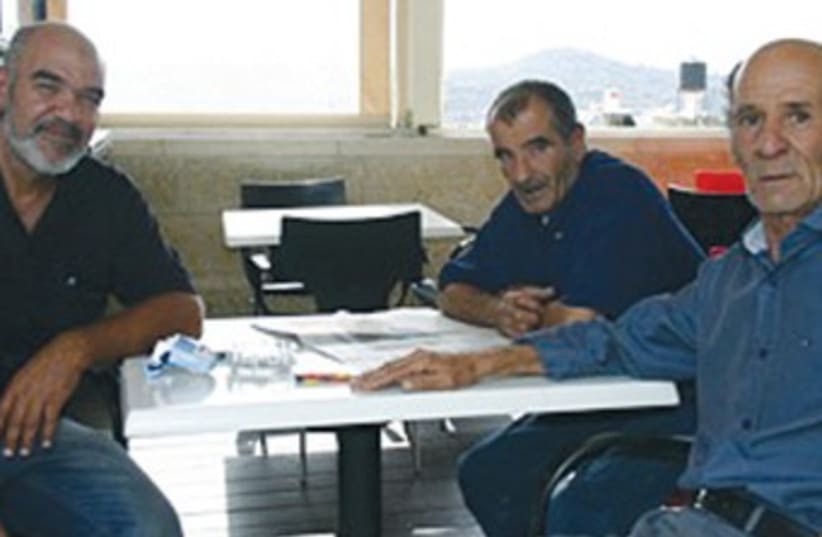
By ILENE PRUSHERAbu Ghosh Khubez Bakery 370(photo credit: ILENE PRUSHER)
At the Khubez bakery and coffee shop in the village of Abu Ghosh, west of Jerusalem, men meet for coffee and conversation every morning.Faisal Abdul Rahman is in the minority, because he says he’ll vote in national elections this January. Most of the others, including Muhammad Ibrahim – who has worked with Abdul Rahman in construction in the past – say that voting is pointless.“It’s not the economy – I have enough food. I want honor, but the state treats us like slaves. Work, eat, keep your mouth shut. There’s no room here for us to develop.Right-wing, left-wing, they all stick together,” says Ibrahim, a 73-year-old grandfather of 14, widely known as Abu Hamza.“And when they have an important vote in the Knesset, they don’t count the Arab parties – as if they’re worthless. So why even vote?” Abdul Rahman, a generation younger than Ibrahim, is perhaps disenchanted, but not nearly as much. He says it’s worth voting if only to try to bring peace, both with the Palestinians and in the region in general.Click for full JPost coverage“I think we all need to go vote to bring in a government that wants peace. We’re talking about making war on Iran? What are you thinking?” asks Abdul Rahman, who voted in the last election for Ibrahim Sarsur, from the Islamic branch of the once United Arab Party. In the last elections it teamed up with the secular party of Dr. Ahmed Tibi to become United Arab List-Ta’al.Abdul Rahman hasn’t decided for whom he’ll vote this time. He’s waiting, hoping for someone or something to inspire him and the many others who say they won’t vote, whether out of apathy, disillusionment or protest.“It’s hard to find someone in politics who will help the people who are really living below the poverty line, because there are a lot of families here who are,” he says. He notes that Israelis tend to come to the famously hospitable village, eat at one of the large restaurants, and leave, never to see the harsh economic reality for many deep inside Abu Ghosh.Disenchantment with the political system among Israeli Arabs has grown over the past decade, and people who say they don’t plan to vote seem to be as abundant as the olives on the trees this week, at the height of the harvest.Even among the few who said they would vote, there is a sense that politicians – those from Arab parties as well as campaigners trying to attract Arab votes to mainstream Jewish parties, including Labor, Likud, Kadima and Shas – visit only during election season.Afterwards, these potential voters say, they disappear – until the next election.“They come around during election time, and then you never see them again,” says Barhum, who lives in the village of Ein Rafa across the valley – and who didn’t want his last name used. He works at the mall in Mevaseret Zion and pays his taxes. But there isn’t so much as a playground for his kids in Ein Rafa.“The kindergartens are neglected, the roads are bad, there isn’t a community center for kids to go to for activities.After school, they just play in the streets,” he says.Indeed, a drive through Ein Rafa shows it to look no different than a village in the West Bank, save a few more signs in Hebrew and – to be fair – a large and relatively new school, built to alleviate severe overcrowding.Voter participation among Israeli Arabs, many of whom prefer to be identified as Palestinian citizens of Israel, stood at 53 percent in the last elections, a record low. The numbers have been falling since the events of October 2000, at the start of the second intifada, when 13 Arabs – 12 Israeli citizens and one from Gaza – were killed by Israeli police and paramilitary forces during a series of demonstrations.Moreover, as Arabs see it, right-wing parties who want to marginalize the role of Arabs in political life are growing in strength.“The results of the last intifada created a lot of mistrust.Many Arabs feel that people look at them and think, ‘if you’re a real citizen, why were you shot at by the police during these demonstrations?’” says Dr. Yousef T. Jabareen, a lawyer and activist who is the founding director of Dirasat, the Arab Center for Law and Policy, headquartered in Nazareth.“I think the root reason for such low voter participation is that people are frustrated with the political system, and they’re losing hope that their political participation matters,” Jabareen tells The Jerusalem Post.“I share the mistrust, but this shouldn’t reflect negatively on our participation. We don’t have the luxury of sitting back and not trying to influence politics in Israel,” he says. “So even given all of my understanding of the frustration in my community, I tell people, they can’t change things without intensive voting.”According to a poll released Wednesday by the National Union of Israeli Students, even among the youngest and best-educated, the expected voter turn-out is relatively low. While some 89% of Jewish students said they planned to vote, the number was 56% in both the Arab and Druse sectors.Tibi, head of the Ta’al faction (the Arab Movement for Renewal), says the answer to the low Arab participation rate is to present the voter with a list uniting all Arab parties.“Having one Arab list will increase Arab participation in the elections and help us gain more seats,” Tibi tells the Post.“But in order to do it, all Arab parties must agree.” So far, he says, all Arab parties except for Balad are willing to try running on one slate.In addition to Tibi’s four-seat United Arab List-Ta’al – already a combined list teaming secularist with moderate Islamists – there is the four-seat Hadash, a communist party which has both Arab and Jewish supporters, and always has at least one Israeli Jewish representative at the top of the list, currently Dov Henin.Balad, headed by Jamal Zahalka, currently holds three seats. But its most famous member, Haneen Zoabi, is facing a challenge from Likud and other right-wing MKs over her ability to run. MK Ofir Akunis submitted a request to the Israel Central Elections committee Tuesday, demanding it bar Zoabi from running for Knesset again, claiming that her participation in the Mavi Marmara flotilla to Gaza in May 2010 contradicted the Knesset’s basic law, which prevents anyone acting on behalf of “terrorist organizations” or “enemy states” from running for national office.In reaction, Zoabi said that the move to ban her amounted to “cheap, populist incitement” by a Knesset member who wants to “score political points at my expense.”David Rotem of Yisrael Beytenu also filed a complaint with the commission, asking that the entire Balad Party be disqualified.Tibi could also face a challenge.The elections commission received a complaint from Likud lawyer Yossi Fuchs asking that Tibi be disqualified, charging that he made a speech in Ramallah in praise of martyrdom and has visited “enemy countries.” Tibi said his main concern was uniting the parties in order to get more votes. It’s a particularly difficult mission, he noted, considering they only have about three months to launch a campaign ahead of the vote on January 22.“There isn’t much time, but it’s enough time. We can do it, technically speaking, but not all Arab parties agree with the idea,” he says. “Even though there is a natural competition between the three factions, we should cooperate to bring them together so that we encourage voting for Arab parties, not Zionist parties. Any Arab who will not vote will help Israel maintain a powerful right-wing faction.”He adds: “The number of people sitting at home are shooting themselves in the foot – and shooting us as well.”Amal Jamal, a political scientist at Tel Aviv University, says that many Israeli-Arabs expect the parties to pull together for the greater good. Whether such a unified platform is possible, and whether it will get the vote out, is another question.“The platforms of the parties are very similar, so the average person in the Arab public doesn’t understand why these parties can’t run together. If they do, they could gain two to four extra seats,” Jamal predicts.“There is a widespread expectation that uniting Arab parties will make them more influential in the political system. If you’re already running for the Knesset, the thinking goes, why not be effective? Otherwise we are legitimizing the Israeli system as democratic without getting any benefits out of it.”
if(catID != 151){
var cont = `Take Israel home with the new Jerusalem Post Store