Talks with Netanyahu will center on Russia's support for Assad in Syria, nuclear talks with Iran.
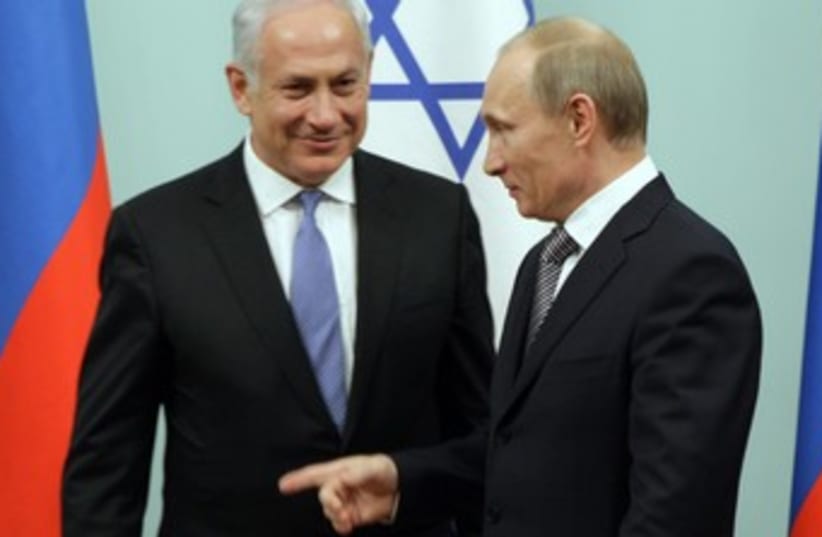
By HERB KEINONRussia's Putin with Netanyahu in Moscow 370 (R)(photo credit: RIA Novosti / Reuters)
Russian President Vladimir Putin, whose support for Syrian President Bashar Assad is straining his ties with the West, is scheduled to visit Israel on Monday for a short trip one diplomatic official said is designed to send a clear message to the world: Russia is a key player in the region that needs to be taken into account.While the official purpose of the 24-hour visit will be to dedicate a memorial in Netanya to the Red Army defeat of the Nazis, talks between Putin and Prime Minister Binyamin Netanyahu will center on Russia’s policy of propping up Assad in Syria and on the talks with Iran. Russia is a member of the P5+1 group – which also includes the US, China, France, Britain and Germany – negotiating with Tehran.Putin last visited Israel in 2005, during his first term as president in a ground-breaking first-ever Russian presidential visit here. While one diplomatic official acknowledged the differences of opinions between Moscow and Jerusalem on issues surrounding Iran, Syria and the diplomatic process with the Palestinians, it was critical for Israel to keep open a good channel of communication with the Kremlin.Moscow, the official said, also recognizes that Israel is a central player in the region, even if it is firmly in the American camp.Another diplomatic official – again not downplaying the policy differences between Israel and Russia – said that there has been an “amazing improvement” in ties with Moscow since the Soviet era, when the Kremlin actively helped Israel’s worst enemies with the goal of hurting Israel.“Obviously we don’t agree about everything,” the official said, “but we have a constructive dialogue.”During an interview published Thursday in The Washington Post, Defense Minister Ehud Barak alluded to the conversation that needed to be had with Russia regarding Syria.Asked whether he thought the West should arm the Syrian opposition, Barak said many steps should be taken, adding that “Russia has invested a lot of political capital and money in the [Assad] regime. They should have a certain role if we want to succeed.”Barak said that if “America and Russia talk[ed] together about who can use what leverage, that could be extremely effective... It’s time for the world to dictate to Mr. Assad to move out of power or else. But the ‘or else’ can be convincing only if America and Russia will join hands,” he said.Barak said he thought the Russians could “in an honest, frank discussion” be convinced to cooperate on Syria. “They could have a major role in helping to solve the Syrian issue.”Putin, accompanied by a delegation that includes a large entourage of 60 journalists, will land Monday morning and be met by Foreign Minister Avigdor Liberman, who met him in Moscow late last year and declared that the presidential elections there were fair and democratic. That position was controversial and at odds with the declared position of US Secretary of State Hillary Clinton.Putin will go directly to Netanya for the dedication of the memorial, believed to be one of the only, if not the only, memorial to the Red Army in a country that was not formerly part of the Soviet bloc. One government official said this showed “the unique historic relationship between the two countries.”Netanyahu announced the plans to build the memorial commemorating the Red Army’s victory over Germany in World War II during his visit to Moscow in February 2010.Approximately 25 million Soviets were killed during World War II, including some 11 million Red Army soldiers.The number of Jews who fought in the Red Army has been put at around 500,000, of which nearly 200,000 are believed to have been killed.Following the dedication ceremony, Putin will go to Jerusalem for meetings with Netanyahu. There will be a one-on-one meeting between the two leaders, followed by statements to the press and a working luncheon with staff.Liberman will attend that meeting, as well as a meeting in the evening between Putin and President Shimon Peres.Peres will then host a state dinner in the Russian leader’s honor.The next day, Putin will travel to Bethlehem to dedicate a Russian cultural center, and then on to Jericho where a meeting is expected with Palestinian Authority President Mahmoud Abbas. From there, he will go to Jordan for talks with King Abdullah II, and then back to Moscow.
if(catID != 151){
var cont = `Take Israel home with the new Jerusalem Post Store