Amid speculation Quartet may give statement on final settlement, J'lem officials worry only Palestinian considerations will be reflected.
By HERB KEINONquartet REUTERS 311(photo credit: REUTERS)
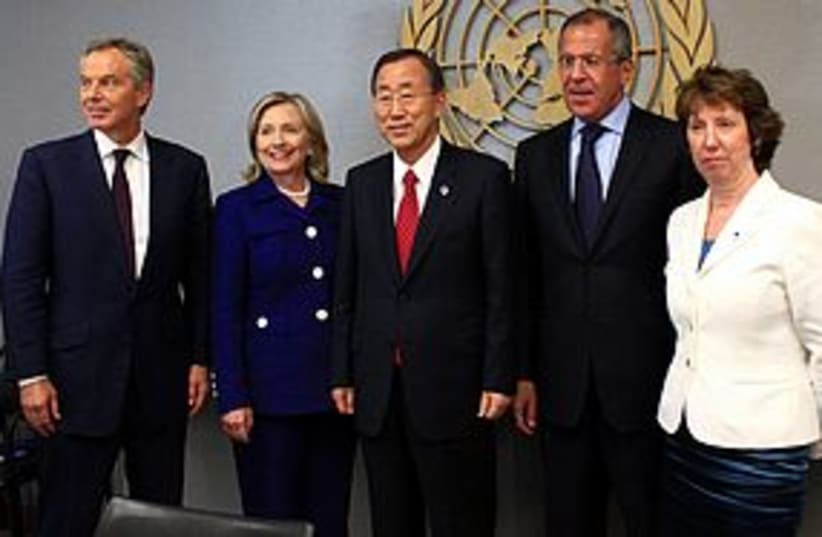
If the Quartet feels obligated to propose outlines of a final Israeli-Palestinian settlement at the end of its upcoming meeting, it needs to take into account Israeli demands, not only Palestinian ones, government sources said this week amid speculation the Quartet may delineate how it sees a final settlement.Britain, France and Germany have reportedly been urging the EU and the UN to propose a statement that would say that a future agreement would be based upon the 1967 lines “with agreed upon land swaps,” and reach a “just fair and agreed solution to the refugee question.” One of the key sticking points in relaunching Israeli-Palestinian negotiations has been the Palestinian insistence that the baseline for talks be a return to the 1967 lines, and Israel’s position that those lines are not sacrosanct, and that what needed to be discussed were secure and defensible borders – something Israel says is not provided by the 1967 lines.RELATED:Israel, PA lobby Quartet over issue of ‘67 bordersAbbas calls for full Palestinian membership in the UNIsraeli officials have recently articulated frustration that some inside the EU are interested in the Quartet issuing a statement mentioning the “1967 lines with agreed upon land swaps,” while ignoring Israeli demands, such as that any future Palestinian state needed to be “demilitarized,” and that the Palestinians must recognize Israel as the nation state of the Jewish people."Why get specific on the issue of borders, but not on anything else?” one official asked.The possibility of the Quartet – made up of the US, EU, Russia and the UN – issuing a farreaching statement is seen by some diplomatic officials as a reflection of that body’s impatience with the stalemated diplomatic process, and an attempt to entice the Palestinians back to the negotiating table.Quartet envoy Tony Blair articulated this sense of urgency in an article in the Wall Street Journal and the Times on March 19, stating that “we ignore the importance of the peace process between Israelis and Palestinians at our peril. This absolutely must be revitalized and relaunched. I know it is said that this wasn’t the issue behind the uprisings.That is true. But we are deluding ourselves if we don’t think that its outcome matters profoundly to the region and the direction in which it develops.”The idea of the Quartet presenting what it sees as the parameters of a future solution is viewed by some in Jerusalem as an attempt to show the Palestinians an “end game,” so they might overcome their objections to negotiating with Prime Minister Binyamin Netanyahu until he stops all settlement construction, including in Jerusalem.Israeli officials, however, doubt this tactic will work, and that if the Palestinians see that they can get benefits from the international community as a result of refusing to engage with Israel, they will continue to refuse to negotiate, believing this will bring them even more.They also say that this creates the “illusion” that the international community can deliver a peace agreement while avoiding Israel, something one official characterized as a “mirage.”The Palestinians will only return to the table, the official said, if the international community makes clear that the Palestinians will get nothing without returning to talks.The Quartet is expected to meet in mid-April at the most senior level – US Secretary of State Hilary Clinton, EU foreign policy chief Catherin Ashton, Russian Foreign Minister Sergei Lavrov, UN Secretary General Ban Ki-moon and Blair. No date or venue has yet been set, leading to some doubt in Jerusalem about whether the meeting – at a time when the world’s attention is focused on other nations in the region – will even take place.A planned high-level Quartet meeting in March was cancelled, soon after Netanyahu’s aides indicated that he was on the cusp of delivering a major policy address, likely to the US Congress in May. Talk about that address has been overshadowed by regional events, including the terrorist attacks in Itamar and Jerusalem, and the continuing shelling of the south.Nevertheless, Netanyahu is still planning on going to Washington toward the end of May, coinciding with the annual American Israel Public Affairs Committee meeting in Washington that begins on May 22. He also is still planning an address to Congress.
Related TagsTony Blair
if(catID != 151){
var cont = `Take Israel home with the new Jerusalem Post Store