Shas spiritual leader says Ashkenazim should show gratitude to Sephardi party for housing subsidies; denounces Amnon Yitzhak.
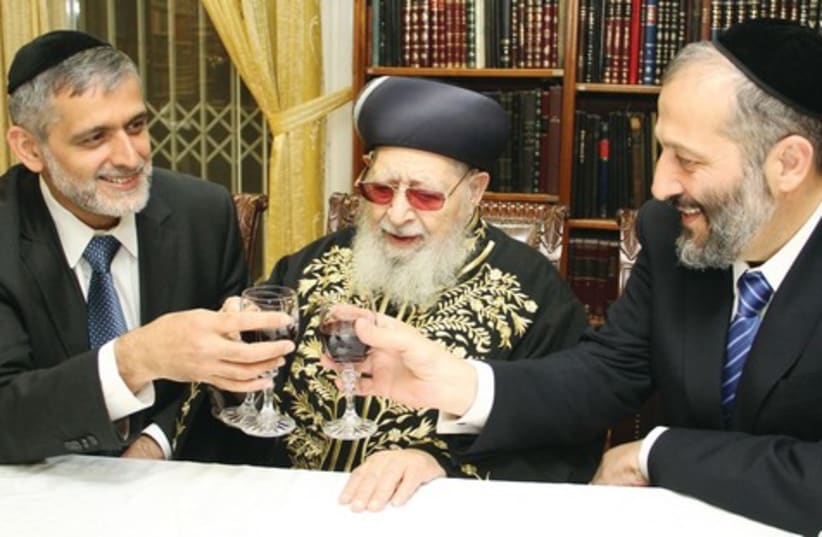
By JEREMY SHARONEli Yishai, Rabbi Ovadia Yosef and Arye Deri 521(photo credit: Marc Israel Sellem)
With the imminent opening of election booths, the Shas Party’s political and spiritual leadership issued their final campaign messages on Monday, along with a general call to get out the vote for Tuesday’s election.Joint Shas leader Arye Deri returned to the two major themes of the party’s election campaign, protesting socioeconomic divides in the country and the preservation of the status quo with regards to matters of religion and state.“The gaps in Israeli society are growing every year and it hurts me to hear and see these serious differences between those who have and those who don’t,” Deri said on Monday. “I came back to politics for the weak sectors of society, a sector which is growing and that has to chose between buying bread and buying medicine, between heating their homes and a buying a bus pass.”The Shas co-leader said that the creation of a better social safety net was required to ameliorate these problems, although he noted that the budget deficit must also not be increased.Click for full JPost coverageOne solution Deri proposed is to lower VAT on basic items and to fund that reduction by increasing taxes on luxury goods.“The time has come for the rich to pay more and the poor to pay less,” he declared.Shas has come under fire during the campaign from former party MK Haim Amsalem, who was expelled from Shas for publicly opposing the party’s stance on discrimination against Sephardi school girls in haredi schools and its position on conversion.Speaking to The Jerusalem Post last week, Amsalem dismissed Deri’s advocacy for Israel’s poor and in particular for Sephardim as insincere, saying that he had done nothing for the poor Sephardi community in 30 years.“What has he done so that there shouldn’t be unemployed Sephardim?” Amsalem asked. “Nothing. He continues to talk about it and will talk about it in the next elections too.“But he hasn’t allowed Sephardim to study. They need to study the core curriculum in order to be able to integrate into the work force, but how can they study when they’re sent to yeshiva to study only Torah?” he said.Bayit Yehudi leader Naftali Bennett said on Facebook that he hoped the current election would be the last one to include “ethnic overtones,” alluding to the frequent references made by Deri and Shas to what they argue are discernible economic disparities between the Sephardi and Ashkenazi sectors.“I also hope [this is the case],” retorted Deri sardonically. “Very much.”In a surprising step, Shas spiritual leader Rabbi Ovadia Yosef called on Ashkenazi voters to cast their ballots for the Sephardi party. Yosef said that many Ashkenazim had received subsidized housing because of the efforts of Housing and Construction Minister and Shas MK Ariel Attias, and that they should show their gratitude by voting Shas.Opinion polls have shown that Shas is struggling to improve on its haul of 11 Knesset seats in the 2009 election.Both Shas and the Ashkenazi haredi United Torah Judaism party are concerned with their failure to increase their share of the vote despite the haredi population’s rapid rate of growth.Yosef also took the opportunity to fiercely denounce haredi preacher Rabbi Amnon Yitzhak for running his Koah Lehashpia Party in competition with Shas for religious Sephardi voters.Shas is concerned that votes cast for Koah Lehashpia will cause it to loose a Knesset seat.“Amnon Yitzhak is stealing votes from us, I am greatly pained by his evil deeds,” Yosef said, pointedly omitting Yitzhak’s title as a rabbi. “He does not fear Heaven, everything he does is for his own honor.“Anyone who votes for him I will not forgive, not in this world and not in olam haba [the world to come],” the rabbi threatened. “Because our strength is in the Torah and Shas will protect the Torah.”As well as socioeconomic issues, Deri also mentioned Shas’s other main campaign platform over the weekend, slamming Bayit Yehudi’s Ayelet Shaked for saying that her party would institute civil marriage for couples in which one partner was Jewish and the other not, as well as her comments that the party seeks to take control of and reform the conversion process.Shaked later clarified that she had meant that she supported civil marriage for two non-Jews.In comments made on his Facebook page, Deri said that he “apologized” for a controversial ad campaign on conversion, broadcast by the party, “not for the message or the use of national stereotypes,” but instead for not directing the ad against Bayit Yehudi as well as the original target Yisrael Beytenu.“Bennett and Shaked will harm Jewish identity. If this is the ‘Jewish home’ they’re offering, I suggest they move house,” Deri jibed.The ad disparaged the conversion system and proposals to reform and expedite the conversion process, with a tall, blonde woman with a heavy Russian accent receiving a conversion certificate by fax after dialling “1-800 conversion” while standing under a wedding canopy with her husband-to-be.Deri said that the use of stereotypes had not meant to offend anyone, and had “no racist motivation, God forbid,” but was a way, “often employed in satire” of emphasizing the party’s message that it would combat “the immoral phenomenon of fictitious conversions.”National-religious political parties and interest groups view as problematic the intermarriage of Israeli Jews and the some 330,000 Israelis from the former Soviet Union who are of Jewish descent, but not defined as Jewish according to Jewish law.Such groups see reform of the conversion process, especially for those of Jewish descent, as a vital tool in combating further intermarriage.The idea is anathema to the haredi political parties however, who insist that converts commit entirely to fully and strictly observing all aspects of Jewish law before being accepted.Despite his party’s hard-line policy on the issue, Yosef is known to hold a more lenient approach to conversion.Separately, the Central Election Committee levied a NIS 36,000 fine on Shas for distributing campaign leaflets in which Yosef says that anyone voting for Shas will be blessed.Such practices are illegal and the committee has previously warned Shas not to engage in this kind of electioneering.
if(catID != 151){
var cont = `Take Israel home with the new Jerusalem Post Store