'Experiments misjudge plant responses to climate change'
“Findings have extensive consequences for predictions of species diversity, ecosystem services,” expert at UCSD says.
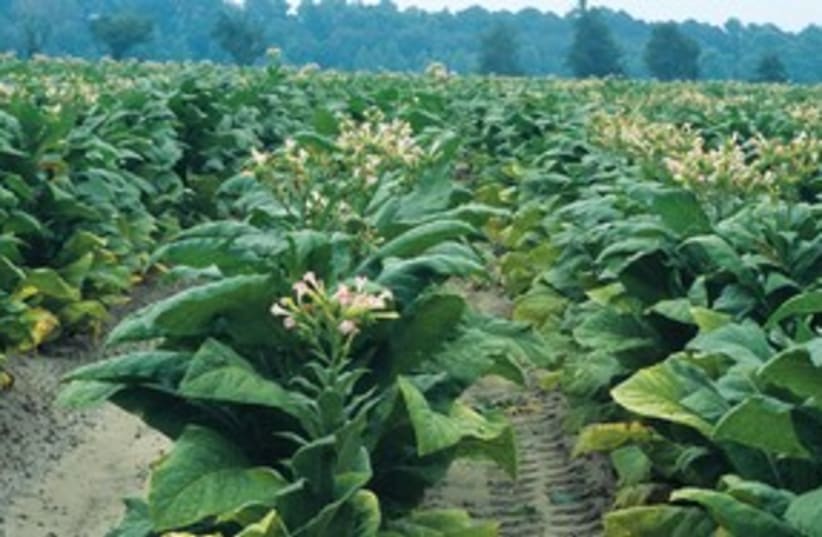
By UNIVERSITY OF CALIFORNIA, SAN DIEGOTobacco plants 311(photo credit: Thinkstock/Imagebank)
Experiments may dramatically underestimate how plants will respond to climate change in the future. That’s the conclusion of an analysis of 50 plant studies on four continents, published this week in an advance online issue of the journal Nature, which found that shifts in the timing of flowering and leafing in plants due to global warming appear to be much greater than estimated by warming experiments.“This suggests that predicted ecosystem changes—including continuing advances in the start of spring across much of the globe—may be far greater than current estimates based on data from experiments,” said Elizabeth Wolkovich, an ecologist at the University of British Columbia who led an interdisciplinary team of scientists that conducted the study while she was a postdoctoral fellow at the University of California, San Diego.“These findings have extensive consequences for predictions of species diversity, ecosystem services and global models of future change,” said Elsa Cleland, an assistant professor of biology at UC San Diego and senior author of the study, which involved 22 institutions in Canada, Sweden, Switzerland, the U.K. and the U.S. “Long-term records appear to be converging on a consistent average response to climate change, but future plant and ecosystem responses to warming may be much higher than previously estimated from experimental data.”Predicting plant responses to climate change has important consequences for human water supply, pollination of crops and the overall health of ecosystems. Shifts in the timing of annual plant events—which biologists call “phenology”—are some of the most consistent and visible responses to climate change.Long-term historical records show that many plant species have shifted their leafing and flowering earlier, in step with warming temperatures over recent decades. Because historical records are not available in most locations and climate change may produce temperatures higher than previously recorded, however, ecologists often rely on experiments that warm small field plots to estimate plant responses to temperature and project future conditions.With support from the National Center for Ecological Analysis and Synthesis, a research center funded by the National Science Foundation, the State of California and the University of California, Santa Barbara, the scientists created new global databases of plant phenology to compare the sensitivity of plants to temperature— that is, how much plants shift their timing of leafing and flowering with warming. These were calculated from experiments and then compared to long-term monitoring records.Wolkovich and her colleagues found that experiments underpredicted plant phenological responses to temperature by at least fourfold compared to long-term records. Long-term historical records consistently showed that leafing and flowering will advance, on average, 5 to 6 days per degree Celsius—a finding that was strikingly consistent across species and datasets.“These results are important because we rely heavily on these experiments to predict what will happen to communities and ecosystems in the future,” said Ben Cook, a climatologist at the NASA Goddard Institute for Space Studies and Columbia University, who helped bring together the research team.Wolkovich said a number of factors could explain this discrepancy—including additional effects of climate change not mirrored by warming experiments, or specific aspects of the experimental design such as the degree of warming. But her team’s analyses found that within the range of temperature increases considered, responses were not noticeably affected by the degree of warming or the number of years the study spanned. Instead, the discrepancy may be driven by exactly how researchers manipulate temperatures and how accurately they measure them.“Researchers use a variety of methods to increase temperatures in the field—including heating cables in the soil, small greenhouse-like structures and heating above plants,” explains Wolkovich. “We found that plant sensitivities to temperature vary with the design of the experiment, with above plant warming producing consistent advances in flowering.”Additionally, because the comparison was based on a metric that considered plant responses per degree Celsius of temperature change, experiments that overestimate their temperature increases could underestimate the change in leafing and flowering per degree of warming. The difference in estimated responses from experiments versus long-term records has important consequences for predictions of species diversity, ecosystem services and global models of future change.“Continuing efforts to improve the design of warming experiments while maintaining and extending long-term historical monitoring will be critical to pinpointing the cause of the mismatch,” said Wolkovich. “These efforts will yield a more accurate picture of future plant communities and ecosystems with continuing climate change.”The study was funded by the National Science Foundation, the State of California and the University of California, Santa Barbara.This article was first published at www.newswise.com
if(catID != 151){
var cont = `Take Israel home with the new Jerusalem Post Store