Society for the Protection of Nature in Israel says Israel Military Industries complex planned for land with rare plant species.
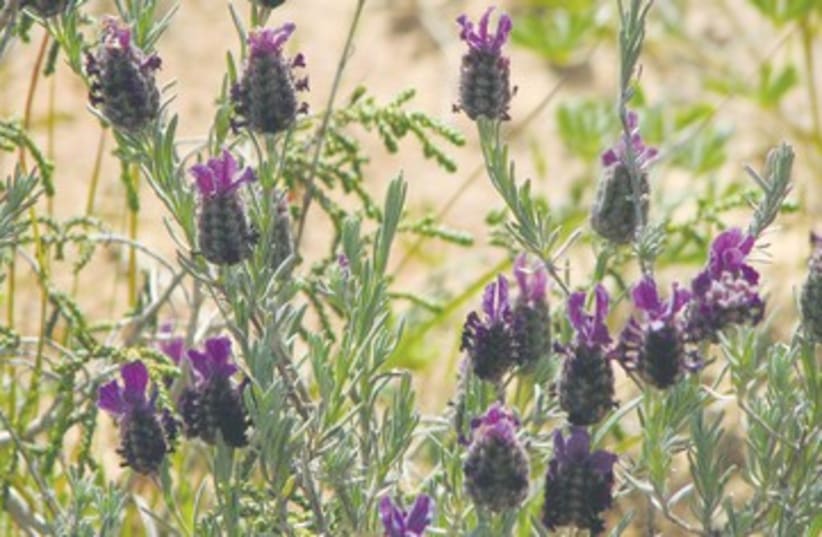
By SHARON UDASINFrench Lavender in Israel 390 (photo credit: SPNI)
An Israel Military Industries complex planned for the Sharon region is to be built on land containing 370 species of plants – 50 of which are either protected or rare, the Society for the Protection of Nature in Israel said on Monday.The compound, which is slated to contain 23,000 housing units, is supposed to be located on a cross-section of land in Ramat Hasharon, Herzliya, Hod Hasharon and the South Sharon Regional Council, according to the survey, which was conducted by ecological and environmental consultant Dr. Ron Frumkin and commissioned by the Israel Lands Authority.The land, however, contains 370 plant species, of which 23 are considered protected and 27 are considered rare. Of these, the existence of 14 species is in jeopardy, and 20 of the total have very limited geographical distribution.“Unfortunately, the habitats of plants such as those found in the survey have drastically shrunken on the Coastal Plain, and it is crucial to ensure the preservation of the natural area in the Sharon IMI [Israel Military Industries] complex at a level of utmost importance,” said Moshe Perlmutter, wildlife coordinator for SPNI. “Today, the planning for the different areas of building and development in the Sharon IMI plan are advancing while completely ignoring the nature survey and its findings; many areas in which rare and protected species were found are intended for construction.”The survey looked at the entire 746-hectare (1,830-acre) area, of which 466 hectares will be within IMI fencing.Among the protected species in Frumkin’s survey are the holy orchid, crown anemone, snake tongue orchid, common gladiolus, sun’s-eye tulip, field lupin, hyacinth squill and pink butterfly orchid. Among the rare species are French lavender, Italian medick, snail medick, galium philistaeum, smooth cat’s ear, maresia nana, European umbrella milkwort, spotted rockrose, yellow lupin and Labillardiere’s clover.Objections to the program must be filed with the Israel Land Authority by next week, and SPNI said it was preparing an official objection, focusing on the natural assets of the land and pushing for a network of open space to remain in the region.“SPNI seeks to implement significant changes in the plan and to adjust the future plan to findings on the subject of soil contamination and the findings of the natural assets survey that has been carried out in the area,” Perlmutter said.Key changes, according to Perlmutter, would leave the scope of the development in place, but bring changes in location and distribution, “enabling maximal preservation of the natural areas” and maintaining continuity among them.Ideally, within the complex, the developers would create a designated and protected nature park for the rare plants, he said.“The planners have the unparalleled opportunity to preserve and nurture natural and continuous lands and to create a designated and uniquely vast nature park, to which there is nothing similar in the country’s Center, which will constitute a ‘Garden of Eden’ for the existence of many wild plants, some of which are endangered,” Perlmutter said. “No less important, the nature park at the IMI complex would serve the hundreds of thousands of residents of neighboring cities, as well as the millions of residents in the center of the country, and it would enable travel and recreation in the bosom of nature near home, as well as a significant improvement in the welfare and quality of life of the residents.”A spokeswoman for IMI said it was not responsible for zoning assignments and that this was the responsibility of the Israel Lands Authority and the Interior Ministry.Meanwhile, a spokeswoman from the ILA said that under the framework of the survey, dozens of reviewers mapped out the species and collected bulbs and seeds that it intends to have distributed in the complex area.As the developers of the plan, the ILA sees this subject as a crucial consideration in the development of the plan, and will use both this and other important elements as guides for the program, the spokeswoman said.Today, the plan exists on a descriptive level only, and no building permits have been issued, according to the ILA. A detailed design process will take into account all the natural assets found in the survey, as well as many other factors to consider in planning, the spokeswoman added.
if(catID != 151){
var cont = `Take Israel home with the new Jerusalem Post Store