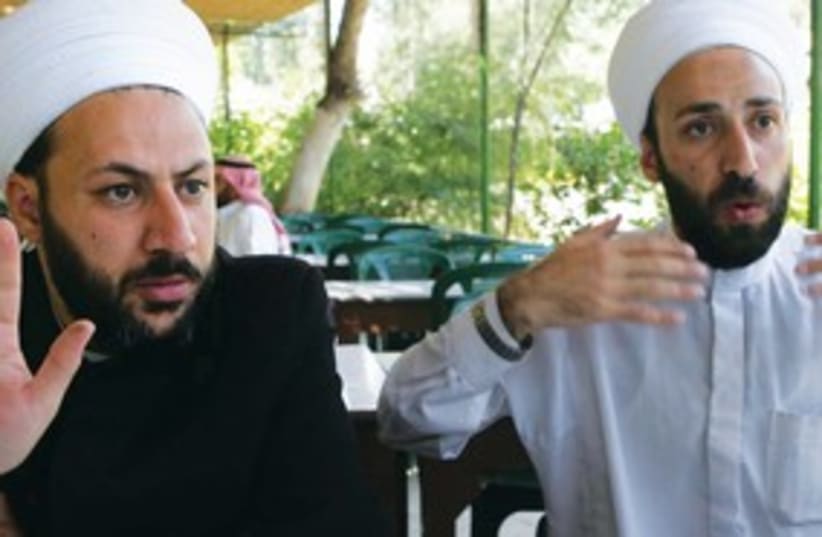
By JONATHAN SPYERKurds 311(photo credit: Paul Assaker/KRT/MCT)
On March 21, 2010, the Syrian security forces opened fire with live ammunition on a crowd of 5,000 in the northern Syrian town of al-Raqqah. The crowd had gathered to celebrate the Kurdish festival of Nowruz. Three people, including a 15-year-old girl, were killed. Over 50 were injured. Dozens of injured civilians were held incommunicado by the authorities following the events. Some remain incarcerated. This incident was just one example of the repression taking place of the largest national minority in Syria – namely, the Syrian Kurdish population.Kurds constitute 9 percent-10% of the population of Syria – that is, around 1.75 million in a total population of 22 million. Since the rise of militant Arab nationalism to power in Damascus, they have faced an ongoing campaign for their dissolution as a community.All this is taking place far from the spotlight of world attention. The current US Administration pursues a general policy of considered silence on the issue of human rights in Middle East countries. The Syrian regime remains the elusive subject of energetic courting by the European Union and by Washington.As a result, the Kurds of Syria are likely for the foreseeable future to remain the region's forgotten minority.The severe repression suffered by the Syrian Kurds has its roots in the early period of Ba’ath rule in Syria. The Arab nationalist Ba’athis felt threatened by the presence of a large non-Arab national majority, and set about trying to remove it using the methods usually associated with them.In 1962, a census undertaken in the area of highest concentration of Kurdish population in Syria – the al- Hasaka province – resulted in 120,000-150,000 Syrian Kurds being arbitrarily stripped of their citizenship.They and their descendants remain non-persons today.They are unable to travel outside the country, to own property, or to work in the public sector. People in this category today number about 200,000 – though no official statistics exist for them. They are known as ajanib (foreigners).A large additional group of around 100,000 Kurds in Syria remain entirely undocumented and unregistered.This group, known as maktoumeen (muted), similarly live without citizenship or travel and employment rights.The bureaucratic struggle of the Syrian regime to wish away its non-Arab population has been accompanied by practical measures on the ground to alter the demographic balance of the country.In the 1970s, a campaign of “Arabization” of Kurdish areas commenced, on the order of president Hafez Assad. The intention was to create a “belt” of Arab population along the northern and northeastern borders of Syria with Turkey and Iraq, where most of the country’s Kurds live. The purpose of this was to prevent Kurdish territorial contiguity. Kurdish place names were changed to Arab ones, Kurds were deprived of their land and instructed to re-settle in the interior. Kurdish language, music, publications and political organization were banned. It was forbidden for parents to register their children with Kurdish names.The vigorous policy of Arabization later largely faded into bureaucratic torpor. But for a while it produced the desired result – of a divided, demoralized, repressed and largely silent population.THIS SITUATION no longer pertains. In March 2004, following the recognition of Kurdish autonomous control of northern Iraq, something resembling an uprising began among the Kurds of Syria.The spark that ignited the wave of protests that month was the shooting dead of seven Kurds by the security forces following a clash between Kurds and Arabs at a football match in Qamishli, a city of high Kurdish population close to the Turkish border. Further shootings took place at the funerals of the dead, and unrest spread across the Jazira, and as far as Aleppo and Damascus. The army moved into the Kurdish areas with heavy armor and air cover, and the protests were crushed.Despite conciliatory noises made by President Bashar Assad following the 2004 unrest, nothing of substance has been done to change the conditions endured by Kurds in Syria. As a result, the situation since 2004 has been one of simmering tension between the Syrian regime and its Kurdish subjects, with occasional flareups.In August, 2005, and again in October, 2008, and then again earlier this year, there were clashes between Kurdish citizens and the security forces in Qamishli, with some deaths and many arrests.Syrian oppositionists speak of the emergence of a young, increasingly nationalistic younger generation, estranged from the Arab opposition in Syria as well as from the regime. As yet, no single movement has emerged to reflect this sentiment. Twelve different political parties exist among the Kurds of Syria, a reflection of the peculiar divisiveness to which regional opposition movements in general, and Kurdish ones in particular, remain prone.For a variety of reasons, the Kurds have difficulty making their voices heard on the international stage. Their oppressors are fellow Muslims, rather than Christians or Jews, so the powerful alliance of Muslim states on the international stage is not interested. Arab states are by definition indifferent or hostile to their concerns.And with their regular lucklessness, they now face a situation where the rising powers in the region – Turkey and Iran – and their enthusiastic smaller partner Syria all have sizable Kurdish populations and a shared interest in keeping them suppressed.The misfortune of the Syrian Kurds is compounded by the fact that contrary to the accepted cliché, the enemy of their enemy is not their friend. This is because the enemy of the Syrian Kurds’ enemy is the west and the United States. These are today led by a philosophy which believes in accommodating, rather than confronting rivals. As a result, the systematic, half-century old campaign of the Syrian Arab Republic to nullify the existence of its Kurdish minority looks set to continue apace.The writer is a senior researcher at the Global Research in International Affairs Center, IDC, Herzliya.
if(catID != 151){
var cont = `Take Israel home with the new Jerusalem Post Store