Ankara facing the possibility of sharing long-term borders with two semi-sovereign Kurdish entities.
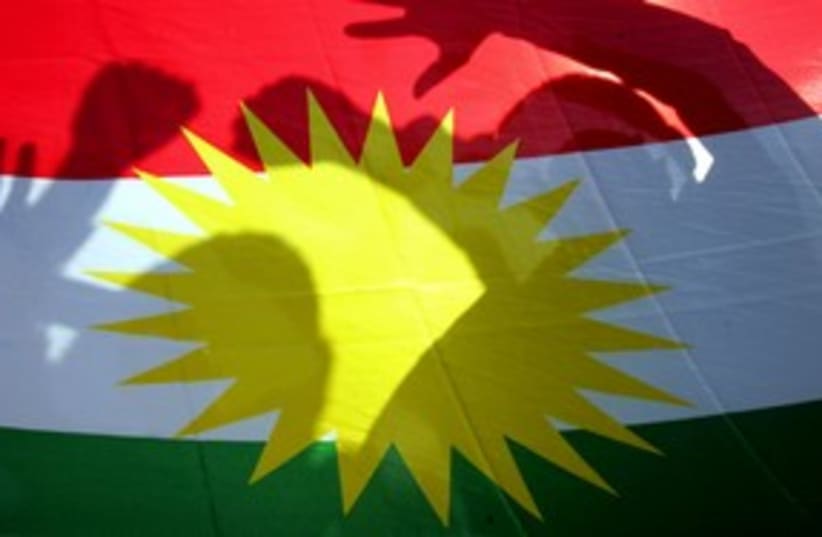
By JONATHAN SPYERKurds pose behind Kurdish flag_311(photo credit: Mike Finn-Kelcey/Reuters)
Turkish forces have launched a major offensive in recent days against positions held by the PKK rebel movement in the area of the Turkish-Iraqi border. Up to 2,000 troops are taking part in the operation, according to Turkish media sources.Turkey’s Interior Minister, Idris Naim Sahin, claimed that 115 Kurdish rebels had been killed by the Turkish security forces – an assertion dismissed by the PKK, which itself claims to have killed up to 49 Turkish soldiers.The fighting has been going on since July 24, when the Turkish army responded in force to a PKK attempt to seize control of the road between the towns of Semdinli and Gerdiya. The authorities have closed off the area, making it difficult to attain an accurate picture of events on the ground.A PKK media statement described the Semdinli area as an “area of war,” involving “thousands of enemy soldiers and hundreds of guerrillas,” in which Turkey is using “tanks, warplanes, helicopters and other military technology.”Semdinli’s mayor, Sedat Tore, who is affiliated with the Kurdish BDP party, told The Economist magazine that Semdinli’s residents are currently surrounded by a “circle of fire.”From the point of view of the government in Ankara, however, the circle of fire is a Kurdish one, directed against Turkey and currently increasing in its dimensions.The Turkish move comes at a time when Ankara is deeply concerned at the notable improvement in the strategic position of the Kurds as a result of a series of regional developments. Currently unable to influence events in Syria and Iraq, Ankara appears to be trying to draw a line in the sand at its own border. Turkey is seeking to scotch any attempt to foment unrest among Kurds in Turkey who might feel emboldened as a result of the improving Kurdish position in Syria and Iraq.Turkey’s concerns, from its point of view, are easy to grasp. Contrary to endless media reports that the situation in Syria has entered its “endgame,” the civil war now under way in that country shows no signs of nearing conclusion. Rather, the various sides are entrenching themselves in their sectarian strongholds and preparing for a long and drawn-out struggle.Central government in Syria no longer exists in a meaningful sense. The Kurds of Syria’s northeast have taken advantage of the regime’s desire to entrench and consolidate its forces. The Syrian Kurds are natural opponents of the Arab nationalist Assad regime.But there is also deep suspicion of the Turkish-backed, Muslim Brotherhood dominated Syrian National Council.There is a strong desire in the Kurdish northeast of Syria to stay out of the fight. Kurdish paramilitaries in that area have sought to prevent the rebels of the Free Syrian Army from activity that could bring down regime retribution.The regime is now seeking to concentrate its forces in the most volatile and vulnerable areas and is pouring troops into the battle for Aleppo. To free up personnel from its limited pool, it has carried out a withdrawal from the main parts of Kurdish-dominated Hasakah governate.This area is now under the de facto control of a coalition of Kurdish forces. These forces, in turn, are dominated by the PYD (Democratic Union Party).This is the franchise of the PKK among the Syrian Kurds. The area now controlled by the coalition led by the PYD includes a long swathe of the 900-kilometer border between Turkey and Syria. This raises the possibility of a new front, directed by the PKK and its allies, from an area of Kurdish autonomy.The PKK currently maintains its main stronghold in the Qandil mountains between Kurdish-controlled northern Iraq and southern Turkey. Ankara is now dealing with the possibility of this situation being duplicated on another of its borders.Turkish Prime Minister Recep Tayyep Erdogan has made clear that Turkey sees intervention against rebel bases in northern Syria as its “most natural right.”Turkish forces and missile batteries were moved to positions adjacent to the Kurdish enclave in Syria in recent days.Ankara maintains good relations with the Kurdish Regional Government of Massoud Barzani in northern Iraq. But Turkey was further concerned by Barzani’s brokering in his capital, Erbil, of the agreement between the PYD and the non-PKK-affiliated Syrian Kurdish factions of the KNC (Kurdish National Council), which has made possible joint Kurdish control of the areas abandoned by Assad.Turkey’s political strategy appears to involve deepening relations with Barzani and the KRG, while seeking to marginalize the PYD.The PYD, for its part, has sought to stress that Turkish concerns regarding the Syrian Kurds are groundless and that its focus is on ensuring the security of its own community, rather than seeking a base for military action against Turkey.From a limited, military perspective, this is probably true. The land between northeast Syria and Turkey is less suited for guerrilla actions than is the Qandil mountain area. And Turkey’s track record suggests that it would not hesitate to respond in force to any such actions.But from a longer-term strategic perspective, Turkey does indeed have grounds for concern. A series of events in the Arab world over the last decade have for the first time put the borders in place since the collapse of the Ottoman Empire in 1918 seriously into question. The Kurds, who were the central losers from those borders, are the main beneficiaries of this.The US invasion of Iraq allowed a semi-sovereign Kurdish enclave in northern Iraq to come into existence.This enclave, while seeking normal relations with Turkey, also permits the use of its territory by rebels engaged in an insurgency on behalf of Turkey’s large Kurdish population.As a result of the outbreak of civil war in Syria, another Kurdish enclave has emerged in Syria. This enclave is dominated by the sister party to the PKK. But the Iraqi Kurds also exert influence there.As Arab borders and the integrity of Arab states look more shaky than they have at any time in living memory, Turkey faces the possibility of sharing long-term borders with two semi-sovereign Kurdish entities.The specter of eventual Kurdish sovereignty and Turkish fear of this are also discernible in the air.From this point of view, it becomes easy to understand why a move by the PKK in the Semdinli area received such a furious response from the Turkish state army. Ankara is utterly determined to prevent the extension of any Kurdish Spring to its own 25-percent Kurdish minority, and will evidently employ whatever measures and means it deems necessary to ensure this.
if(catID != 151){
var cont = `Take Israel home with the new Jerusalem Post Store