If the Indians conclude Tehran was behind attack, it could be a game changer. But that is a huge "if."
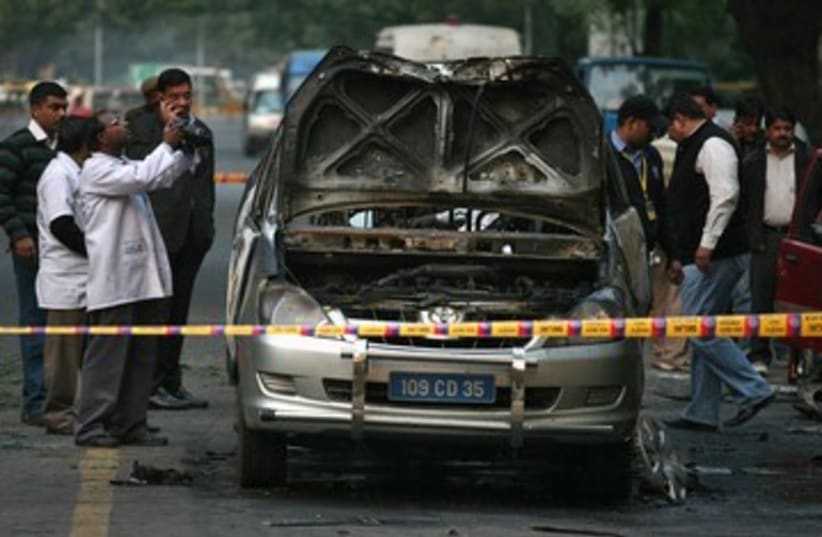
By HERB KEINONExploded car at Israeli New Delhi embassy in India 390R(photo credit: REUTERS/Parivartan Sharma)
Within a few hours of Monday’s twin attacks against Israeli diplomatic targets in New Delhi and Tbilisi, Prime Minister Binyamin Netanyahu said with full confidence that Iran was behind the attacks.Defense Minister Ehud Barak and Foreign Minister Avigdor Liberman echoed his comments shortly thereafter, and Liberman hinted that Israel would take some kind of action in response.Most Israelis took as a given Iran’s hand in the attacks – either directly or through its Hezbollah proxy – including the one in India that injured Tal Yehoshua-Koren, the wife of an Israeli diplomat.The reasons for the certainty: because the attacks took place a day after the fourth anniversary of the killing of Hezbollah’s shadowy commander Imad Mughniyah; because Iran had vowed to avenge the assassinations of a number of leading nuclear scientists; and because the explosive device used against Yehoshua-Koren’s car was similar to the magnetic explosive devices – “sticky bombs” – that were used against some of the Iranian scientists.And for those who may have had some lingering doubts about Iran’s involvement, the arrest the next day in Thailand of two men carrying Iranian passports for the botched attack there probably put those misgivings to rest.In India, however, things were not so cut-and-dried.Though intelligence sources were anonymously quoted in various papers there as pointing a finger toward Iran, government spokesmen on the record – from the foreign minister on down – were very careful not to cast blame.A day after the attack, the Press Trust of India quoted Union Home Secretary R.K. Singh as saying “we have no evidence to name any country. It’s premature to taken any country’s name.”Call it a case of governmental cognitive dissonance.Placing the blame squarely on Iran would have huge strategic ramifications for India, which so far is sitting on the fence regarding Iran – voting against it in various international forums, but doing a robust business with it and importing nearly 12 percent of its oil from that country.“On the whole,” said Sudeep Paul, a leading columnist and assistant editor of The Indian Express newspaper’s opinion section, Monday’s attack could be a “game changer.” Not only was it the first time a diplomat was attacked in India, he said, but it also took place just a couple of hundred meters away from the prime minister’s residence, in one of the most closely-guarded districts in the country.Paul said that if it is proven that Iran was indeed behind the attack, that would mean “the Middle East conflict has come to India, and that we are now a playground where this conflict is played out.” The attack, he said, could be the trigger that finally forces India to take sides regarding Iran, an issue he characterized as a “diplomatic tightrope” for India.Everyone knows about India’s huge oil interest in Iran, but it also has common strategic interests with Tehran in Afghanistan that are less obvious. India is very concerned about what is happening in its nearby neighbor to the north, and about Pakistani influence there. As a result, the Indians have cooperated with Iran on certain projects there to reduce Pakistan’s sway and weaken the Taliban.Indeed, how India views Iran must be seen through the prism through which it views the entire world: Pakistan. While Iran under the shah supported Pakistan, Iran under the ayatollahs does not – something appreciated in New Delhi and something India does not want to see changed.Yet on the other hand, India’s relationship with Israel is also very important to New Delhi, since Israel is India’s second largest, if not largest, defense partner. An editorial in The Indian Express Wednesday called Israel a “vital ally” of India, “making enormous contributions to India’s defense.” Up until now, Paul said, India has had a nuanced policy toward both Iran and Israel, not wanting totake sides, performing a balancing act of not agreeing to sanctions against Iran, but consistently voting against its nuclear program in the International Atomic Energy Agency.BUT HARSH reality – in the form of Monday’s attack – may force India to decide where its allegiances lie.“There are three basic conflicts in the Middle East, all centered around Iran,” Paul said, citing a recent opinion piece in his paper written by noted Indian foreign policy analyst Raja Mohan. “Iran and the west, Iran and Israel and Iran and Saudi Arabia. And India, even if it does not want, will soon be dragged into it.”Apart from Israel and the US pressing India to take a firmer stance against Iran, pressure is also coming from Saudi Arabia and the Persian Gulf countries, which Paul said have been pressing India “for a long time to join against Iran.” And, indeed, there are huge Indian interests there as well, including oil and some 6 million Indian workers in the Arab world.While India would like to keep doing its robust business with Iran, with reservations about the nuclear program, the reality brought home by Monday’s attack may make that impossible.But in order for that reality to change, in order for the Indians to finally take a clear side on the Iranian issue, it will need concrete evidence that Iran was behind the New Delhi bombing. Otherwise, it will not want to complicate its ties with Iran.Israeli diplomatic officials said that Israel’s top three leaders – Netanyahu, Barak and Liberman – would not have blamed Iran had they not had concrete evidence of its involvement. But there are voices inside India, originating mainly from the country’s large Muslim community, asking how Israel could have found such concrete proof just hours after the attack. These voices also asked why that evidence has not been presented openly.Another argument raised inside India against the claim that Iran was involved is the that it would simply make no sense – in fact, it would be insane – for Iran to carry out an attack inside India and risk its ties with one of the few friends and steady customers it has left in the world.But this version of an insanity plea does not work here, said Patrick Clawson, director of research and head of the Iran Security Initiative at the Washington Institute for Near East Policy, since Iranian involvement in the attack fits in with other Iranian actions over the last few months that simply “don’t make sense.” Sacking the British embassy in Tehran, as the Iranians did in November, or organizing a plot to kill the Saudi ambassador in the US, as American officials uncovered in October, also didn’t make sense in that both incidents seemed counterintuitive to Iran’s interest. Nevertheless, Clawson said, it all happened.The New Delhi attack “fits into a pattern of really stupid things they have been doing for the last nine months,” he stated.Clawson said that if the Indians come to the conclusion at the end of the day that the Iranians were responsible for the attack, the Indian security apparatus “will be furious, just furious.”“The Indians have a lot of terror problems already with the Pakistanis,” he said. “They will ask why the Iranians are sponsoring a terrorist bomb within spitting distance of the prime minister’s residence. They will ask what they are doing setting up a terrorist cell that can operate inside India. They have enough problems already, and don’t need this.”The consequences of the anger the may result could go in many different directions. It could be relegated to an angry meeting with Iran’s envoy in New Delhi or it could take on more severe forms.“India is an important, respected voice in the IAEA and other international forums, and if the Indians conclude that the Iranians are not being helpful, and that it may be useful to isolate Iran, they could put Iran in a difficult situation,” he said. .Clawson said the Indian banking system has been “"going through the hoops trying to figure out ways to make payments to the Iranians as a result of sanctions against that country’s banks. And if India sees that this is how they are getting paid back, they might just conclude it is not worth the effort.”Monday’s blast in New Delhi may force India to reassess its entire Iranian policy if the government concludes that the Iranians were behind the attack.But reaching that conclusion – already taken for granted in Israel – is a huge “if” in India.
if(catID != 151){
var cont = `Take Israel home with the new Jerusalem Post Store