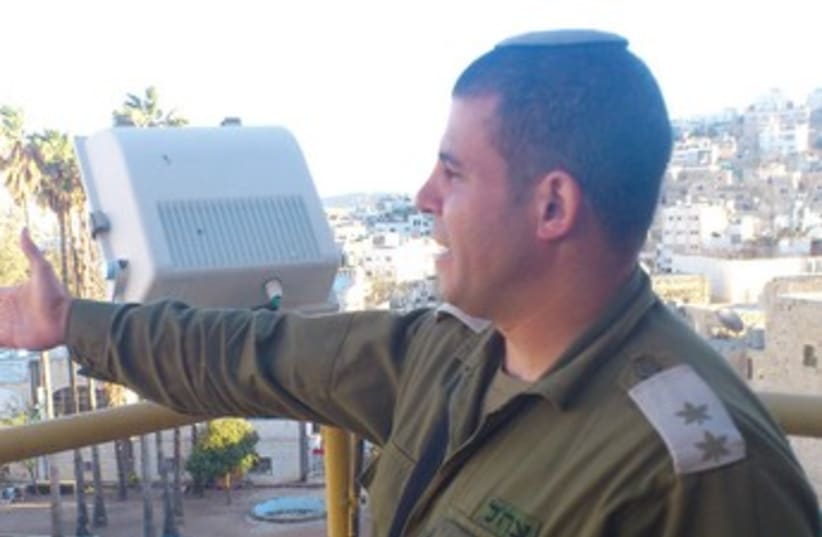
The ‘Post’ goes on patrol in Hebron with Lt.-Col. Shahar Spada, deputy-commander of the IDF’s Judea Division.
By YAAKOV LAPPINShahar Spada_370(photo credit: Yaakov Lappin)
A green bullet-proof army jeep snakes along the narrow streets of Hebron’s Old City as the sun sets over the ancient, disputed city, perched high up in the hills.Lt.-Col. Shahar Spada, deputy-commander of the IDF’s Judea Brigade, is at the wheel.“Respect is not guaranteed by rank. These marks on my shoulder don’t mean a thing,” Spada tells The Jerusalem Post as the jeep passes by hardened Palestinian youths loitering on a street corner.“Respect is earned,” Spada continues. “It’s how you behave personally with the soldiers under your command that counts, the example you set. The ultimate worth of a commander is measured by how his soldiers conduct themselves in his absence.”Minutes later, he is out of his jeep, greeting young soldiers warmly, patting them on the back and asking them how they are.Spada is a powerfully-built man who exudes optimism. Neither of these attributes can be taken for granted, in light of his life story. It is difficult, if not impossible to hear Spada’s story without being overwhelmed with a feeling of respect.Fifteen years ago, Spada was a young paratrooper on patrol in southern Lebanon, two years before Israel’s withdrawal from its security zone in the land of cedars.An explosive device went off nearby, causing him severe shrapnel wounds. He suffered a punctured lung, a broken collar bone and multiple deep shrapnel penetrations to his back. Spada somehow survived the incident, but the IDF was convinced that his career in the armed forces had come to an end.Spada, however, had other ideas. “I believe in willpower. If you want to get it done, nothing can get in your way,” he says.He spent the next 26 months rehabilitating himself, swimming laps in a pool and, eventually, jogging. He rebuilt himself back up from scratch.“The first time I cried was from the frustration I felt when the IDF called me to say I would be discharged because of my injuries,” he recalls. “It was like a knife to the heart.” Spada admits that “everyone thought I was crazy” for wanting to go back, including thenpresident Ezer Weizman, who visited him personally.Spada fought tooth-and-nail against the decision to discharge him, arguing with seven army medical committees before finally being approved for service by an eighth committee, a day he describes as one of the happiest in his life. “We have no other country,” he says, summing up the motivation for his actions.“I took no disability benefits, nothing from this country,” he says. “As long as I can stand on my feet, and as long as I have the family God gave me, I have everything I need.”Back in the army, Spada quickly rose through the ranks, passing a commander’s course. His motivation for becoming a commander, he said was the unparalleled satisfaction of leading soldiers in the defense of their country.He was in the thick of the fighting during Operation Defensive Shield in 2002, taking part in intense urban warfare against Palestinian gunmen and suicide bombers in Nablus, Kalkilya and Tulkarm, when one night he received a call from the army informing him that a suicide bomber was heading toward an Israeli target. “I learned the details on the route. The adrenaline was high. We captured him, with the explosives,” he says. As fighting erupted across the West Bank, Spada married the love of his life, with whom he would go on to have four daughters.An officer who had been a guest at his wedding was killed in a firefight just two days after the ceremony.FEW STORIES encapsulate the proximity of ordinary family events and extreme violence that characterize Spada’s life as much as the events that unfolded on the night before his first baby daughter’s naming ceremony.In the middle of the night, Spada was called out with his unit to Kalkilya to intercept a terrorist. A firefight ensued, and his subordinate was shot in the leg.Spada saw that the wound was not life threatening, borrowed his subordinate’s bulletproof vest and charged into the battle zone, exchanging fire with the terrorist before shooting him dead.Soon afterward, Spada returned to his home, where his anxious wife was waiting. “I asked her to give me a haircut because I looked a mess,” he says."I can go from zero to 100 in seconds,” says Spada, acknowledging, though, that this ability to spring into action was earned at a high price.In the summer of 2006, Spada was studying Middle Eastern affairs at Bar-Ilan University when he heard that another war had broken out. He rushed to join the paratroopers, entering southern Lebanon once more to fight against Hezbollah terrorists in house-tohouse combat.Today, Spada is deputy commander of the Judea Brigade, which is tasked with securing Hebron, one of the most complex and difficult-to-defend areas in the West Bank, where Israelis and Palestinians live practically on one another’s doorsteps. The religious, conservative city is a Hamas stronghold, and the calm there is deceptive.“It can easily erupt, and an attack could occur without leaving an intelligence signature,” Spada warns.“People don’t stop thinking about launching attacks and we don’t stop thinking about preventing them,” he says. “Now is a period of calm, but the motivation for attacks hasn’t dropped.”So what is stopping a Palestinian gunman from climbing a hill or mounting a rooftop in the city and opening fire? Spada says it’s the deterrence his force has created, by making terror cells wholly uncertain about when – and from where – IDF soldiers will emerge.“It’s the uncertainty that we aim for. We work for this all the time. We create it, and it’s our defense.” he explains. The gunman will think that he can’t shoot from this spot because he saw an IDF patrol pass by at 2 a.m. and again at 8 a.m, and he is entirely unsure about when and how many soldiers could appear next. Naturally, intelligence plays a crucial role as well, Spada notes.When attacks do slip through, Spada cannot help but hold himself accountable, he says. “’How did I miss this?’ That’s what I ask myself.” Throughout all of the gun battles, the struggle to recover from his injuries, and his day-to-day security missions, Spada says he has not fallen prey to fear – except on one occasion, which occurred far from the traditional battlefield.Spada was in Jerusalem with his wife in December 2001 when they were caught up by chance in the midst of one of the most brutal suicide bombing attacks Israel had ever seen, involving two suicide bombers on foot and one more in a vehicle. The target: civilians at Jerusalem’s Zion Square. He and his wife were visiting the area when the first blast went off.Spada instinctively drew his firearm and ran toward the attack, instructing his wife to stay in their vehicle. As he made his way toward the blast site, he heard two more blasts. Spada ran back to his car and was horrified to discover that his wife was not there. He began frantically searching for her, while also encountering seriously injured people, taking off his belt and shoelaces to tourniquet their wounds.“I jumped over dead bodies and helped the injured, all the while asking, ‘where is my wife?’” he recalls.Fortunately, he later found her safe and well.Ten people were murdered and 155 were injured in that attack.Spada’s life experience has left him convinced that jihadi terrorism can be stopped. “The army can do better than them,” he says, noting the steep drop in such attacks since the bad old days of the second intifada.“People come here to Hebron and feel safe,” he says. “That’s my mission.”
if(catID != 151){
var cont = `Take Israel home with the new Jerusalem Post Store