Using terms like ‘West Bank,' Palestinian ‘sovereignty,’ terms he rarely says in public, our PM is talking a new course.
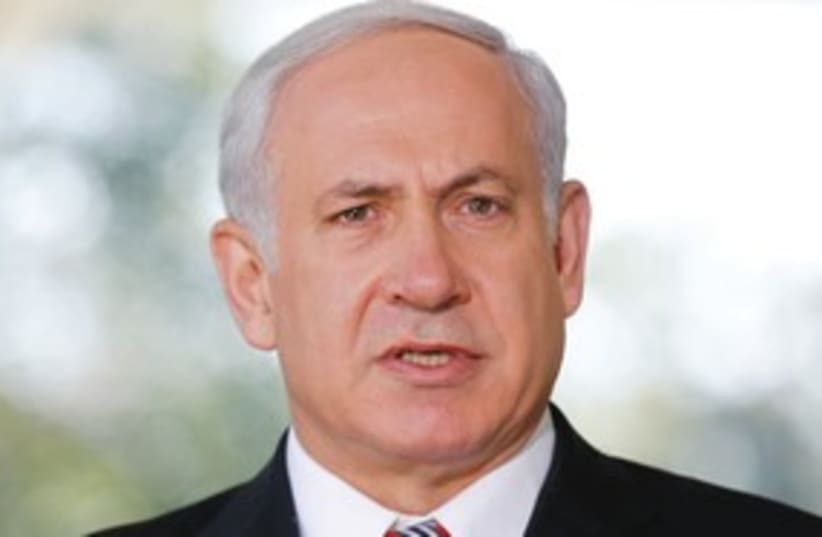
By HERB KEINONNetanyahu Headshot 311(photo credit: Associated Press)
Politicians and pundits both here and abroad were left scratching their heads following last week’s talks in Washington. Prime Minister Binyamin Netanyahu, in two tightly and carefully written statements, did not come across in a way in which he could be easily pigeonholed.The pundits could not cast him, as they generally love to, as that “hard-line,” right-wing leader who misses no opportunity to torpedo any chance for peace, because his rhetoric did not fit that characterization.Indeed, on the day after four Israelis killed in a terrorist attack near Hebron were buried, and two other people were shot at near Rimonim, Netanyahu did not declare that it was impossible to negotiate while terrorism was rampant and then quit the talks. Instead, he called Palestinian Authority President Mahmoud Abbas his “partner” in peace.And the politicians, those here carefully monitoring every word he says for signals of his true intentions, had to stand up and take notice when he uttered terms like “West Bank,” which he says rarely in public, and Palestinian “sovereignty,” a term he almost never uses, while at the same time refraining, even once, from mentioning Jerusalem or saying that it will remain Israel’s undivided capital.What does this obvious change of tone mean, and what is Netanyahu “up to?” There are three basic schools of thought.The first maintains that Netanyahu is simply calling Abbas’s bluff. According to this thinking, Netanyahu does not believe Abbas really wants to reach an agreement, and so he is eager to “rip off his mask” for the whole world to see, much as prime minister Ehud Barak said he was trying to do to Yasser Arafat at Camp David in 2000.According to this thinking, he “knows” that Abbas will not accept any offer that will necessitate any Palestinian concessions, just as he refused a very generous offer by Ehud Olmert in the twilight of his premiership in 2007, and as such Netanyahu can come out looking moderate.The second school of thought posits that Netanyahu is 100 percent genuine, and that his mouth and heart are completely in sync. According to this school of thought, Netanyahu has undergone what both Yitzhak Rabin and Ariel Sharon underwent before him – a political metamorphosis caused by sitting at the country’s helm.Or, as Sharon famously said, what you see from there (the opposition), you don’t see from here (the Prime Minister’s Office). According to this way of thinking, Netanyahu now has an up-close appreciation of the vast array of threats against Israel, and believes that the best way to deal with them is to solidify relations with the US by cementing an agreement with the Palestinians.According to those who hold this position, Netanyahu meant every word he articulated in Washington.And the third school of thought, a mutation of the second, is that while the prime minister – like his Foreign Minister Avigdor Lieberman – does not really believe a peace deal is possible, he is going through the motions because he wants to score points with the US before a possible attack on Iran. In this way of thinking, taking out Iran is more important than holding on to the West Bank, and if giving up much of the West Bank is necessary to get US approval to take out Iran, then – with much pain – so be it.REGARDLESS of which school of thought one adheres to, one thing was clear: Certain terms and phrases appeared in Netanyahu’s White House speech last Wednesday night, and then again in his State Department speech the following morning, that are not characteristic of the way he generally speaks.What follows is a brief primer of some of the different phrases and terms that are now in the Netanyahu lexicon.In the White House speech before the joint meeting with US President Barack Obama, Abbas, Egyptian President Hosni Mubarak and Jordanian King Abdullah II, the prime minister surprised many right away by turning to Abbas and saying, “President Abbas, you are my partner.” As if to pull the rug out from under the feet of the disbelieving skeptics, those who couldn’t believe Netanyahu was speaking in these terms about a man whom he has never publicly refereed to a as a partner before, he repeated the comment the next day at the State Department. “President Abbas, as I said yesterday in our meeting at the White House with the president of the United States, the president of Egypt and the king of Jordan, I see in you a partner for peace.”His comment came just days after the Geneva Initiative, reportedly funded partly by USAID money, initiated an ad campaign aimed at the Israeli public trying to convince it that the PA was a peace partner. This campaign was necessary, to a large extent, because the message coming from the top has been that there really is no partner on the other side willing – and then able – to make peace and implement it.Just two months earlier, in a speech to the Council on Foreign Relations in New York, Netanyahu said he was serious about peace, but cast doubts about the other side.“People dismissed [Menachem] Begin and they dismissed [Anwar] Sadat,” he said. “You should read the mountains of skeptical print that were written about them. I intend to confound the critics and the skeptics.I need a partner. You can’t go on a trapeze, hold out your hand and not have a partner on the other side.You have to have that.” His implication was clear, he was not certain – at least in July – whether he had that partner. Two months later, however, his doubts had apparently melted away.In the White House speech, which took place just a day after the terrorist attack near Hebron, Netanyahu also sounded almost like President Shimon Peres saying, “I will not let the terrorists block our path to peace, but as these events underscore once again, that peace must be anchored in security.”True, this was not exactly Yitzhak Rabin saying, “We will negotiate as if there were no terrorism, and fight the terrorists as if there were no negotiations,” but it was a much more moderate response than the country has been conditioned over the years to hear from Netanyahu.And if this was not exactly the response the country anticipated, many were even more surprised when he spoke of Judea and Samaria as the “West Bank.” “I see what a period of calm has created in the Palestinian cities of Ramallah, of Jenin, throughout the West Bank, a great economic boom,” he said, adding that what Israel hoped for eventually was that “the skyline of the West Bank” would be “dominated by apartment towers – not missiles.We want the roads of the West Bank to flow with commerce – not terrorists.”While this was not the first time Netanyahu referred publicly to Judea and Samaria as the West Bank – he did so in his Council on Foreign Relations address and in a speech to the American Israel Public Affairs Committee in Washington in March – this is far from his norm. As someone who often eloquently articulates the Jewish people’s 3,000 year connection to Israel, Netanyahu is well aware of the power of words and the symbolism of using the term West Bank instead of Judea and Samaria.Asked about his use of the term, a source close to Netanyahu downplayed it, saying it was a slip of the tongue. Yet the term “West Bank” appeared in the written text that was distributed to reporters before the speech was delivered. By contrast, Netanyahu never once during his public statements in Washington used the term “Judea and Samaria.”Within this context, it was also significant that, during his White House speech, Netanyahu said – perhaps for the first time – that Israel will concede territory. “ We want to ensure that territory we’ll concede will not be turned into a third Iranian-sponsored terror enclave armed at the heart of Israel – and may I add, also aimed at every one of us sitting on this stage.”While Netanyahu said a number of times in the past – first in his Bar-Ilan speech, and later in other foreign policy addresses over the last year – that he was in favor of a demilitarized Palestinian state next to Israel, he never laid out in such bald terms that this would entail “conceding territory.” It is one thing for everyone to realize that this is the natural outgrowth of a two-state solution, but it is quite another when he actually comes out and – starkly – talks about it, as if by talking about it he is starting to prepare the country for that eventuality.Netanyahu’s different usage of words and terms was also evident during his statement at the State Department on Thursday, when he said that a true peace, a lasting peace, will “be achieved only with mutual and painful concessions from both sides – from the Israeli side, from the Palestinian side, from my side, and from your side.”This was a much gentler variation of his motto from his first term, “If they give, they’ll get; if they don’t give, they won’t get.” It is also a much milder, toned-down version of what he said at the AIPAC annual conference in March. “Peace requires reciprocity,” he said then. “It cannot be a one-way street in which Israel makes all the concessions and the Palestinian Authority makes none. That has got to change. Israel stands ready to make the compromises necessary for peace, but we expect the Palestinians to compromise as well – to do their part.”During the statement in the State Department Netanyahu also made reference to the Hebron and Wye agreements he signed with Yasser Arafat in 1997 and 1998, agreements he does not generally wave as great personal achievements.“You spoke about the veterans who are gathered here at this table,” Netanyahu said to Secretary of State Hillary Clinton.“We’ve been here before. We fashioned the Hebron agreement and the Wye agreement.”His atypical reference to those agreements seemed an attempt to remind the watching world that he could sign peace agreements, and that – indeed – he has done so in the past.And, finally, Netanyahu said publicly he respected the Palestinian desire for “sovereignty,” a term that implies full independence and self-government. “President Abbas, I am fully aware and I respect your people’s desire for sovereignty,” he said.The use of the word sovereignty seemed an upgrade from the way he described a future Palestinian state in the Bar-Ilan speech. “In my vision of peace,” he said then, “in this small land of ours two peoples will live freely, side-by-side, as good neighbors with mutual respect. Each will have its own flag, its own anthem, its own government. Neither will threaten the security or survival of the other.”This was described by senior confidants at the time as a recipe for a “state-minus,” a state without the full trappings of sovereignty that could endanger Israel.NO LESS significant than what Netanyahu did say at Washington, was what he left out.First and foremost, he said nothing of Jerusalem. Not a word. Nor did he make much mention of Iran, a favorite theme of his talks when addressing an international audience. He also said nothing of Palestinian incitement or “economic peace.”Granted, in two brief addresses at two ceremonial events he couldn’t touch on everything. Still, Netanyahu seemed to consciously sidestep the issues that would play into his image as the “hard-line” Likud leader, while choosing instead language that would color him in a softer, gentler hue.
if(catID != 151){
var cont = `Take Israel home with the new Jerusalem Post Store