France's barring of the Muslim Brotherhood spiritual leader shows that Paris no longer views group as moderate.
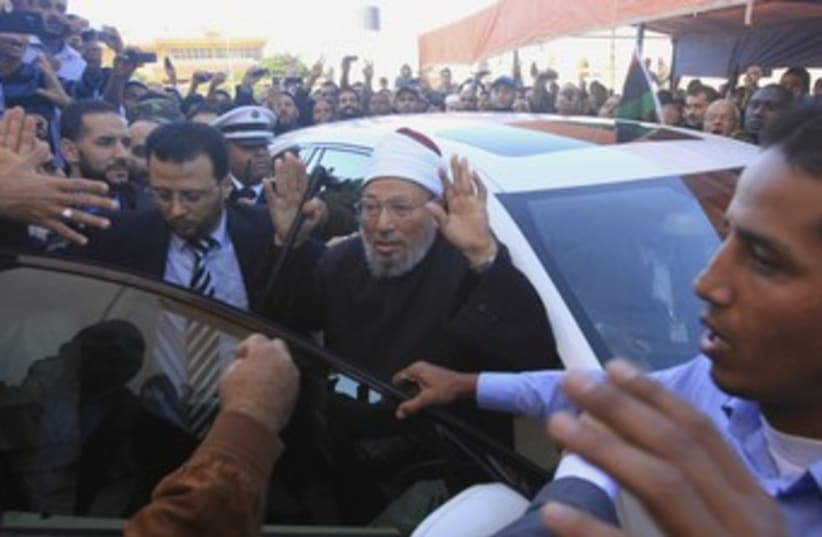
By YAAKOV LAPPINYusuf Qaradawi arrives for Friday prayers_370(photo credit: Esam Al-Fetori/Reuters)
For many years, the Muslim Brotherhood’s spiritual leader, Yussuf Qaradawi, has attempted to pass himself off as a moderate Islamic authority.The Qatar-based figure’s calls for dialogue with the Christian world and condemnation of al-Qaida violence allowed some in the West to turn a selective blind eye to Qaradawi’s open support for terrorist attacks against Israeli civilians and his ambitions for a European continent dominated by Islam in the future.Today, however, the doors to Europe are being slammed shut in the 86-year-old’s face. In 2008, Qaradawi was banned from entering Britain despite having received a red carpet welcome four years earlier from London’s former mayor Ken Livingstone.This week, in the aftermath of the horrific terror attacks on a Jewish school in Toulouse – in which Rabbi Jonathan Sandler, his two sons, Arieh, five, and Gabriel, three; and Myriam Monsenego, eight, were killed – and the killing of three French soldiers by radicalized French citizen Mohamed Merah, French President Nicolas Sarkozy banned Qaradawi from arriving to take part in a conference organized by an umbrella Muslim group.“There are certain people who have been invited to this congress who are not welcome on French soil,” Sarkozy said during a radio broadcast. Qaradawi was at the top of the no-entry list.Sarkozy’s move was applauded by both of his rivals for the presidency, from the Socialist Party and the Front National.“Qardawi is an important spiritual leader, maybe the most important, [hence] the message sent by Sarkozy is very important,” said Professor Efraim Inbar, director of the Begin-Sadat Center for Strategic Studies at Bar-Ilan University. “A major, important European state makes the point that it does not see the Muslim Brotherhood as a moderate movement. The French signal to the West [is] to slow down its attempt to launch a dialogue [with the Brotherhood].”Inbar argued that dialogue is the “preferred liberal modus operandi” of Western liberals when it comes to dealing with the rising force in the Arab world, which is the Muslim Brotherhood.The movement has seized power in Egypt and Tunis, and is poised to increase its standing across the Arab world in the wake of the Arab Spring. Its offshoot, Hamas, controls Gaza.The new anti-Muslim Brotherhood message being sent out from Paris will also negatively affect Hamas’s attempts to gain legitimacy, Inbar added. “It shows strategic clarity on part of Sarkozy,” he said.Last year, soon after Mubarak’s downfall, the Egyptian- born Qaradawi returned to his native land, from where he had been exiled. He spoke to hundreds of thousands of people at Tahrir Square and said, “A message to our brothers in Palestine: I harbor the hope that just like Allah allowed me to witness the triumph of Egypt, he will allow me to witness the conquest of the al-Aqsa mosque [in Jerusalem] and will enable me to preach in the al-Aqsa Mosque.”According to the Investigative Project on Terrorism website, which is run by preeminent US terrorism expert Steven Emerson, Qaradawi gave a speech in 2009 calling for Allah to eliminate the Jews, saying, “kill them down to the very last one.”Yet it is not the Muslim Brotherhood’s designs for the Middle East that most concern France, but rather its influence on French Muslims, said Esther Webman, a senior research fellow at the Moshe Dayan Center for Middle Eastern and African Studies at Tel Aviv University.Webman, who is also head of Zeev Vered Desk for the study of Tolerance and Intolerance, stressed that “the first and foremost fear of France is the infiltration of radical Islam into its borders, and Qaradawi represents this force, despite claiming to be moderate.”Webman said that in most of his sermons, Qaradawi presents himself as being of the Al-Wasati, or “middle way.”“He promotes dialogues with Christians and claims he has nothing against Jews but that ‘Palestine’ is the problem,” she added.“The problem with Qaradawi is that his concepts are based on a vision under which Europe will become Islamic. He declares this openly. It’s not the only thing he talks about, but this is one of his concepts, that European Muslims are on a mission to gradually convert the local population,” Webman said.In fact, barring Qaradawi will not stop the spread of his ideas in Europe, Webman said, noting that years ago he had set up a council of scholars dedicated to releasing fatwas, or rulings, about European Muslim life. The council is aimed at stopping other Muslim voices who are more liberal and promote integration with the non-Muslim majorities, she said.“Sarkozy’s decision is about France, and Europe in general, where second- and third-generation Muslims are asserting themselves more and more through Islamist identities,” Webman added.As Islamists go from strength to strength in the Middle East, only time will tell whether the barring of their iconic cleric from France will dent their presence in and plans for Europe.
if(catID != 151){
var cont = `Take Israel home with the new Jerusalem Post Store