Once famous for daring military operations,Israel, following the Schalit swap, is seen by some as a country that surrenders to terrorist demands.
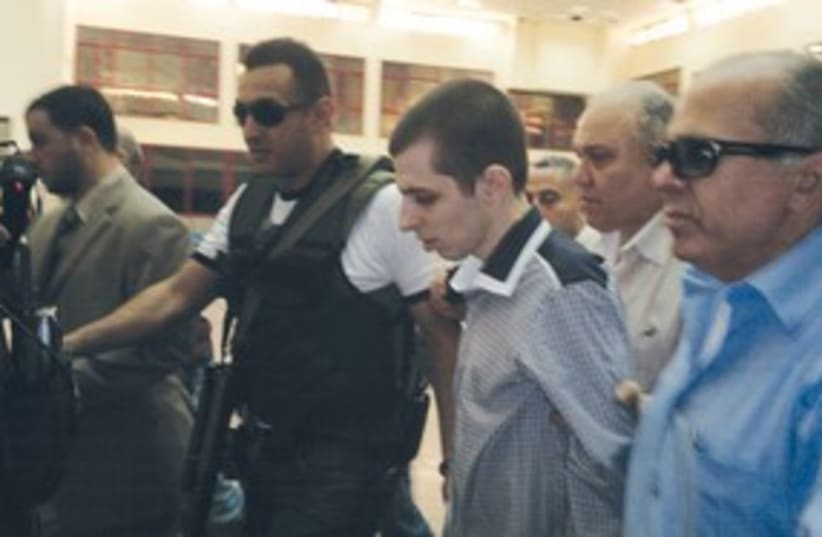
By YAAKOV KATZSchalit with Hamas 311 R(photo credit: Reuters)
On June 21 1972, Israel launched “Operation Crate” to kidnap Syrian intelligence officers who it planned to use as bargaining chips to negotiate the release of three Israeli Air Force airmen who had been captured by Syria two years earlier.The unit chosen for the operation was the IDF’s elite General Staff Reconnaissance Unit, otherwise known as Sayeret Matkal. It’s commander at the time was a young lieutenant colonel named Ehud Barak. One of his squad leaders was a young lieutenant named Binyamin Netanyahu.The night of the operation, Barak stayed back at IDF headquarters to ensure that the General Staff would not cancel the raid as it had done on previous occasions. It ended successfully with the capture of five senior Syrian intelligence officers. A year later, the three IAF airmen were returned to Israel in a prisoner swap.On Tuesday, Barak and Netanyahu again participated in an operation that led up to a prisoner swap although of a different kind. Gilad Schalit, who was kidnapped on June 25, 2006 - almost 34 years to the day of “Operation Crate” - was returned to Israel in a swap with Hamas which will end with 1,027 Palestinians released from Israeli prisons.Something has changed in Israel. Once a country famous for daring and brave operations like the one in 1972 or others in more recent years such as the alleged bombing of a weapons convey on Sudan or a nuclear reactor in Syria, Israel is today - following the swap - perceived by some as a country that surrenders to terrorist demands.While Jerusalem may preach to the world about the need to stand strong in face of the growing Islamic terror threat, it appears - on the surface - to be doing exactly the opposite.That is why there is no question that at least in the short term, the deal will strengthen Hamas and most likely undermine Fatah. While the Palestinian Authority was able to enjoy some of the spotlight with the release of 96 convicted terrorists to Ramallah, the real celebration belonged to Khaled Mashal in Cairo and Ismail Haniyeh in the Gaza Strip.Hamas has proven to its people and to the larger “resistance” world which consists of Hezbollah, Syria and Iran that terror pays and that it’s use of force, even at the expense of military operations, sea blockades and diplomatic isolation ultimately pays off. Hamas has been able to do what Fatah couldn’t.It is likely for this reason that Prime Minister Binyamin Netanyahu decided to make the deal now.While the so-called “Arab Spring” and the fear that the current Egyptian mediator will not be in power in a few months to close the deal contributed to the decision to go ahead with the swap now, so did the fact that a new round of negotiations with the PA have not yet started. Had Israel been in the middle of peace talks with Fatah, a prisoner swap of this size and magnitude might have had to wait and as the whole world witnessed on Tuesday, Schalit did not look like time was on his side.The first images that came out of Schalit were filmed by an Egyptian film crew that had been strategically placed at the Rafah Crossing. It showed him being pulled out of a white pickup truck and wearing a black baseball hat and a checkered shirt - apparently the latest in Gaza fashion - by two Hamas men and being half-dragged half-led into the Rafah Crossing.One of the men was wearing a uniform and was armed. He was later identified as Ra’ad Atar, commander of the Hamas brigade in Rafah and one of the main planners of the June, 2006 attack near Kerem Shalom, during which Schalit was abducted.The second man, wearing a blue shirt with the trimmed beard was Ahmed Jabar, commander-inchief of Hamas’s Military Wing and one of the mostwanted terrorists in the Gaza Strip today.The fact that Schalit was accompanied by both of these top terror chiefs was an indication for Israel of just how involved they must have been in the prolonged captivity. In the coming weeks, when Schalit’s debriefing begins, the IDF will learn whether Schalit knew who they were and whether he was able to identify his different captors.In general, the IDF was surprised by Schalit’s mental state. When he sat down minutes after crossing into Israel for his first conversation with an IDF psychologist, he smiled and said to the doctor: “I knew you would be surprised by my condition.”He apparently had a television at some point and was allowed to regularly listen to the radio. Interaction with other people though was severely limited as Schalit told Egyptian State TV during the interview he was forced to undergo before being released to Israel.With the Schalit chapter behind Israel, the Netanyahu-Barak duo can now move forward with plans to deal with some of the other strategic challenges Israel faces in the region, such as Iran’s nuclear program as one example.While the two issues – Iran and Schalit - are not directly connected, it is likely that following an Israeli attack against Iran which would destabilize the Arab and Muslim world, the ability to reach a deal with Hamas would also be significantly delayed.By reaching a deal now, Netanyahu clears his desk and is able to focus on Israel’s true strategic predicaments.With that said, an attack on Iran is not likely to happen so soon. More immediately, Israel might start to feel an improvement in its ties with Egypt which played the key role in mediating the deal with Hamas. David Meidan, the former Mossad operative turned chief Schalit negotiator, declared more than once that without the Egyptians there would not have been a deal.That is also why Israel was willing to let the uncoordinated interview with Egyptian TV slide by with just minor criticism. The hundreds of journalists and IDF officers gathered at the Tel Nof Air Force Base awaiting Schalit’s arrival and watching the interview on a large screen let out a joint sound of disgust when journalist Shahira Amin asked Schalit if he would now campaign for the release of the Palestinians who remain in Israeli jails.For Egypt, the interview was its way of taking credit for the deal and being able to show it off to the world. It comes at a time when the world looks at Egypt as a country in complete disarray. By mediating the deal and overseeing the prisoner swap, Egypt positions itself as the country it was known as under Hosni Mubarak – a regional superpower.When it comes to he potential risk that the released prisoners pose to Israel, the IDF and the Shin Bet (Israel Security Agency) are not overly concerned. While statistics accumulated by the Shin Bet show that 60 percent of Palestinians released in previous swaps have returned to terror activity, in this case, the fact that only 96 terrorists were released to the West Bank dramatically minimizes the threat. The hundreds released to Gaza will be a boost for existing Hamas capabilities but the Izz a Din al-Kassam Brigades already numbers 20,000 soldiers.The main problem is the same dilemma that Israel faced when Schalit was originally abducted in 2006 - to negotiate a prisoner swap or not. This question will come up again if and when another soldier is abducted. The possibility that the government will simply declare now that from now on it will not negotiate for kidnapped soldiers is a bit extreme considering that it will be going from 1,027 to zero.There is no question that Israel needs to formulate a clear policy for dealing with instances of kidnapped soldiers. This was made clear by the Winograd Commission which probed the failures of the Second Lebanon War and dedicated a chapter called “Kidnapping - A Strategic Threat” in its report.In the beginning of the chapter, the members of the war panel stressed the sensitivity of the issue but claimed that lack of a formulated policy on how to deal with a kidnapped soldier was harmful for Israel's national security.“The lack of a clear and detailed policy - at all the different levels - for dealing with the kidnapping threat is a strategic mistake and even weakens Israel,” the report read. “It is clear that as long as we appear vulnerable... the price for the return of the soldier is higher and the motivation to kidnap additional soldiers increases.”While not mentioning names, the committee criticized then Prime Minister Ehud Olmert in the chapter, claiming that his initial declaration that Israel will not negotiate the release of Schalit and then engaging in talks with Hamas “weakened Israel as well as its ability to deal with a kidnapping incident.”In the report, the committee members mentioned the US’s declared policy of not negotiating with terrorists as an example which the panel said was partially responsible for minimizing the number of attempts to kidnap American soldiers.Since then though, not much has changed. Israel has not established an official policy, nor has it set criteria for who can and cannot be released from among the thousands of Palestinian prisoners it holds in its prisons.What has happened is that Defense Minister Ehud Barak appointed a committee led by former Supreme Court Justice Meir Shamgar to issue a series of recommendations of what to do. These recommendations have not been made public and like a number of committees set up by Barak, this one to was likely set up for appearances.There is still much that Israel itself can do. All one had to do was watch the release of Schalit from captivity and the release of the Palestinians from Israel.While Schalit walked out pale, skinny and shaking, many of the Palestinian prisoners appeared to be quite “healthy,” in the weight context of the word. While Schalit was apparently provided a radio and at times a TV, he was not allowed to enroll in university studies like the Palestinian prisoners are allowed in Israeli jails.Some defense officials wondered this week whether it might be time for this all to change.Click for full JPost coverage on Gilad Schalit
if(catID != 151){
var cont = `Take Israel home with the new Jerusalem Post Store