Religious Affairs: Choosing between the law and Torah
Is the tension over the arrests of Dov Lior and Ya’acov Yosef a precursor to an inevitable collision between Halacha and the judiciary?
By JONAH MANDELReligious students 311(photo credit: Ronen Zvulun/Reuters)
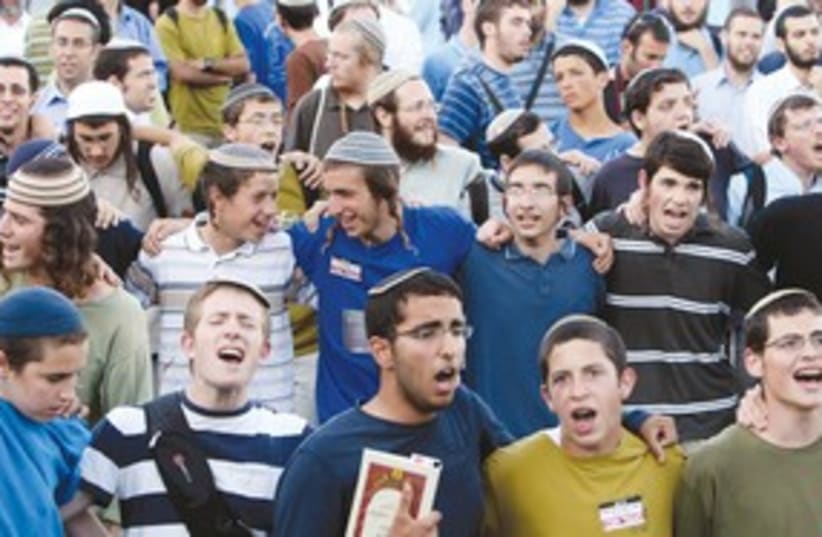
It is no coincidence that the slow procession of hundreds of young men celebrating the release of Rabbi Dov Lior from a brief session of police questioning made its way from below the capital’s String Bridge to the nearby Mercaz Harav Yeshiva late last Monday.In an address that stressed, among other issues, the importance of learning faith and that “the whole essence of rabbis is against violence,” Lior noted that Rabbi Zvi Yehuda – who headed Mercaz Harav – had said that “the true Torah must stand out.”Earlier that day, Lior was pulled over by police after months of refusing a summons for questioning over his endorsement of the book Torat Hamelech.The Kiryat Arba chief rabbi, who heads the hesder yeshiva there and is one of the most senior figures in the national religious community, had insisted that it was his right and duty as a rabbi to express his opinions freely on matters of Judaism, including those addressed in the book, and that the authorities shouldn’t meddle in this internal Torah discourse.Torat Hamelech deals with the halachic traditions surrounding the prohibition of killing non- Jews, and states that during warfare, gentiles – including babies – may be preemptively killed.Police hauled in the book’s authors for questioning over alleged incitement to racism and violence, and summoned the three rabbis who endorsed the book. One of them, Rabbi Yitzhak Ginsburgh, who is a spiritual mentor to the authors and provided guidance on the book, showed up for the questioning, viewing it as an opportunity to explain why the book neither incited to violence nor promoted racism. The other two, Lior and Rabbi Ya’acov Yosef – Shas mentor Rabbi Ovadia Yosef’s son, who is more affiliated with the religious Right than the haredi Sephardi public – refused the police’s repeated appeals.Yosef was picked up this Sunday for half an hour of questioning, following which he was released.At the spontaneous rally in his support below his home later that day, his only words to the hundreds of youth attending were to the effect of “Thank you, but now it’s time to go back to study.”A massive rally across from the Supreme Court planned for earlier this week, in support of the two rabbis and the independence of the Torah and its scholars, didn’t draw anything near the 100 buses organizers had predicted. The theme of the small demonstration was that Torah should retain its independence, and that the legal system was discriminating against the Right and therefore had lost its legitimacy. Following that rationale, rabbis summoned by that system shouldn’t feel obliged to heed to it.“This was not a demonstration against the court,” stressed Rabbi Yehuda Amar, one of the demonstration’s organizers. “Rabbis, and anyone else, are not above the law in Israel.”However, he said, “you must understand that Jews learn Torah, and that cannot be limited in any way. The second point is that there is law here, but it’s not equally applied to all. And when that’s the situation, it loses its legitimacy. How would you feel if in all of Israel, the only place there were traffic policemen was on your street, next to your house?” The 34-year-old rabbi, who teaches at the Ra’anana hesder yeshiva, asserted that “the national-religious love the country; we see in it ‘the beginning of our redemption.’” But, he said, “there is a continuous misrepresentation of Lior’s approach, which is very statesmanlike.”Amar acknowledged that in the past, Lior had spoken out against Arabs on various occasions.“He is a Holocaust survivor, and really sees Israel as an entity that saves Jews.”Why, then, did Lior refuse the police summons? Here, Amar returned to the content of the book, proposing a differentiation between two processes – scholastic debate, and adjudication.“This book is not issuing rulings,” he insisted, noting the young ages – 34 and 40, respectively – of authors Rabbi Yosef Elitzur and Rabbi Yitzhak Shapira.“Do you think a 40-year-old decrees on such matters?” he asked. “When such issues are ruled upon, it is only after very serious debate by senior rabbis, and can reach the Chief Rabbinical Council.Certainly what rabbis Lior and Yosef were encouraging was the scholastic process, not the implementation of the halachic conclusions in the book.”Amar didn’t say whether this misunderstanding within the law enforcement system was intentional or not, but he was clear about the result of the crackdown on the book: “The people making the decisions created a situation in which the public had to choose between the law enforcement system, or the Torah.”BAR-ILAN UNIVERSITY law professor Yedidia Stern, who is vice president of the Israel Democracy Institute and one of the country’s foremost experts on the tensions between state and religion, firmly rejects the notion that a rabbi – or anyone, for that matter – can independently decide that he should not be subject to an investigation.“A person cannot be exempt from the rule of law, just because he has a subjective feeling that the law is being applied in a non-egalitarian manner,” said Stern. “Allowing every person to decide when they think they should be investigated and when not is a formula for chaos. Imagine a Muslim sheikh – a religious leader like Lior, only from a different religion – being summoned for investigation on incitement. Would we think that he is allowed to say, I don’t want to be investigated because my sector is discriminated [against]?” The place to raise charges of discriminatory implementation of the law is in court, he added.Most of the speakers in the recent rallies for Lior and Yosef have evoked instances of intellectuals from the Left speaking out in a way that seemingly incites violence against the Right or settlers, as evidence that the legal system is biased and hence unworthy of cooperation.But the reason academics from the Left are not summoned for questioning might be their lack of influence over people who would act out their violent words, Stern posited.“Freedom of speech is the ‘queen’ of rights, certainly political freedom of speech,” he said. “It’s at the top of the ‘pyramid’ of rights. The instances in which it is limited, when a person is investigated over [remarks or writings], are rare.The criterion for when freedom of speech is challenged is when it poses a clear and immediate danger to others.”He continued, “Whose remarks could be more harmful – the outrageous ones of Professor Ze’ev Sternhell” – who said it would be wise of the Palestinians to concentrate their terror solely against the settlements – “and his ilk? Do their words lead to action, or do those of rabbis?” According to the law professor, “if somebody from the Left were arrested for investigation, I don’t think that within two hours their supporters would stop traffic and storm a court. The practical force of professors is smaller than that of rabbis.”The question of whether Torat Hamelech could lead people to violence was not one Stern could clearly answer.“Unfortunately the book doesn’t state that it’s solely a study, theoretical, not to be acted upon, like many other books from this genre are and declare to be,” he said. “Could this book help create another Baruch Goldstein? I don’t know. But when important rabbis write endorsements, there is a type of empowerment to the dangers that could emanate from the book.”To Stern, it is clear that the rabbis should have heeded the police summons. He was also adamant that rabbis should not be exempt from legal responsibility for their teachings just because of their religious leadership positions – as members of the Right proposed in a recent bill, which the government shot down.“The desire to create a legal extraterritoriality for religious leaders will surely give Muslim religious factors, who are enemies of Israel, the opportunity to preach against the state, without the possibility to act against them,” he argued.“Whoever feels that Islamic leaders should not be allowed to express themselves in ways that endanger us, whoever thinks that the legal system has to be able to be involved – must agree that rabbis should also” be within the parameters of the legal system, said Stern. “Whoever wants equality must give it, too.”The law professor, who wears a crocheted kippa, also took to task the claim that the Torah is above the law.“To say so means the end of the rule of the law, since Torah applies to all of reality – it has a say on everything. And since that is the case, rabbis would be exempted from everything, there would be people to whom the law doesn’t apply,” he contended. “But what is Torah? And who would define it? The body that would have to set those rules would be the court. Do Lior and his supporters want the court to determine what is Torah and what is not?” The responsibility to heed to the authorities should be a religious obligation, said Stern, conjuring the verse from the Mishna that without the fear of the regime, there would be anarchy. “Doesn’t the fact that you are a rabbi in Israel force you to act under the paradigm of the rule of law, out of a religious perception?” THE QUESTION then remains why a traditionally loyal public increasingly seems to be veering to the right and away from the state in recent years, at a time in history that more and more members of the national religious public are taking senior positions in the country’s “secular” mechanisms.“I fear that certain people from the national-religious public seek to sharpen the tension between Jewish law and the law of the land. They also benefit from it politically; it makes them stronger,” said Stern.“My feeling is that the Zionist religious public is moving toward the national leadership table. More national religious people than ever before are taking leading positions in the executive authority. The Knesset also has more people with skullcaps, [including] in secular parties. Over a third of the officers in the elite IDF units are religious, which is the true indication of future leadership; the legal system and media are also growing in numbers of religious members. Religious people are ‘taking over,’ which is a positive development for the state,” he asserted.“Instead of understanding that the entire nation expects reasonable, moderate leaders who can see the interests of the general populace, the Zionist religious leadership is pulling the more militant parts of that public to a fringe position of irrelevance and a lack of understanding of the historic role of the religious leadership,” he said, adding, “There seems to be a desire to ideologically oppose the state.”Of Lior, Stern cautiously noted that “alongside his loyalty to the state, he also has a record of ongoing dispute with the state, on the issue of the attitude toward the Arab minority, among others.”The fact that more moderate rabbis like Haim Druckman attended the rally in support of Lior reflects the distortion in the debate over Torat Hamelech.“Druckman does not agree with the content of the book,” said Stern. “The battle became not over what the book actually says, but rather an attempt to decree on issues of principle. In the State of Israel, can a rabbi – in his capacity of a rabbi – say ‘no’ when the law tells him to show up for an investigation? I can’t imagine such a reality; we can’t let that happen. At the same time, a rabbi’s freedom of speech cannot be diminished.”It was over 10 years ago that Stern published his seminal article “Halacha and Public Policy” on the potential clash between the two directives, and the issues raised there are more relevant than ever.“At the end of the day, we are witnessing an almost inevitable process,” he said. “Once rabbis decide that they want to express their opinion not only from a spiritual point of view, but also from a halachic one, on issues like foreign and security policy; not only on issues like Shabbat and kashrut, but also on the borders of the land, peace and the attitude to Arabs – there will be a harsh collision.”He pointed out that the concept of rabbis decreeing on all topics, civilian included, is not a classic product of modern Orthodox Jewish thought, even from the national religious circles, but a development of Rabbi Zvi Yehuda Kook, who headed the Mercaz Harav Yeshiva.“This attitude is not illegitimate, but one must understand that this line of thought will inevitably lead to clashes between state and religion,” the law professor said. “Every question becomes halachic.Whoever does endorse that directive will have to find an inner halachic mechanism to allow accepting the majority’s decisions, even if it stands in contrast to what Torah would say. Otherwise, we are doomed to a civil war on the basis of Jewish law.”
if(catID != 151){
var cont = `Take Israel home with the new Jerusalem Post Store