The IDF is on standby as the regional upheaval threatens to reach Israel’s borders.
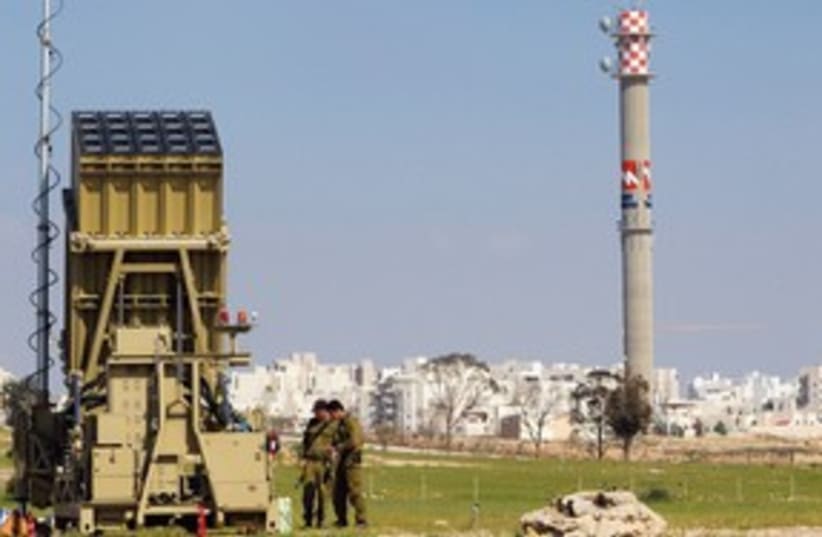
By YAAKOV LAPPINIron Dome outside Beersheba 311 (R)(photo credit: Reuters)
So far, the geostrategic storm raging around Israel’s borders has barely scratched the surface of our “villa in the jungle,” as Defense Minister Ehud Barak once famously described Israel.Nevertheless, the fire of instability continues to burn beyond the northern and southern borders, and the IDF is quietly reconfiguring itself to ensure that it is ready for the new security environment taking shape around us.One year and nine months into the new post-Arab “Spring” (or winter) of the Middle East, a number of patterns can already be discerned.Security challenges are currently growing out of two general geographic zones: the Lebanese-Syrian realm to the north and the Gaza-Sinai area to the south.Of these, it is the northern arena – until now the quieter of the two – which poses the more serious strategic threat and carries the greater potential for a significant escalation.In Lebanon, the Shi’ite Iranian proxy Hezbollah, the most powerful military presence in Lebanon, armed with some 60,000 rockets and a well-trained force of guerrilla fighters, is feeling the heat of the Arab spring.Hezbollah is suffering from waning popularity among Sunni Arab populations in the Arab world, due to its support of the Assad regime’s war crimes in Syria.The Lebanese terror organization is due to lose its Syrian ally when Assad falls. The collapse of the Assad regime means an end to the invaluable arms and logistical supply bridge connecting Iran to Lebanon, and a potentially fatal blow to the Tehran-Damascus-(south) Beirut axis.Inside Lebanon, Hezbollah is facing a growing chorus of calls by Sunni politicians and religious figures (who are emboldened by events in Syria) to give up its menacing arsenal – a demand Hezbollah has no intention of complying with.The more he is squeezed into a corner by a rising Sunni tide, the more tempting it may be for Hezbollah chief Hassan Nasrallah to create a provocation with Israel, a move defense sources in Israel suggest would carry a very heavy price tag for Hezbollah.Israel has closely studied the painful operational shortcomings of the Second Lebanon War and has systematically been preparing its ground forces and air force for a far more devastating reply to Hezbollah, if the need were to arise.It is believed that Israel will refuse to overlook any challenge to its sovereignty emanating from Lebanon.A firm Israeli response to a Hezbollah provocation could lead to more attacks on Israeli targets, and defense planners must therefore take into account the likelihood that a small incident on the northern border could quickly lead to a conflagration.“The quiet is deceitful,” said one defense source this week.Needless to say, any potential strike on Iran’s nuclear sites would also very likely set off a confrontation with Hezbollah.Similarly, the IDF’s Northern Command is committed to a policy of zero tolerance to challenges to Israeli sovereignty from Syria.Syria’s regular armed forces are fully engrossed in the bloody civil war with the rebels and are in no position to think about Israel. But as Syrian sovereignty disintegrates, a myriad of jihadi organizations are moving into the country and they may soon set their sights on the Israeli border. For that challenge, too, the Northern Command must be on standby.Down south, the IDF’s Southern Command is dealing with a challenging, yet less explosive strategic challenge.Unlike the situation on the northern borders, Israel and terror organizations in Gaza are able to deescalate rounds of escalation as quickly as they begin.Every few months on average since Operation Cast Lead in 2009, Israel has found itself dealing with increased rocket fire on southern cities, towns, and rural areas. The rocket fire by Hamas, Islamic Jihad, or and smaller groups in Gaza exacted relatively painful pinpointed Israeli responses in the form of airstrikes on Gazan terror targets.As soon as Israel signals it is prepared to escalate the responses and begin targeting more valuable assets in Gaza, the terror organizations begin winding down the rocket fire, using Egypt as a mediator to arrange ceasefires with Israel.Hence, the IDF’s Southern Command has an open channel of communication with Egyptian security chiefs through which a de-escalation mechanism exists, allowing Israel more room to maneuver itself through conflagrations.The Iron Dome rocket defense system has proven to be an overwhelming success as a protective layer over southern cities, granting decision-makers even more time to think about their next move during escalations with Gaza.The growing jihadi base in the Sinai Peninsula is, however, a major complicating factor in the southern arena. Exploiting Egypt’s lack of sovereignty in the vast desert province, several jihadi groups, as well as Hamas and Islamic Jihad, have built terror infrastructures in Sinai, through which they seek to target Israel .A potential turning point that could mitigate this developing threat came earlier this month. A team of jihadi terrorists, influenced by al-Qaida’s ideology, declared war on Egypt and killed 15 Egyptian security personnel on the border with Israel in a brazen attack, which was stopped by Israel just as the attackers were making their way with large quantities of explosives over the border into Israel.It remains to be seen whether Egypt, now under firm Islamist civilian political rule, is able to translate its new understanding that Sinai terrorists are a threat to Cairo as much as they are to Jerusalem, into tangible results. Israel will watch closely to see if Egypt is successful in shutting down the Sinai terror base.A larger question that looms on the distant horizon is whether the Egyptian Islamist president, Mohamed Morsy, will seek to one day transform the secular, US-dependent Egyptian army into an Islamist fighting force. For the time being, such a goal is blocked by the Egyptian army’s dependence on America’s $1.3 billion annual military aid package. Without this assistance, the Egyptian army would be a shadow of its current self.Morsy will likely first tend to Egypt’s crisis-hit economy, while seeking to gradually Islamicize Egyptian society and state institutions.As events develop rapidly across the northern and southern borders, it is perhaps worthwhile to take a moment to appreciate Israel’s longest and most stable international frontier, the border with Jordan.One must hope that the regional earthquake does not undermine the pillars of the Hashemite Kingdom – the last of Israel’s secular, stability-seeking neighbors.
if(catID != 151){
var cont = `Take Israel home with the new Jerusalem Post Store