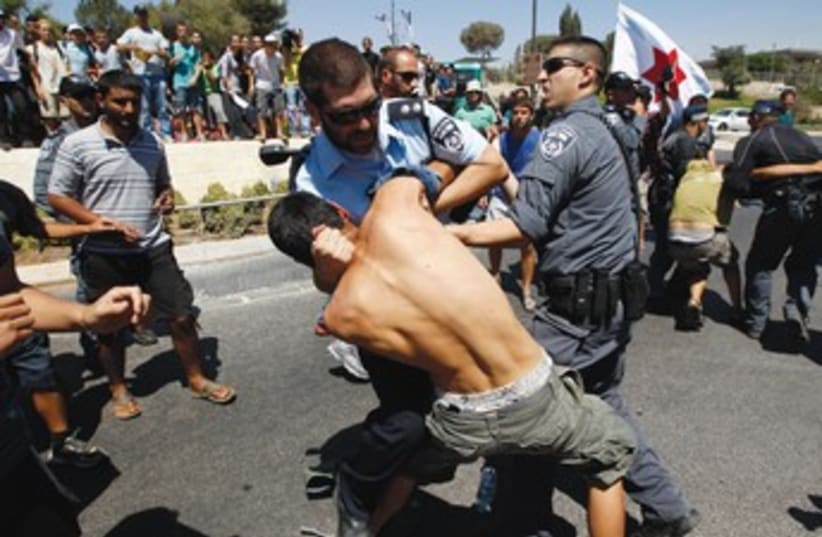
Is the recent rash of violent incidents involving Israeli youth indicative of a trend?
By ILENE PRUSHERYouth Violence (R370)(photo credit: Ronen Zvulun/Reuters)
It was only the third day of classes at Yovel High School in Herzliya when two 10th-graders got into an argument. It ended when one student stabbed the other with a pair of scissors, landing the teenage victim in Meir Medical Center in Kfar Saba in moderate condition.On the same day, several 10thgraders got into an argument at a high school in Tuba-Zanghariya, a Beduin- Arab village in the Galilee. One stabbed the other several times in the throat with a pen. The victim was taken to Ziv Medical Center in Safed in moderate condition.“We don’t know what the fight was over, because this is how it is with 15- year-old boys around here,” says Yehuda Maman, a police spokesman for the northern region. “Any disagreement can quickly deteriorate into a violent clash.”Police arrested suspects in both stabbings, which happened on Wednesday.By Thursday, the two latest incidents of worrisome youth violence quickly disappeared from the headlines. Some would dismiss these as back-to-school brawls gone too far. But coming on the heels of two incidents of appalling teenage-perpetrated violence – the near-fatal beating of an Arab teenager by Jewish youths in Zion Square in Jerusalem and the firebombing of a Palestinian taxi that seriously injured six members of a West Bank family – others say more probing questions need to be asked. Is it hype or hypothesis to say that Israeli youths are becoming more violent?Indeed they are, as are Palestinian youth, according to a new study published last week in Child Development, a bimonthly US journal. An international team of researchers – Israeli, Palestinian and American – came together in a multi-year study funded by the US National Institutes of Health to examine violent behavior among more than 1,000 children ages 8, 11 and 14. In a survey that the researchers say is the first of its kind and that could be helpful for educators and parents of children in conflict zones the world over, the study found a direct correlation between exposure to political violence at large and acting out violently at home or in school.“We know that in many parts of the world there are political conflicts that expose children to violence. But never before has it been measured so accurately and repeatedly as in our study,” says Professor Simha Landau, a criminologist at the Hebrew University of Jerusalem and the Emek Yezreel Academic College and the lead Israeli researcher on the study.“It’s unusual in that we conducted a study of both sides simultaneously,” he says. “Usually it’s just one side, and that side sees itself as a victim.”Landau and his fellow researcher in Israel, Shira Dvir Gvirsman at the Netanya Academic College, teamed up with Prof. Khalil Shikaki, the head of the Palestinian Center for Policy and Survey Research in Ramallah, as well as with researchers at the University of Michigan and at Rutgers University.Landau has been looking at this link since the late 1960s, when he began to see a direct correlation between what can be classified as political violence – be it war, low-level conflict or terrorism – and violent behavior in general.“The more you are involved in violence toward the out-group, the more it spills over and is generalized to society within,” he says. Other studies he’s done, and others by his international colleagues, he says, show that people living amid war or post-war societies have demonstrated an increase in homicide rates. “There’s a hypothesis that there’s a habituation to violence, and it leads to a cheapening of human life.”The researchers examined a sample of 451 Jewish children, 450 Israeli Arab children and 600 Palestinian children – 64% of them from the West Bank and 36% from the Gaza Strip – during three points in time between 2007 and 2010.At the time of the first interview, onethird of the children were eight years old, one-third were 11 years old, and one-third were 14 years old.The age spread was significant in the study because it showed that the younger children were more impressionable, in terms of the impact of violence, than the young ones.“Importantly, we found that late childhood was a critical period,” L.Rowell Huesmann, a University of Michigan psychologist who is a coauthor of the study, wrote in a summary of the study. “The children who were [eight] at the start of our study were more susceptible than older children to the effects of witnessing violence.”Among all children questioned, 51.8% reported that there were incidents of violence in their families during the first time period, in 2007, and this figure rose to 58.7% by 2010.There was a rise in reports of school violence over this period, jumping 6.4% to 11.7%.Unsurprisingly, the Palestinian children reported higher rates of witnessing violence, of knowing a friend or relative who had died or of having seen violent images on the news or on the Internet. These images, says Dvir Gvirsman, also play a role that is underestimated.It might be slightly less damaging to see violent images rather than events themselves, but violent images affect many more children, she says. About 95% of the Israeli children and 100% of the Palestinian children said they had seen violent images of the conflict.Of those surveyed, some 90% of the Palestinians and 40% of Israelis said they had seen some of these violent events in person, once or twice a year.Also notable was the extent to which geography matters. Israeli children who are growing up closer to the “front lines” – communities near Gaza that often get hit by Kassam rockets, for example, or towns in the North that have been hit by missiles launched by Hezbollah in Lebanon, are more likely to develop aggressive or anxious behaviors than Israeli children overall.“Generally we see the trend that with children up North or around Gaza, there is a higher tendency toward violence among the kids who are closer to political violence, as well as PTSD [Post-traumatic stress disorder],” Dvir Gvirsman says.The grinding, seemingly insoluble conflict is clearly not the only culprit, Landau adds. Many things contribute to violent behavior, of course. The culture of one’s home and community play an equally important role. How parents respond and whether they resort to violence as punishment of their children’s behavior, he notes, is particularly crucial.But one of the most interesting new things the study’s authors found is the extent to which normative behavior – in other words, what’s considered normal and acceptable by a child’s peers and elders – has had an impact on the increase of violence in Israeli society.“We’ve found that there’s a mediating role that normative beliefs play between exposure to violence on one hand and aggressive behavior on the other,” says Landau.For example, children were asked to agree or disagree with a statement such as: “It’s OK to hit someone if he hits me, or if I’m angry or frustrated.”“The higher the normative belief that it’s OK, the higher level of aggression,” Landau says. “We measured that, but also the normative beliefs of aggression toward the ‘out-group.’ Those who shout “death to the Arabs” are more prone to hit an Arab when they have the opportunity. “ That incitement to violence is often shouted at football matches and dismissed as light-hearted hooliganism. But when it is also shouted by a crowd beating Arab youths, as it was two weeks ago in Zion Square, it demonstrates how problematic some of the socalled normative behavior in Israeli society has become.Until now, the problem has been brushed aside as a one for educators and occasionally police to deal with, but not necessarily as something to be addressed at the highest levels of government.“The violence has reached really dangerous levels in these recent incidents, and the idea that children [ages] 12 or 13 could commit such atrocious acts, if this is not a warning or a writing on the wall, I don’t know what can be. Besides saying that the situation is quite awful, we need to see various social and educational agencies, from the Prime Minister’s Office downwards, come up with a plan to cope with and to minimize acts of this kind. Just saying it’s complicated and doing nothing doesn’t work. We’re shedding light in a corner that has really been neglected.”Professor Paul Boxer, who is a specialist in violent and anti-social behavior at Rutgers University and is one of the leading researchers on the study, said the study will be helpful for understanding what children, parents and teachers go through in other conflict zones.“I think what is unique about this conflict is the duration and entrenchment of the conflict in everyday life in the region. From our theoretical standpoint, this really does ensure that we are examining events that emerge from very deeplyseated cultural and religious belief systems and ideologies,” Boxer says. “Our results show that interventions at the level of the family, school and community could be quite useful. For example, support groups for families in neighborhoods where the risk of exposure to ethnic-political violence is greater, or for youth in schools near those neighborhoods.“Given what we know about how aggression is learned, it is critical that adults come together to model appropriate, prosocial solutions to interpersonal conflict to counteract the legitimization of and habituation to violence occurring at the political level.”
Related TagsPTSD
if(catID != 151){
var cont = `Take Israel home with the new Jerusalem Post Store