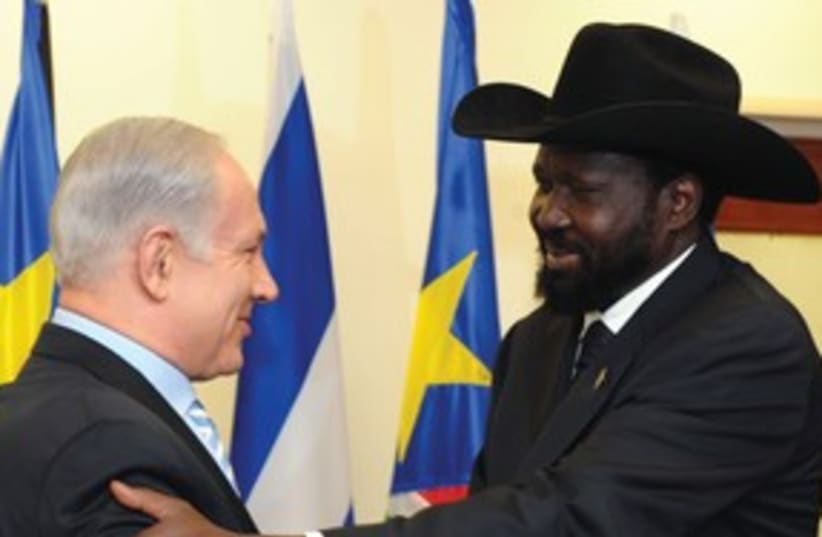
South Sudanese President Salva Kiir’s low-key visit this week was filled with large strategic ramifications.
By HERB KEINONNetanyahu Kiir 311(photo credit: Avi Ohayon/GPO)
South Sudan’s President Salva Kiir, wearing his signature black cowboy hat, rode into Israel this week as head of the world’s newest country for a visit clearly signaling a growing Jerusalem-Juba alliance.Though blessed with massive oil deposits and largely untapped natural wealth, South Sudan is a dirt-poor nation of eight million people in eastern Africa entangled with its stronger neighbor to the north in a border dispute that seems on the brink of spilling over into an all-out war.
On the surface, this would not necessarily seem to be the most valuable country for Israel to befriend. South Sudan, which is predominantly Christian, seceded from its Muslim neighbor to the north in July after decades of civil war that began in 1955. Israel recognized South Sudan within hours of its independence declaration.In an indication of just how important Israel views its relationship with the fledgling country, Kiir – who was accompanied on his first trip here as president by his defense and foreign ministers – met and was greeted warmly by Israel’s top leaders: President Shimon Peres, Prime Minister Binyamin Netanyahu, Defense Minister Ehud Barak and Foreign Minister Avigdor Lieberman.Peres alluded to the help Israel gave south Sudanese rebels in the late 1960s, reminding Kiir that as deputydefense minister he had met in Paris, alongside then-prime minister Levi Eshkol, with local leaders from southern Sudan."We provided them with extensive assistance in agriculture and infrastructures,” Peres said. That was an understatement.According to Jimmy Mulla, an advocate for South Sudan living in Washington, Israel at the time also provided invaluable training to the rebels. “Israel helped the [rebel] movement, giving them instruction,” he said in a telephone interview.PaanLuel Wel, a prolific South Sudanese blogger also based in Washington, wrote in July that the friendship of the South Sudanese to Israel, besides being based in the country’s deep Christian religious roots, can be traced back to the beginning of the south’s rebellion.“For many years during that first south Sudanese struggle of 1955- 1972, the Jewish state of Israel was the main moral supporter of the Southern rebels and the chief supplier of physical materials such as arms and international maneuvering,” he wrote.Consequently, it didn’t come as a big surprise when the head of the rebel movement, General Joseph Lagu, was among the first world leaders to send a letter of congratulations to Eshkol after the Six Day War.To the Southern rebels led by Lagu, Wel wrote, Israel was fighting the very enemy that was discriminating against and oppressing them.Wel’s words help to explain what Peres meant when he told Kiir during their meeting that this was a “moving and historic moment” for him and for Israel.“Israel has supported and will continue to support your country in all areas in order to strengthen and develop it,” he said. “We know that you courageously and wisely struggled against all odds to establish your country and for us, the birth of South Sudan is a milestone in the history of the Middle East.” According to a statement put out by Peres’s office about the meeting between the two men, Kiir said he was moved to be in Israel and “walk on the soil of the Promised Land, and with me are all South Sudanese people.”“Israel has always supported the South Sudanese people,” he said.“Without you, we would not have arisen. You struggled alongside us in order to allow the establishment of South Sudan and we are interested in learning from your experience. As a nation that rose from dust, and as the few who fought the many, you have established a flourishing country that offers a future and economic prosperity to its children. I have come to see your success.”Despite those very warm words, diplomatic officials in Jerusalem said that this week’s Israeli bear hug, or at least the fact that the hug was made public, somewhat embarrassed Kiir, who was hoping for a more low-profile, under-the-radar visit. This desire for a low-key visit was not because he or his people are not extremely pro-Israel. Indeed, one of the more memorable images of 2011, at least from an Israeli perspective, was the publication of pictures in July of South Sudanese celebrating their independence by waving Israeli flags.Rather, Kiir – who does want a strong relationship with Jerusalem – preferred to keep the visit low-key because he realizes that with his country taking its first baby steps, it must be concerned about how visible ties with Israel will be interpreted by his powerful neighbors to the north: Sudan and Egypt.And he does indeed have something to be worried about.Two days after his visit, The Sudan Tribune – a news website dealing with Sudanese and African affairs – reported that Sudan was alarmed by Kiir’s trip to Israel. According to the website, which ran a photo of Kiir laying a wreath at Yad Vashem, the official spokesman of Sudan’s foreign ministry, Al-Obaid Marawih, told reporters in Khartoum that the government was concerned and was studying the visit to “ascertain its possible ramifications.”Regarding Egypt, one diplomatic official in Jerusalem said that Israel’s ties with South Sudan “drive the Egyptians nuts,” because of an almost conspiratorial fear they have that Israel will gain leverage over Cairo by somehow diverting the flow of the White Nile tributary, which flows through South Sudan.This same concern about the Nile was also voiced by the Egyptians when Israel and Ethiopia forged ties in the 1990s. In an indication of how real this fear of nefarious Israeli designs on the Nile is in the Arab world, the topic was a component of a news program piece on Al Jazeera in English this week about the burgeoning Israeli-South Sudanese ties.Ask Israeli diplomatic officials what interests Israel has in South Sudan and they will say – if they are willing to talk at all – that Jerusalem is keen on helping the fledgling nation develop and can offer all kinds of assistance in the spheres of technology, infrastructure development, construction and agricultural and water management.Indeed, the only thing the Prime Minister’s Office was willing to say about Kiir’s visit was that a team of experts will be dispatched to South Sudan shortly to determine that country’s needs and how Israel can help.Israeli officials don’t talk, and nobody will talk, about security cooperation, which is obviously something that the South Sudanese – already involved in skirmishes with Sudan – have in mind.For Israel, South Sudan is extremely important geographically.It is a friendly country in the heart of a region that Iran is trying to penetrate. Israel is concerned about a flow of arms going from Iran, through Sudan, into Egypt, Sinai and then Gaza.Indeed, foreign reports said that Israel was behind a couple of mysterious raids on arms convoys in Sudan over the past three years.In addition, South Sudan is part of a cluster of countries in eastern Africa, including Ethiopia, Kenya and Uganda, that Israel is trying to cultivate in a manner not seen for years. Each of these countries is facing threats from Islamic radicals, giving them an interest in closer cooperation with Israel.The leaders of Uganda and Kenya were both in Israel last month and Netanyahu is planning the first extended visit by an Israeli prime minister to sub-Saharan Africa since 1966 with a trip to Kenya, Uganda and Ethiopia tentatively planned for February.(Yitzhak Rabin made a stopover of a few hours in Kenya in 1993 on the way back from a Far East trip, but that was anything but the full blown state visit Netanyahu has in mind.) South Sudan, for its part, is obviously interested in military relationship, as attested by the visit of the country’s defense minister along with Kiir, but also for Israeli civilian technology and know-how.As blogger Wel puts it, South Sudan stands to reap many benefits from a close relationship with Israel. “Israel is among the most economically advanced OECD member states,” he writes. “With our own naturally endowed abundance of resources, befriending such a country will open many doors of opportunities for the mining and exploitation of our own resources.”Wel contrasts Israel to China and the West, saying it has no history of neo-colonialism in Africa.Furthermore, Israel, he writes, can help develop the country’s education systems that, due to oppressive polices from successive governments in Khartoum and the long civil war, is in “a pathetic condition crying out for refurbishment.”“What is needed is a technologically based system of education, one that befits the 21st century we are in,” he writes. “The state of Israel has it and, as our long-time friend, it is willing to help us get on our own feet, after decades of painfully crawling on the rough edges of illiteracy, poverty, desolation, and disillusionment.”
if(catID != 151){
var cont = `Take Israel home with the new Jerusalem Post Store