Deputy minister says his Bayit Yehudi party will boycott any attempt to institute civil marriage.
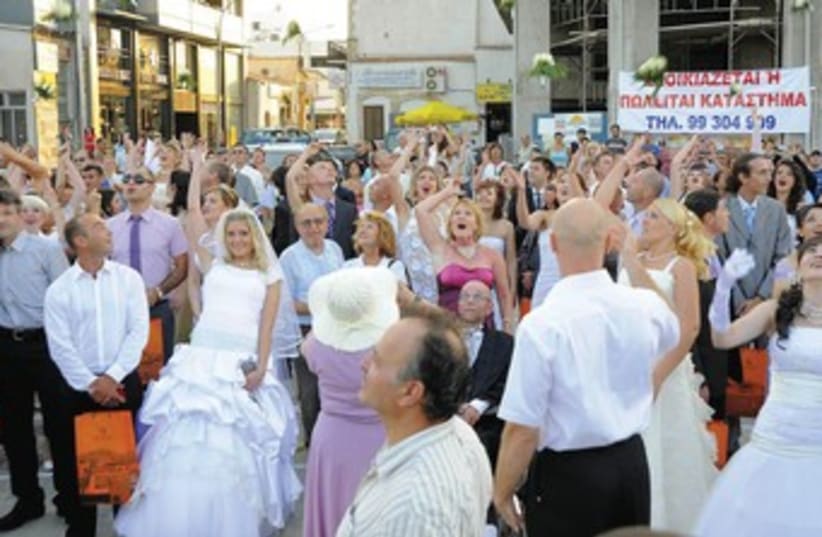
By JEREMY SHARONCivil ceremony in cyprus 370(photo credit: Pavlos Vrionides/Reuters)
There has been little respite in recent months from a slew of controversies that have erupted in the Jewish state relating to the role and prominence of religious life in the country.From the explosive issue of haredi enlistment in the army to the ongoing campaign being waged by those seeking equal prayer rights at the Western Wall, problems with a religious foundation seem to be proliferating in Israeli society.And it is not only the headline-grabbing disputes that are involved. Problems of a more administrative nature within the realm of religion continue to cause frustration, discontent and suffering, especially surrounding the provision of services for life-cycle events that are defined and administered according to Jewish law.One of the fundamental policies advocated by the Bayit Yehudi party during the recent election campaign was to reform the provision of religious services in order to stop the growing alienation felt by many Israelis towards the Orthodox religious establishment in the country.The burden of this task will fall in large part on the shoulders of the newly appointed Deputy Minister for Religious Services, MK Rabbi Eliahu Ben-Dahan of Bayit Yehudi, who is now running the ministry.In large part, the raft of conflicts that have arisen surrounding matters of religion, such as public transportation on Shabbat, non-Orthodox conversion and civil marriage, relate to the control of religious affairs by an Orthodox establishment, as well as the close connection of religion and state in Israel.According to Ben-Dahan, some of these conflicts are inevitable because as the only Jewish state, it is important to preserve the Jewish character of the country.“This is the only Jewish state in the world, and the only state which is [defined by its] nationality and its religion. Because of this, we want to be strict and guard the things that express the uniqueness of the Jewish people at all costs,” says the deputy minister.“Yes, these issues can cause conflict between the non-religious and religious communities, but it is still important to preserve the public symbols of Judaism in our country.”According to the deputy minister, the fact that “some individuals and communities” are adversely affected by the dominance of Orthodoxy is unavoidable if Israel is to protect what he says are its “central principles.” “There’s no doubt that in any reality in which there are people living in a collective, public forum, there are individuals who are negatively impacted,” says Ben-Dahan.“Since we want to be one people, there is no choice. There’s no other way apart from knowing that sometimes there are people who lose something. For sure, I won’t say that this doesn’t happen. People lose out.”One of the most central issues surrounding matters of religion and state that Ben-Dahan will face is that of marriage in Israel. Since the founding of the state, marriage and divorce have been under the sole jurisdiction of the different religious authorities in the country, making it impossible for two people of different faiths to marry, while civil marriage for people of the same faith is also not mandated.Additionally, marriages conducted by non-Orthodox Jewish rabbis are not recognized by the state.This issue has caused much consternation among non-Israeli Jewry, especially in the US. During the recent election campaign, Yesh Atid leader Yair Lapid promised “to do everything in my power” to institute civil marriage in Israel and bring non-Orthodox streams onto a level footing with the Orthodox Jewish establishment with regard to funding and status.Ben-Dahan is adamant, however, that such reforms will not occur within the life of the current government.“It won’t happen because the coalition agreement stipulates that there won’t be any changes to matters of religion and state without all parties in the coalition agreeing to them,” said Ben-Dahan.Should such issues be raised, he says, Bayit Yehudi will most likely veto them.The deputy minister acknowledges that the societal tensions caused by the issue of marriage, along with other problems, have arisen because of the close connection between religion and state in the country.The way around it, he says, is twofold: greater empathy for the opposing positions and the purity of their motives, along with reforms for the provision of religious services within the framework of Orthodox Judaism.“It’s crucial that we believe that the other person has good and true intentions. We need to respect those with opinions different from our own and acknowledge that they are not acting in order to harm those who disagree with him,” he says.“We must ascribe value and respect to positions which are held by others and not disparage and belittle each other.”As to some of the reforms he is planning, Ben- Dahan says one of the first bills he is advancing would open up marriage registration jurisdictions and thereby allow anyone from any part of the country to register for marriage wherever they wish.Currently, a couple one must register for marriage in the city of residence of one of the spouses.Many local rabbinates have bad reputations for the level of service and bureaucracy people experience when registering for marriage, as well as seeking other religious services.The increased competition resultant from this reform, says Ben-Dahan, will create a significant boost to the provision of many religious services.“If the Jerusalem department for marriage knows that the residents of Jerusalem are not captive to them, but can go to Mevaseret or Ma’aleh Adumim or Beit El to register, they will understand that it’s a different world, there is competition,” he says. “If there’s competition and you don’t provide a good enough service, then you’re going to lose out.”BEN-DAHAN ALSO seeks to shake up the conversion system, particularly with regard to Israelis from the former Soviet Union who are not Jewish according to Jewish law.There are approximately 330,000 Israelis who fall into this category, who encounter significant difficulties when requiring services for life-cycle events such as marriage, divorce and burial because they are not classified as Jewish.In addition to those problems, several Orthodox groups are concerned with the possibility of assimilation and intermarriage with Israelis considered to be Jewish according to Jewish law, and have therefore strongly advocated for a state-driven campaign to attract more people in this demographic to convert.In 2011, less than 2,000 Israelis from the former Soviet Union converted.Ben-Dahan says that the Religious Services Ministry will shortly be launching a campaign to reach out to Israelis of Jewish ancestry in order to encourage conversion.He cites a lack of knowledge about the process as one of the reasons behind the low demand for conversion, as well as a failure to appreciate the importance of converting for the person in question and their children.“In many cases they don’t understand that the conversion process is not as tough as they might think, and that it can certainly be achieved,” he says.Like other religious services, the conversion process has suffered from burdensome bureaucracy, as well as insensitivity to candidates and strict controls, partially designed to prevent conversion from becoming a tool to obtain Israeli citizenship by foreign workers.Ben-Dahan’s plan to boost the number of conversions is to enlist the help of people who have already converted to act as emissaries for the conversion program, who would go out to communities and explain the process.“I want to bring this community closer to the idea of conversion and explain that it is not so terrible,” he says.Another issue which remains at the forefront of the struggle against the religious status quo is the ongoing problems experienced by women whose husbands refuse to grant them a bill of divorce, or get.Although the rabbinical courts, which have exclusive jurisdiction over the divorce proceedings, can impose punitive sanctions against husbands who refuse to grant a get, in practice this tool is rarely used.According to a Rackman Center report, sanctions, such as revocation of driver’s licenses and even imprisonment, are employed in just 1.5 percent of applicable cases – so one of the main avenues being pursued by women’s rights groups to remedy the problem is to have more liberal-minded rabbinical judges appointed to the rabbinical courts.Women’s rights groups say that this effort has been stymied by the lack of women on the 10-member committee responsible for selecting rabbinical judges, and they have therefore been conducting a concerted campaign to reserve a number of spots on the panel for women.They argue that because the panel includes the two chief rabbis and two supreme rabbinical court judges, who are perforce men, four spots should also be reserved for women.Ben-Dahan, however, says he disagrees with the principle of reserving spots for women, arguing that 40% of the panel is not set aside in other government forums. He added that since the new justice minister, who is also automatically a member of the selection committee, is a woman – Tzipi Livni – and that a spot on the panel reserved for a Bayit Yehudi MK will be given to a woman, no further legislation is necessary.Yet he says he would not oppose legislative efforts to reserve more spots on the committee. In his opinion, however, “it is a mistake.” “If you try and get to much, you won’t achieve anything,” he notes.AS HAS been apparent with the controversy over Western Wall prayer rights and the campaign by the Women of the Wall activist group, the disputes that have erupted of late centering on how public religious life in Israel is conducted will not disappear.If anything, they are likely to become more intense and more frequent as those who do not subscribe to Orthodox practice, and those frustrated with the general lack of empathy emanating from the state’s religious service providers, become increasingly assertive in pursuit of their rights.If the Israeli public is to be reconciled with the religious establishment in its current Orthodox guise, much will depend on how Ben-Dahan runs his ministry and the extent to which he is prepared to instigate reforms for the better, smoother and more attentive provision of religious services to its customers.Should such reforms fail to materialize, it is likely that calls for a complete separation of religion and state will get both louder and a great deal more intense.
if(catID != 151){
var cont = `Take Israel home with the new Jerusalem Post Store